
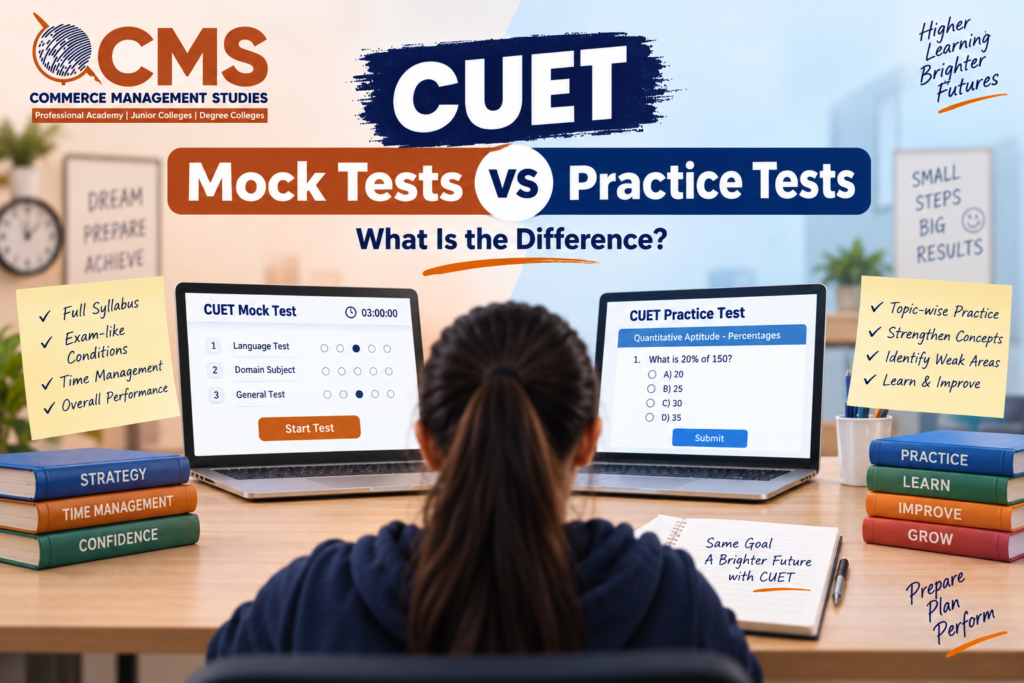
Preparing for an entrance examination involves more than simply studying the syllabus. Students also need to practise answering questions, understand how well they have learned different topics, improve their speed, and become comfortable with the examination format. For CUET aspirants, both practice tests and mock tests can be useful parts of preparation, but they serve different purposes.
The terms “practice test” and “mock test” are sometimes used interchangeably, which can make it difficult for students to understand when and how to use them. A practice test is generally used to strengthen particular topics or skills, while a mock test attempts to recreate the conditions of the actual examination. Knowing this difference can help students use both methods more effectively instead of treating every test in the same way.
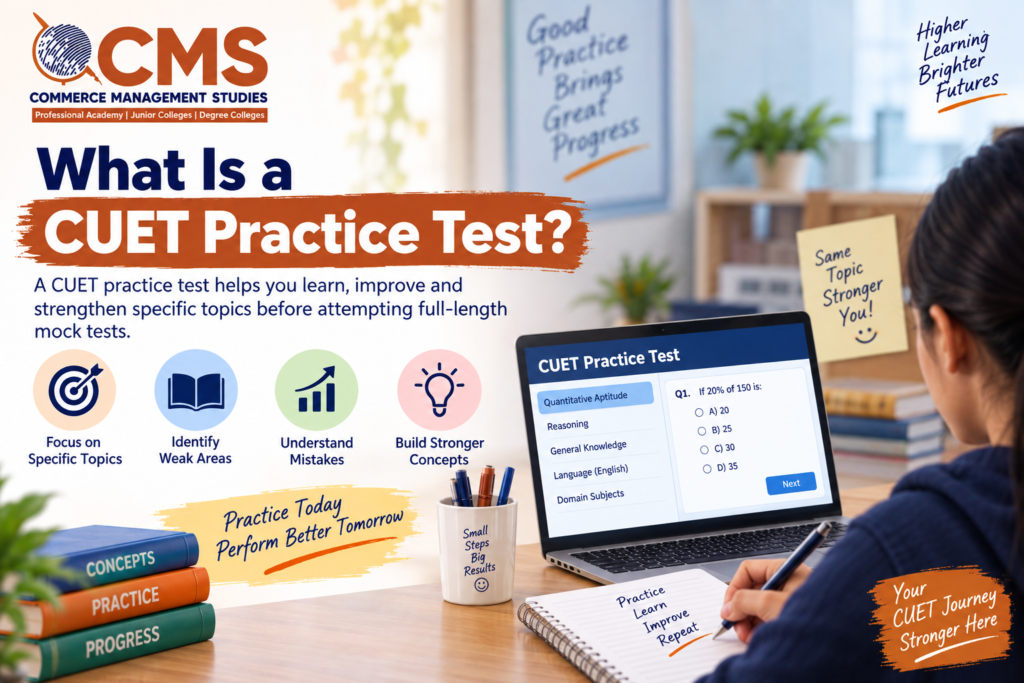
What Is a CUET Practice Test?
A practice test is primarily designed to help students learn and improve. It can focus on a particular subject, chapter, topic, or type of question. For example, a student preparing for a quantitative section may practise questions involving percentages, ratios, data interpretation, or basic mathematical reasoning separately before attempting a complete test.
The main purpose of practice testing is to identify areas that require more learning. Students can attempt questions, check their answers, understand their mistakes, and then return to the relevant concepts. Because practice tests are learning-oriented, students do not necessarily need to follow strict examination conditions every time they take one.
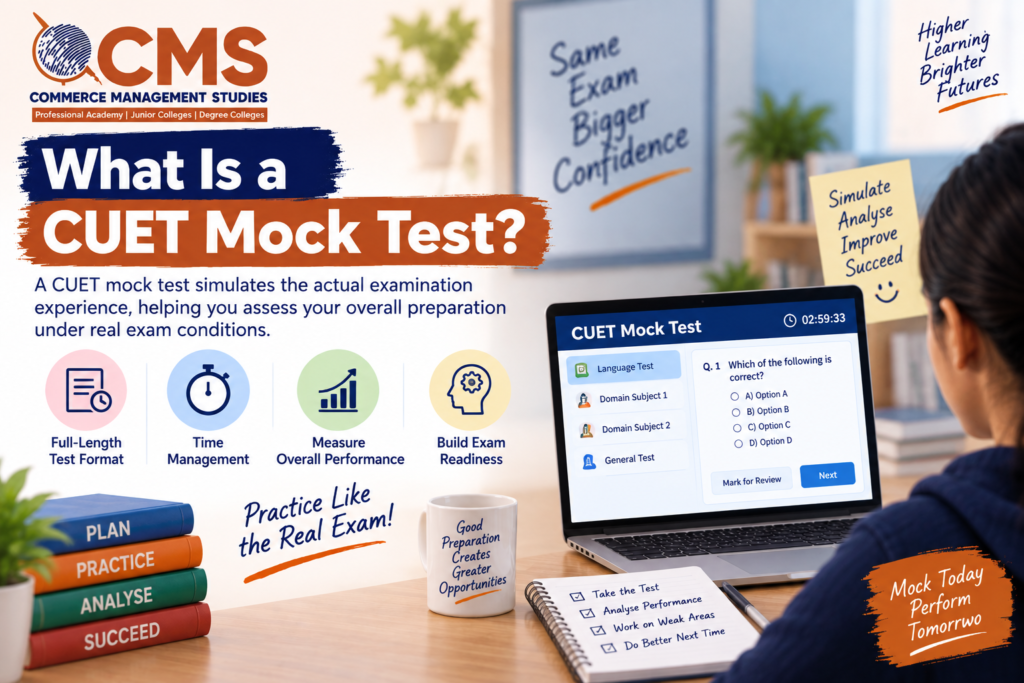
What Is a CUET Mock Test?
A mock test is designed to simulate the experience of taking the actual examination as closely as possible. Instead of concentrating on only one small topic, a mock test generally brings together questions from the relevant areas and requires students to manage their time across the test.
Mock tests are particularly useful once students have covered a significant portion of their preparation. They help students understand how they perform when several topics appear together and when they have limited time to make decisions. A mock test can therefore provide information about not only subject knowledge but also speed, question selection, concentration, and time management.
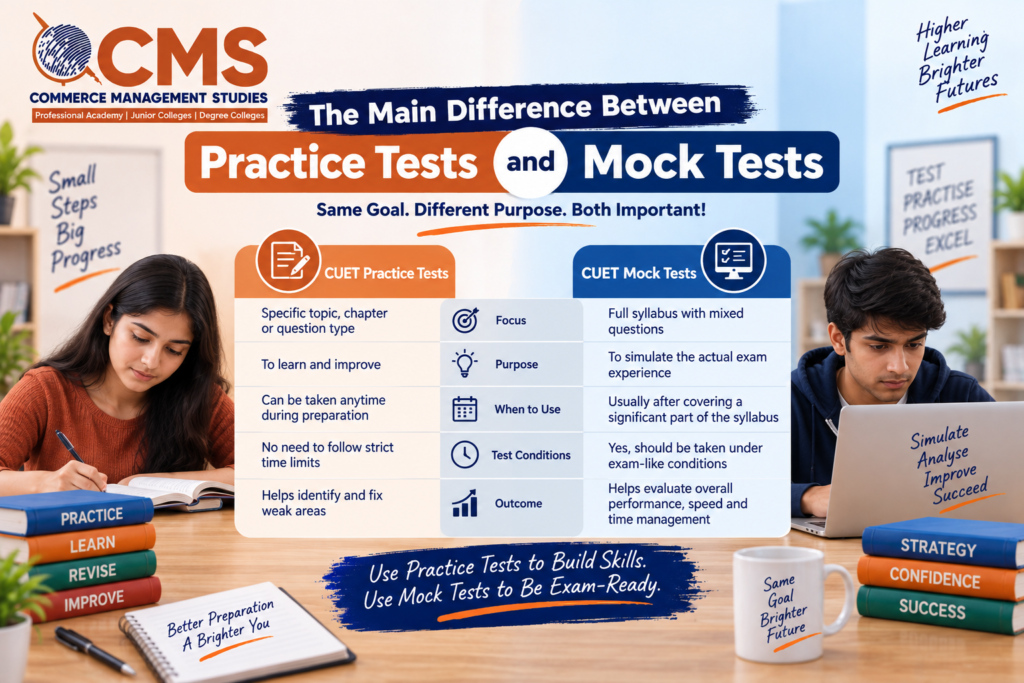
The Main Difference Between Practice Tests and Mock Tests
The simplest way to understand the difference is to think of a practice test as a learning tool and a mock test as a performance simulation. Practice tests help students work on specific weaknesses, whereas mock tests help students evaluate how effectively they can apply their preparation in an examination-like situation.
Both have an important place in CUET preparation, but they should not necessarily be used in exactly the same way. Spending all preparation time on mock tests without analysing individual weaknesses may not improve understanding, while only solving topic-wise practice questions may leave students unprepared for the pressure and time constraints of a complete examination.
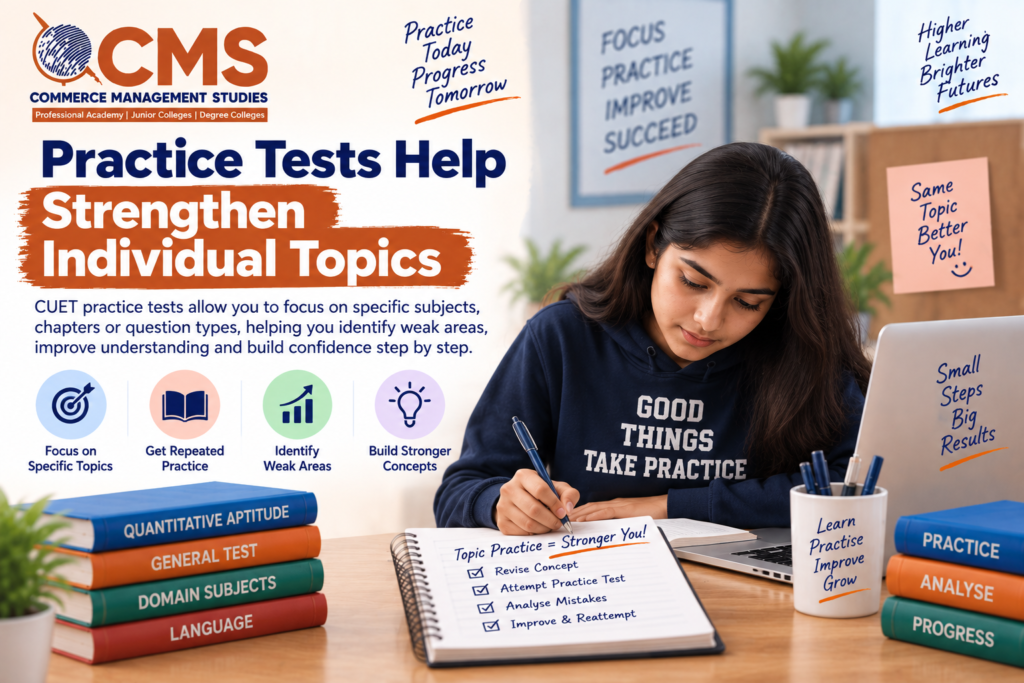
Practice Tests Help Strengthen Individual Topics
One of the biggest advantages of practice tests is that they allow students to focus on specific areas. If a student consistently makes mistakes in a particular topic, a focused practice test can provide repeated exposure to similar questions. This makes it easier to identify whether the problem is a lack of conceptual understanding, calculation errors, confusion between similar concepts, or careless mistakes.
Practice testing is also useful after completing a chapter or topic. Instead of immediately moving to another area, students can use a short test to check whether they can actually apply what they have studied. This creates a feedback loop in which studying is followed by testing, analysis, and revision.
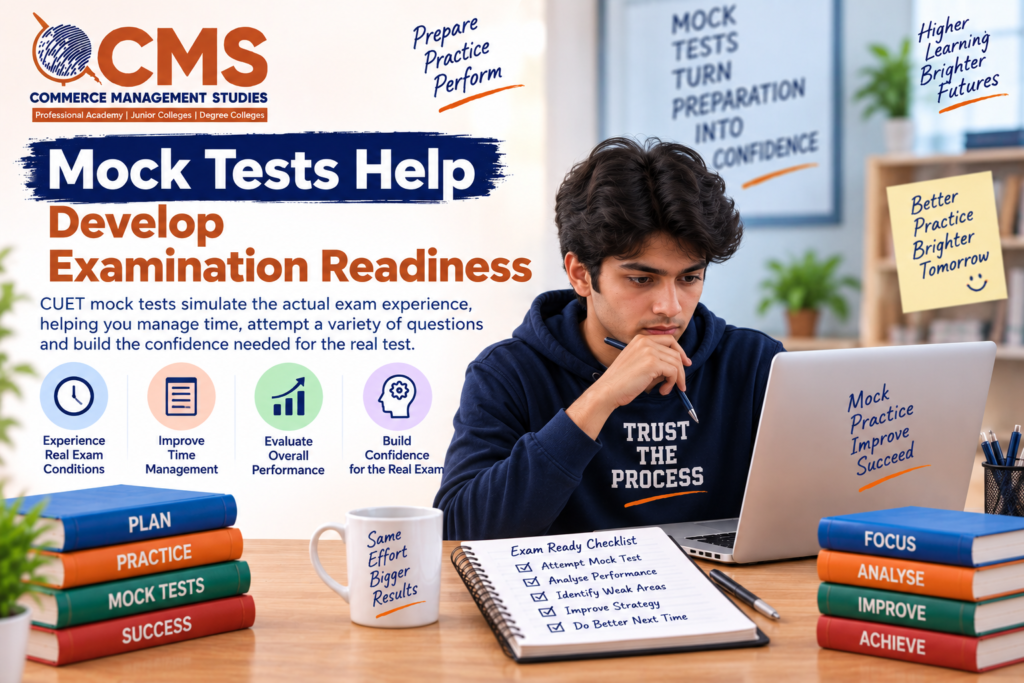
Mock Tests Help Develop Examination Readiness
Mock tests become especially useful when students need to understand how they perform under realistic conditions. A student may be able to solve individual questions correctly during relaxed practice but struggle when several sections have to be completed within a limited period. Mock tests can reveal this difference.
They also help students develop an examination strategy. Students can experiment with the order in which they attempt sections, decide how much time to spend on difficult questions, and learn when it is better to move on rather than spend too long on a single problem. Repeated mock testing can gradually make these decisions more natural.
How to Analyse a Practice Test
Simply checking the score after a practice test is not enough. Students should examine the questions they answered incorrectly as well as questions where they were uncertain. A correct answer obtained through guessing should also be reviewed because it may indicate that the underlying concept is not yet secure.
A useful analysis can classify mistakes into different categories:
- Conceptual misunderstanding
- Incorrect calculation
- Misreading the question
- Careless mistake
- Time-related mistake
- Guessing or uncertainty
- Difficulty applying a familiar concept
This classification helps students identify patterns rather than treating every wrong answer as an isolated error.
How to Analyse a Mock Test
Mock-test analysis should go beyond looking at the final score. Students should examine how much time they spent on different sections, which questions consumed too much time, where they lost marks, and whether they changed correct answers unnecessarily.
It can also be useful to compare performance across several mock tests. One low score does not necessarily indicate poor preparation, just as one high score does not guarantee consistent performance. Looking for patterns across multiple tests provides a more realistic picture of strengths and weaknesses.
When Should Students Use Practice Tests?
Practice tests are useful throughout the preparation process. Students can begin with topic-wise tests after completing individual concepts and gradually move toward subject-level tests. This approach allows them to strengthen their understanding before dealing with a larger mixture of questions.
During the middle stages of preparation, students can combine regular study with short practice tests. For example, after revising a particular topic, they can solve a focused set of questions and analyse the mistakes immediately. This prevents gaps in understanding from accumulating until the final stage of preparation.
When Should Students Start Taking Mock Tests?
Mock tests are generally more valuable after students have developed a reasonable understanding of the syllabus. Taking full-length mocks too early can sometimes make it difficult to distinguish between problems caused by incomplete preparation and problems caused by poor examination strategy.
As preparation progresses, students can gradually increase their use of full-length mock tests. The goal should not simply be to take as many tests as possible. The greater benefit comes from attempting a test seriously, analysing the result, revising weak areas, and then applying the lessons in the next test.
Why Students Should Not Choose Only One
Practice tests and mock tests answer different questions. Practice tests ask, “Do I understand this topic and can I solve questions based on it?” Mock tests ask, “Can I use what I have learned effectively in an examination-like situation?”
Using only practice tests may leave students less familiar with full-test conditions, while relying only on mock tests may result in repeated mistakes without sufficient topic-level improvement. A balanced preparation strategy uses practice tests to build skills and mock tests to measure overall readiness.
Building a Balanced CUET Testing Strategy
A practical testing strategy can change as preparation progresses. In the early stage, students can give greater importance to topic-wise practice. As more of the syllabus is completed, subject-level tests can be introduced. In the later stages, full-length mock tests can become a more regular part of preparation.
A simple progression could look like this:
- Early preparation: Topic-wise practice tests
- Middle preparation: Subject-wise and mixed-topic tests
- Advanced preparation: Full-length mock tests
- Final revision: Mock tests combined with targeted practice of weak areas
The exact frequency can vary from student to student. The important point is to ensure that every test contributes to improvement rather than becoming just another activity on the study schedule.
The Importance of Reviewing Mistakes
The real value of testing comes from what students do after completing the test. If a student takes one test after another without reviewing mistakes, the same weaknesses can continue to appear. Test analysis should therefore be treated as part of the preparation process rather than an optional activity.
Students can maintain a simple mistake record containing the question, topic, type of error, correct approach, and any lesson learned. Reviewing this record periodically can help identify recurring problems. Over time, this makes revision more focused because students know which areas require additional attention.
How Mock Tests Can Improve Time Management
Time management is not simply about solving questions quickly. It also involves deciding which questions deserve immediate attention and which ones should be revisited later. A student who spends too much time on one difficult question may lose the opportunity to answer several easier questions.
Mock tests provide an environment in which students can practise these decisions. After each test, they can examine where time was lost and adjust their strategy. With repeated practice, students can become better at balancing accuracy and speed while avoiding unnecessary time pressure.
Using Practice Tests to Fix Weak Areas
Suppose a student discovers through a mock test that questions from a particular topic are consistently causing problems. The best response may not be to immediately take another full-length mock. Instead, the student can return to that topic, revise the underlying concepts, and solve several focused practice questions.
Once performance improves in the weak area, the student can test the improvement through another mixed or full-length test. This creates a cycle of identify → practise → revise → test again, which can make preparation more systematic and productive.
How CMS Students Can Use Both Approaches
For students preparing for CUET alongside Intermediate studies, managing academic subjects and entrance preparation requires a structured approach. At CMS CUET Coaching in Hyderabad, students pursuing Intermediate pathways can work toward their academic subjects while also preparing for entrance-oriented goals such as CUET. The key is to use testing as part of regular learning rather than treating it as something reserved only for the final weeks.
A balanced approach can involve topic-level practice after learning concepts, periodic subject tests to measure progress, and full-length mocks as the examination approaches. Students can then use their test results to decide what needs revision instead of following the same study pattern for every subject.
Common Mistakes Students Make With Tests
One common mistake is focusing too heavily on the number of tests completed. Taking ten tests without analysing them may be less useful than taking fewer tests and carefully reviewing every mistake. Another mistake is becoming discouraged by an early low score when a student has not yet completed the syllabus.
Students should also avoid changing their preparation strategy after every individual test. Performance can naturally fluctuate. Instead, they should look at trends across several tests and identify consistent weaknesses. A test should provide feedback, not become a source of unnecessary anxiety.
Conclusion
CUET practice tests and mock tests are both valuable, but they serve different purposes. Practice tests are primarily designed to strengthen concepts, improve question-solving ability, and address specific weaknesses. Mock tests, on the other hand, are designed to assess overall performance under examination-like conditions and help students develop speed, time management, and test-taking strategies.
The most effective approach is therefore not to choose between the two, but to use them at the appropriate stages of preparation. Practice tests can help build the foundation, while mock tests can help students measure how well that foundation works under pressure. When combined with careful analysis and targeted revision, both forms of testing can make CUET preparation more organised, measurable, and purposeful.