
Introduction
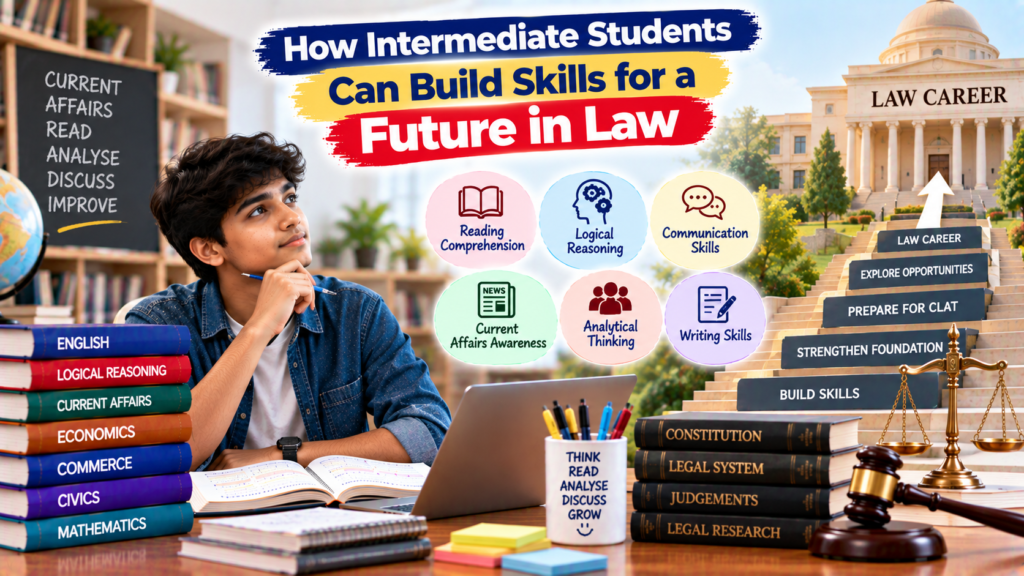
A career in law requires more than learning legal provisions and remembering case names. Lawyers and legal professionals need to read carefully, understand complex information, analyse arguments, communicate clearly, evaluate evidence, and develop logical conclusions. These abilities can be developed gradually, which means students do not have to wait until they enter a law degree to begin building them.
For Intermediate students, the choice of stream can provide different opportunities to develop these foundational skills. Students pursuing MEC, CEC, or ACE (Accounts, Commerce and Economics) can all build abilities that are useful for legal education and entrance examinations such as CLAT. By using their Intermediate years to strengthen reading, reasoning, communication, awareness, and analytical skills, students can create a useful foundation for exploring law as a future career.
Understanding What a Career in Law Involves
Law is a broad professional field that extends beyond courtroom arguments. Legal professionals can work in areas such as corporate law, litigation, taxation, intellectual property, contracts, banking and finance, compliance, technology law, civil services, legal research, and several other fields.
Different areas of law require different combinations of skills. A corporate lawyer may work extensively with contracts and business regulations, while a litigation lawyer may spend considerable time researching legal issues and presenting arguments. Understanding this diversity can help Intermediate students see that studying law does not necessarily lead to only one type of professional role.
Why Intermediate Is a Useful Stage to Start Building Skills
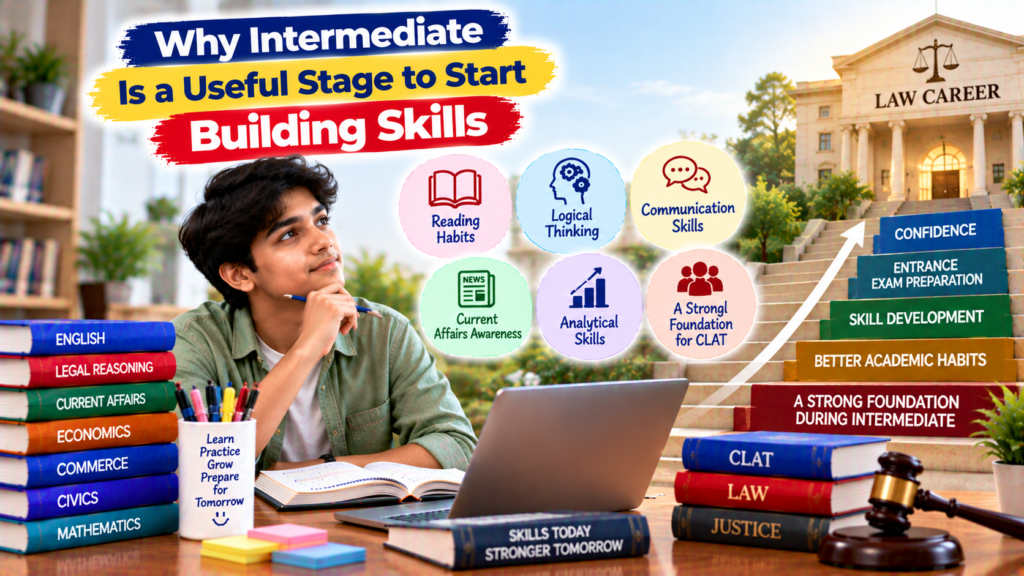
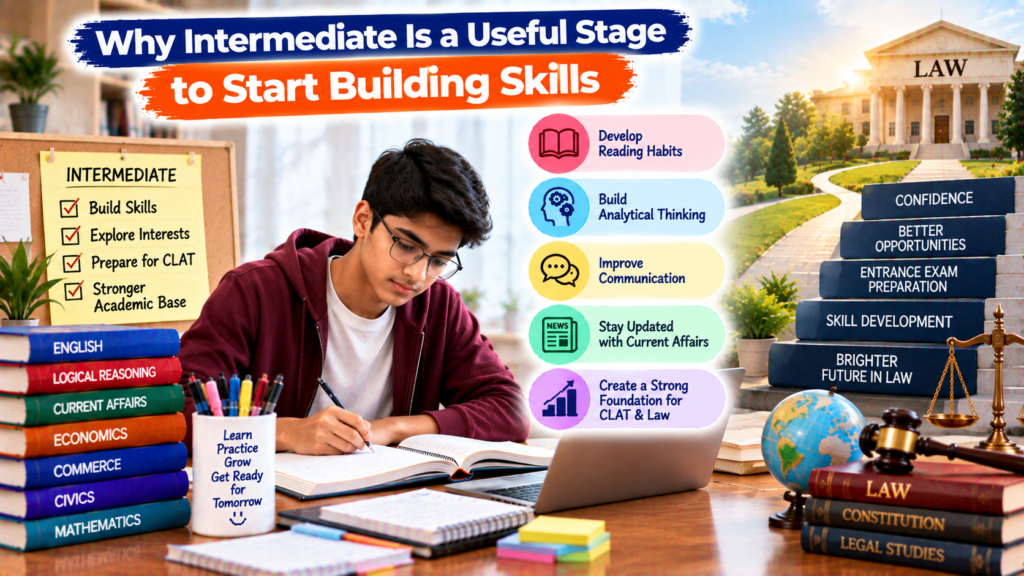
The two years of Intermediate provide students with an opportunity to develop academic habits before entering higher education. Students can use this period not only to prepare for their regular examinations but also to strengthen skills that may be useful for future entrance examinations and professional studies.
For students interested in law, activities such as reading regularly, analysing arguments, following important current events, participating in discussions, and improving written and verbal communication can become part of their routine. These activities do not require students to start studying advanced legal subjects at this stage.
How MEC Can Support Skills Relevant to Law
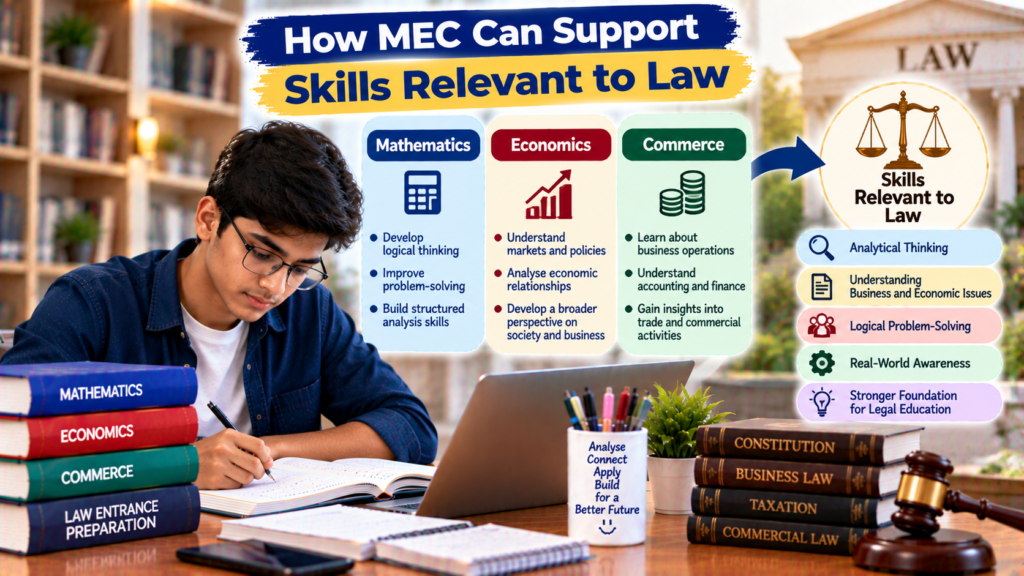
MEC, which includes Mathematics, Economics, and Commerce, can expose students to numerical reasoning, economic concepts, and business fundamentals. These subjects can help students develop different forms of analytical thinking that can be useful when studying law.
Mathematics can encourage structured problem-solving, while Economics can help students understand markets, policies, resources, and economic relationships. Commerce can introduce students to areas such as business, accounting, and financial concepts. Students interested in areas such as corporate, commercial, taxation, or business-related law may find this broader understanding particularly relevant to their future academic interests.
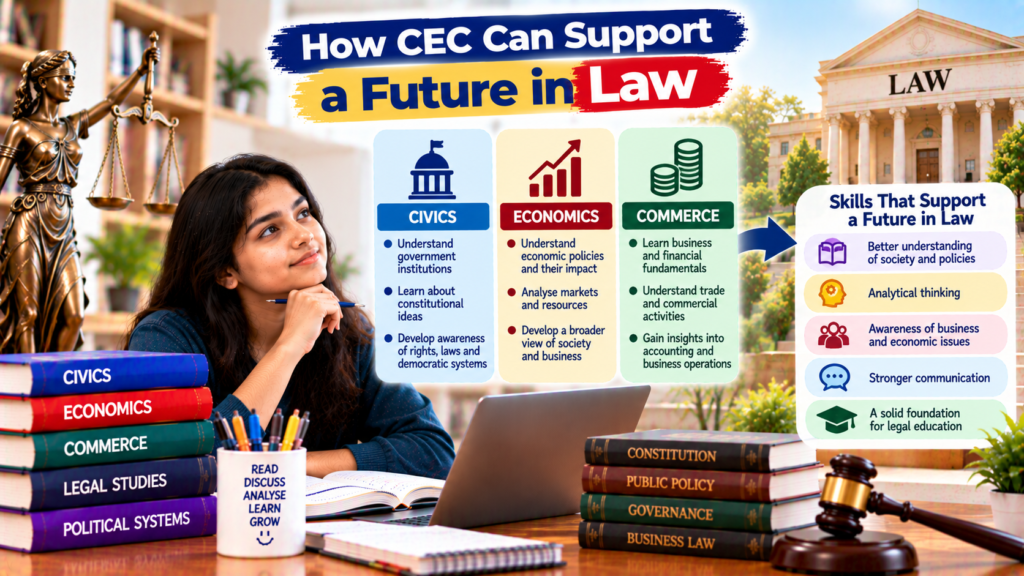
How CEC Can Support a Future in Law
CEC, which includes Civics, Economics, and Commerce, can provide students with exposure to subjects that connect naturally with several aspects of law and society. Civics introduces students to institutions, governance, constitutional ideas, and the functioning of democratic systems.
Economics and Commerce add an understanding of economic activity and business concepts. Together, these subjects can encourage students to think about how institutions, businesses, individuals, and government interact. This can provide useful background for students who are considering legal education and want to understand the broader environment in which laws operate.
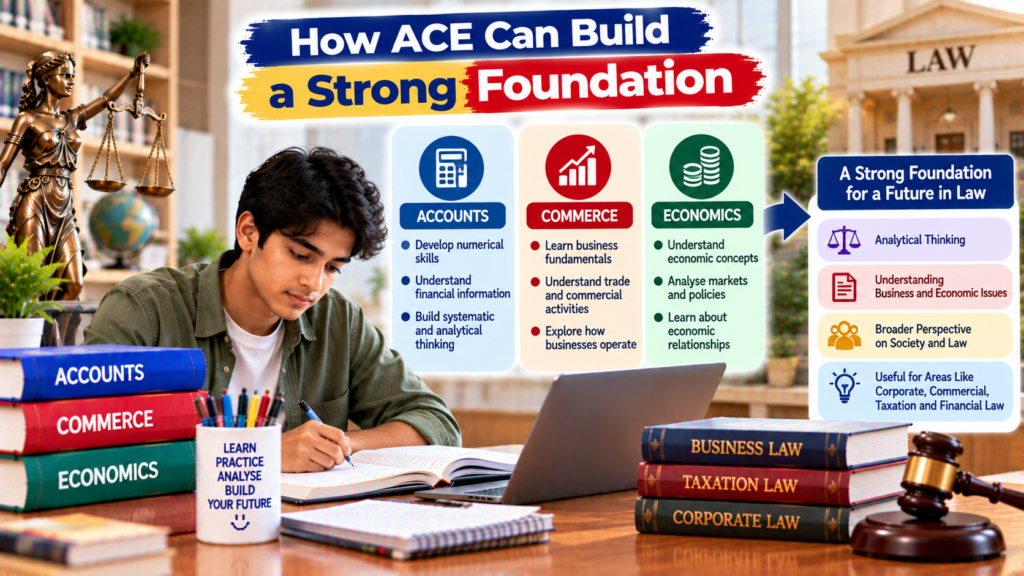
How ACE Can Build a Strong Foundation
ACE, which focuses on Accounts, Commerce, and Economics, provides students with exposure to financial, commercial, and economic concepts. These subjects can be particularly relevant for students who are interested in understanding the business side of law.
Accounts can introduce students to financial information and systematic numerical analysis, while Commerce and Economics can help them understand business activities and economic relationships. This foundation can be useful for students who later explore areas such as corporate law, commercial law, taxation, banking, or financial regulations.
Reading Is One of the Most Important Skills
Law involves dealing with large amounts of written information. Legal professionals may need to read legislation, contracts, judgments, reports, case materials, and research documents. Developing strong reading habits during Intermediate can therefore be valuable.
Students can begin with newspapers, well-written articles, editorials, essays, and books on different subjects. The objective should not be to read simply for the sake of completing pages. Students should try to understand the author’s main argument, identify important evidence, recognise different viewpoints, and summarise what they have read.
Build Strong Reading Comprehension
Reading comprehension involves more than understanding individual words. Students need to identify the central idea, understand relationships between statements, interpret the author’s position, and distinguish important information from supporting details.
These skills are useful in both legal education and entrance examinations. Students can improve comprehension by reading a passage and attempting to explain its main idea in their own words. They can also ask themselves what evidence the author uses and what conclusion the passage supports.
Develop Logical Reasoning
Law frequently involves analysing arguments and determining whether conclusions follow from available information. Logical reasoning is therefore an important skill for students considering legal education and CLAT.
Intermediate students can develop this ability through reasoning questions, puzzles, analytical exercises, and discussions. More importantly, they can develop the habit of asking why a particular conclusion follows from the information provided. This encourages them to rely on reasoning rather than assumptions.
Learn to Identify Arguments and Evidence
When reading an article or discussing an issue, students can practise separating the argument from the evidence supporting it. They can ask what the writer is claiming and what information is being used to support that claim.
This habit can gradually make students more analytical readers. It can also help them recognise when a statement is based on evidence, when it represents an opinion, and when additional information may be required before reaching a conclusion.
Improve Communication Skills
Legal professionals need to communicate clearly in both written and spoken forms. A well-reasoned argument may lose its effectiveness if it is difficult to understand or poorly structured.
Intermediate students can begin developing communication skills through presentations, group discussions, debates, essays, and classroom participation. Speaking regularly in structured settings can gradually improve confidence, while writing exercises can help students organise their thoughts more clearly.
Develop a Habit of Following Current Affairs
Law is closely connected with society, government, business, technology, and public policy. Students interested in law can therefore benefit from developing an awareness of important current events.
For students preparing for CLAT, current-affairs preparation can also form an important part of their examination routine. Instead of trying to memorise large amounts of information at the last moment, students can develop a regular reading habit and periodically revise important developments.
Learn to Look at Different Perspectives
Legal questions can involve competing interests and different interpretations. Students can prepare for this type of thinking by learning to consider more than one side of an issue.
When reading about a controversial topic, for example, students can identify the main arguments presented by different sides and examine the evidence used by each. The purpose is not necessarily to choose a side immediately but to understand how different arguments are constructed and supported.
Develop Writing Skills
Writing is an important part of legal education and professional work. Students may eventually need to write arguments, research papers, legal opinions, applications, summaries, and other forms of professional communication.
Intermediate students can begin by practising structured writing. Instead of simply writing everything they know about a topic, they can organise their response around an introduction, key points, supporting explanation, and a clear conclusion. This can improve both academic writing and general communication.
Mathematics Can Strengthen Analytical Thinking
Students sometimes assume that Mathematics is unrelated to a future in law. However, mathematical study can contribute to broader analytical abilities by requiring students to work systematically, identify relationships, and solve problems using defined information.
For MEC students, regular mathematical practice can therefore complement the reading and reasoning skills needed for law. While legal education is not primarily mathematical, the ability to approach problems logically and systematically can be useful across different academic disciplines.
Economics Can Help Students Understand Law in Context
Economics and law frequently interact in areas involving markets, businesses, taxation, competition, employment, consumer protection, and government policy. Understanding basic economic concepts can therefore help students appreciate the broader context behind many legal and regulatory issues.
MEC, CEC, and ACE students all encounter Economics as part of their Intermediate education. By understanding concepts rather than simply memorising definitions, students can develop a stronger foundation for analysing how economic decisions and legal frameworks influence individuals and organisations.
Commerce Can Introduce the Business Side of Law
Commerce provides students with an introduction to how businesses operate, including areas such as trade, accounting, finance, and organisational activities. This knowledge can become useful when students later encounter commercial and corporate legal concepts.
For example, understanding how companies operate can provide context when learning about contracts, corporate structures, financial regulations, taxation, or business compliance. Students do not need to study these legal areas in depth during Intermediate, but developing basic commercial awareness can be valuable.
Civics Can Help CEC Students Understand Institutions
CEC students have the advantage of studying Civics, which can provide exposure to government institutions, constitutional concepts, rights, responsibilities, and democratic processes. These topics can encourage students to understand how public institutions function and how laws operate within a broader constitutional framework.
This background can be particularly useful for students who are interested in public law, constitutional studies, civil services, or legal education. It can also encourage students to connect classroom concepts with current events and developments in society.
Build Skills Through Everyday Activities
Skill development does not always require additional coaching material. Students can use everyday activities to practise legal and analytical thinking.
Reading an editorial and identifying its argument, comparing two viewpoints on an issue, participating in a debate, summarising a news report, or analysing how a business decision may affect different groups can all provide opportunities to develop useful skills. Consistent small activities can gradually strengthen analytical habits.
Preparing for CLAT Alongside Intermediate
Students who are considering a law degree can also explore entrance examinations such as CLAT, depending on the institutions and programmes they are targeting. CLAT preparation generally involves areas such as English language, current affairs, legal reasoning, logical reasoning, and quantitative techniques, with the applicable pattern and requirements subject to the current official examination information.
Students from MEC, CEC, and ACE can begin building these abilities alongside their Intermediate education. Reading can support English and current-affairs preparation, while Mathematics and Economics can contribute to quantitative and analytical development. Regular reasoning practice can then help students become familiar with the type of thinking required in entrance examinations.
How CMS Can Support Law Aspirants From Different Streams
Students preparing for law can benefit from a structured approach that connects their Intermediate education with entrance preparation. CMS Best CLAT Coaching Institute in Hyderabad offers MEC, CEC, and ACE-related academic pathways along with integrated CLAT preparation, giving students an opportunity to continue their Intermediate studies while developing skills in areas such as reading, reasoning, current affairs, and examination practice. This type of integrated approach can help students work on their regular academics while gradually building the foundation required for a future law entrance examination.
Develop Curiosity About the Legal World
Students do not need to start reading complex legal textbooks during Intermediate to develop an interest in law. They can begin by understanding how laws affect everyday life, businesses, technology, education, consumers, and society.
Following major legal developments, reading simplified explanations of important judgments, and understanding the basic purpose of laws can make the subject more familiar. The goal at this stage is to develop curiosity and awareness rather than attempting to master professional-level legal knowledge.
Avoid Focusing Only on Entrance Exam Scores
Entrance examinations are important for students seeking admission through competitive routes, but skill development should not be limited to test scores. The abilities developed through preparation—reading, reasoning, communication, analysis, and awareness—can continue to be useful during law school and professional life.
Students should therefore look at preparation as a long-term learning process. Improving comprehension, becoming more comfortable with complex information, and learning to construct logical arguments can provide value even beyond the entrance examination itself.
Conclusion
Intermediate can be a valuable stage for students who are considering a future in law. MEC, CEC, and ACE each provide different academic exposure that can contribute to the development of useful skills. MEC can strengthen quantitative and economic understanding, CEC can provide exposure to civics and institutions along with commerce and economics, while ACE can build a foundation in accounts, commerce, and economics.
A future in law requires students to develop much more than legal knowledge. Strong reading comprehension, logical reasoning, communication, analytical thinking, current-affairs awareness, and the ability to understand different perspectives can all be developed gradually during Intermediate. By building these skills alongside their regular studies and, where appropriate, preparing for CLAT, students can enter their next stage of education with a broader and more useful academic foundation.