
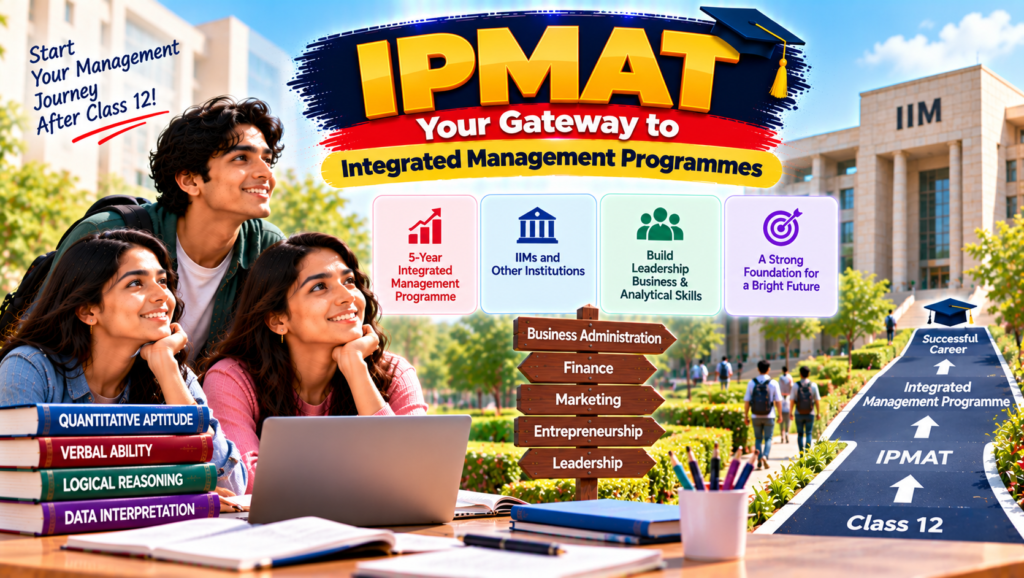
The Integrated Programme in Management Aptitude Test (IPMAT) is an entrance examination for students who want to pursue management education after Class 12. It provides a pathway to five-year Integrated Programme in Management (IPM) courses offered by institutions such as the Indian Institutes of Management (IIMs). These programmes combine undergraduate-level learning with postgraduate management education, allowing students to begin developing their business, analytical and leadership skills soon after completing school. For students interested in business administration, finance, marketing, entrepreneurship and organisational management, IPMAT can be an important examination to explore while planning their higher education.
Preparing for IPMAT requires a combination of quantitative aptitude, verbal ability, reading comprehension and, depending on the examination, logical reasoning and data interpretation. Students need to develop conceptual understanding, practise problem-solving techniques and learn to manage their time effectively during competitive examinations. Starting preparation during Intermediate can give students more time to strengthen these skills alongside their board studies. At CMS, IPMAT coaching is integrated with MEC, allowing students to work towards their Intermediate qualification while preparing for management entrance examinations through a structured academic approach.

1. What Is IPMAT and Why Is It Important?
IPMAT stands for Integrated Programme in Management Aptitude Test. The term is commonly used for the aptitude examination conducted by IIM Indore for admission to its five-year Integrated Programme in Management. IIM Rohtak conducts its own IPM Aptitude Test, while the Joint Integrated Programme in Management Admission Test (JIPMAT), conducted by the National Testing Agency, is used for admission to eligible integrated management programmes at participating institutions, including IIM Jammu and IIM Bodh Gaya. These examinations serve similar broad goals, but their eligibility conditions, test patterns and selection procedures differ.
IPMAT is important because it provides students with an opportunity to pursue management education directly after Class 12 rather than waiting until after completing a separate undergraduate degree. Depending on the institution and programme, students can study foundational subjects during the initial years and progress to advanced management education later. The curriculum may include economics, mathematics, statistics, finance, marketing, organisational behaviour, communication and strategic management. Students should compare the programmes offered by different institutions and understand their admission requirements before deciding which entrance examinations to take.
2. Why Should Students Choose IPMAT After Class 12?
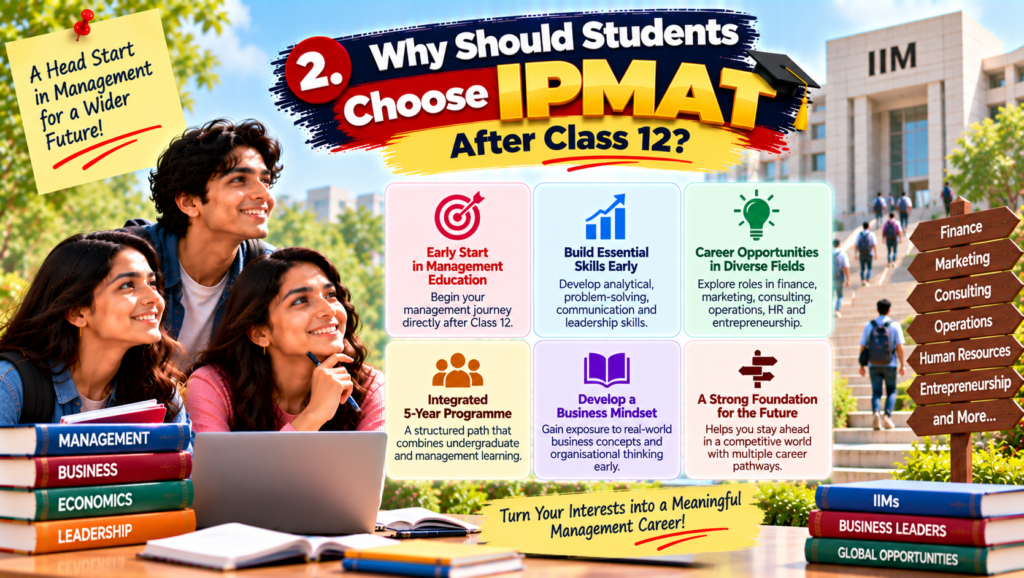
Students who are interested in business, leadership, entrepreneurship and management can consider IPMAT as a route towards integrated management education. The five-year programme structure allows them to begin learning about business and management at an earlier stage. Rather than completing an undergraduate degree and then separately preparing for postgraduate management admission, students admitted to an integrated programme follow a planned academic pathway that combines undergraduate and management-level learning, subject to the institution’s programme rules.
IPMAT preparation can also help students develop skills that are valuable in higher education and professional life. Quantitative aptitude strengthens numerical reasoning, verbal ability improves comprehension and communication, and logical analysis encourages structured decision-making. These abilities can be useful in areas such as finance, marketing, consulting, operations, human resources and entrepreneurship. However, students should choose management education because they are genuinely interested in business and organisational problem-solving. They should also compare course content, fees, campus facilities, internships, admission requirements and future opportunities before selecting an institution.
3. IPMAT Eligibility: Who Can Apply?
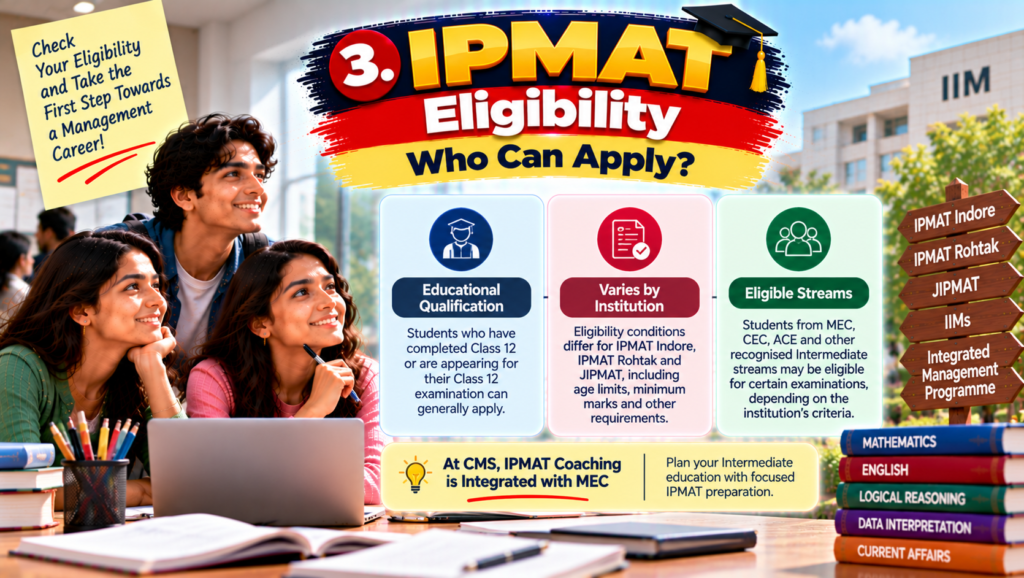
IPMAT and related integrated management entrance examinations are generally intended for students who have completed Class 12 or are appearing for their qualifying examination. However, eligibility conditions vary by institution and examination. The relevant admission notification may specify age limits, qualifying examination requirements, minimum marks, category-based relaxations and other conditions. Students should not assume that meeting the requirements for one IPMAT examination automatically makes them eligible for every integrated management programme.
Students from MEC, CEC, ACE and other recognised Intermediate streams may be eligible for certain management entrance examinations, depending on the relevant institution’s criteria. However, at CMS, the IPMAT-integrated coaching pathway is offered with MEC. Students considering this route should plan their Intermediate subjects and entrance preparation together, while checking the eligibility conditions of their preferred institutions. Before registering for an examination, candidates should review the latest official admission notification, including requirements for Class 10 and Class 12 marks, age and selection procedures.
4. IPMAT Exam Pattern: Understanding the Different Examinations
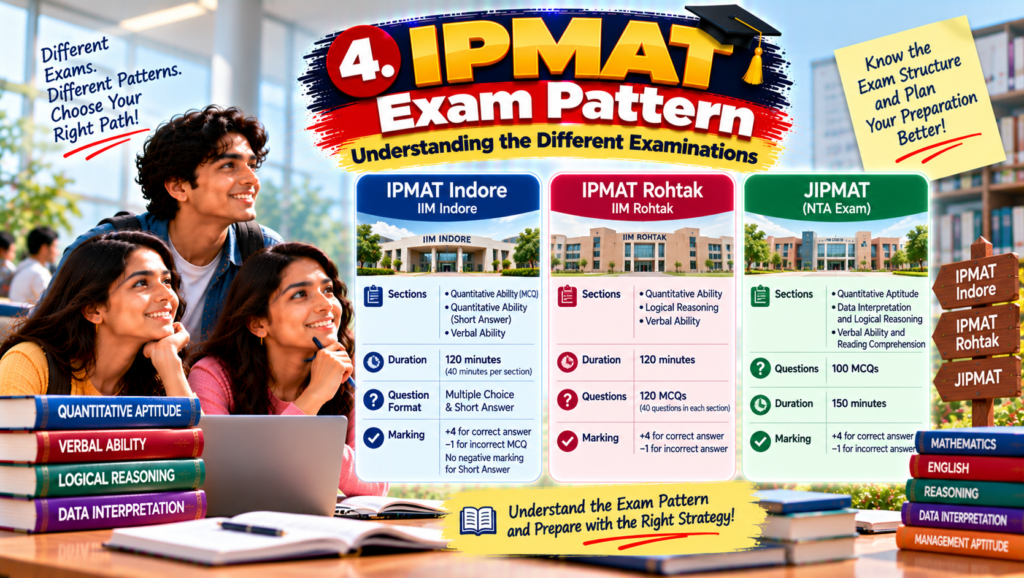
One important point about IPMAT preparation is that there is no single examination pattern shared by every institution. IIM Indore, IIM Rohtak and the institutions using JIPMAT scores have different testing structures. Students should identify the examinations relevant to their preferred programmes and prepare according to the applicable syllabus, question types, timing and marking scheme. Preparing without understanding these differences can lead students to practise the wrong question format or overlook a section required for their target examination.
The major examinations include the following patterns based on their 2026 examination structures:
IPMAT Indore
- Sections: Quantitative Ability (Multiple Choice Questions), Quantitative Ability (Short Answer) and Verbal Ability.
- Duration: 120 minutes, with 40 minutes allocated to each section.
- Question format: Multiple-choice and short-answer questions.
- Marking: Correct answers generally receive four marks; incorrect multiple-choice answers attract a deduction of one mark. The short-answer section does not carry negative marking under the applicable pattern.
IPMAT Rohtak
- Sections: Quantitative Ability, Logical Reasoning and Verbal Ability.
- Questions: 120 multiple-choice questions, with 40 questions in each section.
- Duration: 120 minutes.
- Marking: Four marks for a correct answer and a deduction of one mark for an incorrect answer.
JIPMAT
- Sections: Quantitative Aptitude, Data Interpretation and Logical Reasoning, and Verbal Ability and Reading Comprehension.
- Questions: The 2026 pattern consisted of 100 multiple-choice questions.
- Duration: 150 minutes.
- Marking: Four marks for a correct answer and a deduction of one mark for an incorrect answer under the applicable pattern.
These details describe the 2026 examination structures and should not be treated as a guarantee of the pattern for future years. The question distribution, timing, marking scheme and admission process may change. Students preparing for a future attempt should confirm the latest official information for each examination they intend to take. They should also understand that clearing the aptitude test may be only one part of selection, as some institutions use academic performance, interviews or other criteria in their final admission process.
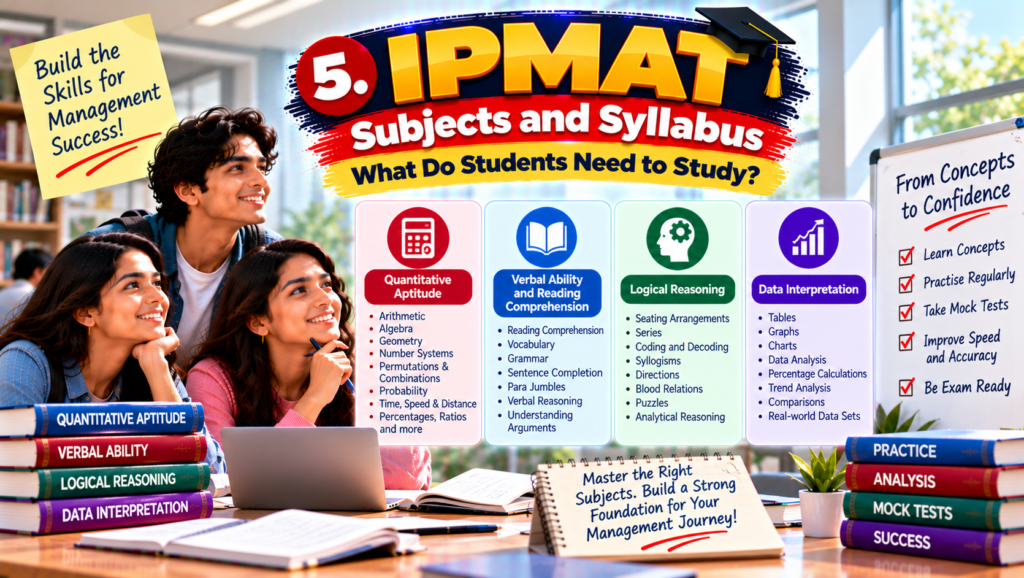
5. IPMAT Subjects and Syllabus: What Do Students Need to Study?
IPMAT preparation mainly focuses on quantitative aptitude and verbal ability, with logical reasoning and data interpretation included in certain examinations. The exact syllabus and section structure depend on the examination selected. Although institutions may not prescribe a single exhaustive list of topics, previous question papers and published admission information help students understand the types of questions they may encounter. Students should strengthen the fundamentals first and gradually move towards timed practice and more challenging problems.
Quantitative Aptitude
Quantitative Aptitude is a major component of IPMAT preparation. It tests numerical understanding, mathematical reasoning and the ability to solve problems accurately under time pressure. Common preparation areas include arithmetic, percentages, ratios and proportions, averages, profit and loss, simple and compound interest, time and work, time, speed and distance, algebra, equations, number systems, geometry, mensuration, permutations and combinations, and probability. The depth and distribution of topics may differ between examinations.
Students should begin by strengthening their mathematical fundamentals and learning how to approach different question types. Memorising formulas alone is not enough; they need to understand when and how to apply each method. Regular problem-solving, timed exercises and review of incorrect answers can improve both speed and accuracy. Students should also practise selecting efficient calculation methods because spending too much time on a single question can affect their performance in other sections.
Verbal Ability and Reading Comprehension
Verbal Ability evaluates how well students understand written information and use English accurately. Depending on the examination, questions may test reading comprehension, vocabulary, grammar, sentence structure, para jumbles, sentence completion, verbal reasoning and the interpretation of written arguments. Students need to understand the meaning and context of a passage, identify the author’s main point and recognise how different ideas connect.
Consistent reading is one of the most useful ways to prepare for this section. Students can read editorials, essays, articles and other suitable non-fiction material while practising the identification of central ideas, supporting arguments and conclusions. Vocabulary can be developed through regular reading and revision, while grammar exercises can help students recognise common errors. Timed reading comprehension practice is also important because candidates must understand passages accurately without spending too long on individual questions.
Logical Reasoning
Logical Reasoning is a separate section in examinations such as IPMAT Rohtak and may also be relevant to preparation for other management entrance tests. It evaluates the ability to identify patterns, understand relationships, analyse statements, draw conclusions and solve structured reasoning problems. Questions may involve arrangements, series, coding and decoding, syllogisms, directions, relationships and other forms of logical analysis, depending on the examination.
Students should practise reasoning questions regularly and focus on understanding the method used to reach an answer. They should not rely solely on guessing or memorising solutions to individual questions. When reviewing mistakes, students should identify which step in their reasoning was incorrect and practise similar problems. This method helps them recognise patterns more quickly and build confidence with unfamiliar question types.
Data Interpretation
Data Interpretation involves understanding and analysing numerical information presented in tables, charts, graphs or other formats. It may be included as a separate area or combined with logical reasoning, depending on the examination. Students may need to calculate percentages, compare values, identify trends or use information from several parts of a data set to answer a question.
Preparation should combine mathematical fundamentals with regular practice in reading charts and interpreting numerical relationships. Students should learn to identify the information relevant to a question before beginning calculations. Practising timed sets can improve speed, while checking each calculation helps reduce avoidable mistakes. Students should also become familiar with different types of data presentations instead of practising only one format.
How Should Students Organise Their IPMAT Preparation?
The first step is to identify the entrance examinations and institutions that match the student’s goals. Students should then compare the syllabus and examination pattern for each target test. Since the sections and question formats differ, they may need a common foundation in quantitative aptitude and verbal ability, followed by examination-specific practice for logical reasoning, data interpretation and short-answer mathematics.
A structured study plan should include concept learning, topic-wise exercises, revision and timed tests. Students should begin with fundamentals, build accuracy and then gradually increase the difficulty and speed of practice. Reviewing mock-test performance helps them identify recurring errors and allocate more time to weaker topics. A balanced preparation strategy is more effective than attempting large numbers of questions without analysing the results.
6. How to Prepare for IPMAT Alongside Intermediate Studies
Preparing for IPMAT while studying Intermediate requires careful time management because students need to maintain their board examination performance while developing aptitude skills. A practical routine can include regular mathematics practice, English reading, vocabulary revision and a dedicated session for entrance examination questions. Students should avoid trying to complete every topic at once. Instead, they can build their skills gradually and increase the amount of timed practice as their understanding improves.
A weekly preparation plan should cover quantitative aptitude and verbal ability consistently, with additional attention to logical reasoning and data interpretation where required by the target examination. Students can begin with topic-wise practice, move to sectional tests and then attempt full-length mock examinations. Reviewing incorrect answers is an important part of the process because it reveals whether mistakes arise from weak concepts, calculation errors, misreading questions or poor time management. With a planned schedule, students can prepare for IPMAT without leaving their Intermediate syllabus until the final weeks.
7. When Should Students Start IPMAT Coaching? Why Intermediate Is the Right Time
Starting IPMAT preparation during Intermediate can give students more time to develop the quantitative and verbal skills needed for management entrance examinations. Mathematics requires consistent practice, while reading comprehension and vocabulary improve through regular exposure and revision. Beginning early allows students to identify their strengths and weaknesses, understand the examination pattern and become comfortable with aptitude-based questions before the final stages of Class 12.
Early preparation should complement rather than replace board examination studies. Students can focus on their Intermediate syllabus while building an additional routine for quantitative aptitude, reading comprehension and logical reasoning. As they become more confident, they can introduce timed tests and mock examinations based on their preferred entrance exams. Integrated IPMAT coaching with MEC can help students coordinate their school subjects and entrance preparation within one academic plan. This approach allows students to work steadily towards both their Intermediate qualification and management education goals.
8. MEC with Integrated IPMAT Coaching at CMS
MEC, which includes Mathematics, Economics and Commerce, is the Intermediate stream at CMS integrated with IPMAT preparation. Its subject combination can be useful for students interested in management education because it provides exposure to mathematical concepts, economic principles and commerce-related topics. These subjects can help students develop a foundation for understanding business, finance and economic activity. However, IPMAT also tests verbal ability and other aptitude skills, so students must prepare for the specific entrance examination rather than rely only on their Intermediate syllabus.
CMS offers integrated IPMAT coaching with MEC, helping students work towards their board examinations while preparing for management entrance tests. A planned programme can combine Intermediate subject learning with quantitative aptitude, English comprehension, reasoning practice and examination-focused preparation. Students can gradually build their skills through topic-wise practice, revision and mock tests while maintaining a balanced study schedule. For students exploring management education after Class 10, understanding the MEC and IPMAT integrated pathway can help them plan their academic choices and future goals more clearly.
9. What Should Students Look for in an IPMAT Coaching Course?
Choosing an IPMAT coaching course requires students to consider how well the programme prepares them for the examination or examinations they intend to take. They should check whether the course covers quantitative aptitude, verbal ability and the other relevant sections, and whether it explains the concepts behind different question types. Faculty guidance, structured practice material, doubt-solving support and an organised timetable can help students build their understanding and address difficult topics more effectively.
Mock tests, regular assessments and performance feedback are also important because they help students measure their progress and identify areas that need improvement. Students should look for a preparation approach that includes timed practice, detailed review of mistakes and revision of important concepts. At CMS, students can explore the integrated MEC and IPMAT coaching option to understand how Intermediate education and entrance preparation are planned together. A suitable programme should help students build consistent study habits while keeping board examinations and future admission requirements in focus.
10. Career Opportunities After an Integrated Management Programme
Students admitted to an Integrated Programme in Management can pursue a structured route towards management education. The first part of the programme generally builds a foundation through subjects such as economics, mathematics, statistics, social sciences, communication and management fundamentals. Later stages focus more directly on management disciplines, which may include finance, marketing, human resources, operations, strategy and organisational behaviour. The exact curriculum and degree awarded depend on the institution and the programme’s current structure.
After completing an eligible management qualification, graduates may explore career opportunities in business analysis, finance, marketing, consulting, human resources, operations, sales, entrepreneurship and other management-related fields. Some students may pursue further specialisation or other professional qualifications based on their interests. Career outcomes depend on the institution, academic performance, practical experience, internships, communication skills and the opportunities available in the market. Students should therefore evaluate the curriculum, costs, internship opportunities and long-term academic options before choosing a particular integrated management programme.
11. Starting Your IPMAT Preparation Journey with CMS
IPMAT can be a useful entrance pathway for students who want to begin their management education after Class 12. Understanding the different examinations, their subjects, eligibility requirements and selection procedures helps students identify the programmes that suit their goals. Successful preparation requires strong quantitative fundamentals, regular reading, verbal ability practice and examination-specific reasoning skills. Starting during Intermediate gives students time to develop these abilities while maintaining their board examination preparation.
CMS IPMAT Coaching Institutes in Hyderabad offers integrated IPMAT coaching with MEC, enabling students to connect their Intermediate education with management entrance preparation. Through a planned study schedule, aptitude practice, mock tests and performance feedback, students can work towards improving their readiness for the examinations they choose. Students interested in management education can explore the MEC and IPMAT integrated pathway at CMS, understand the academic structure and plan their next steps based on their interests and future ambitions.