
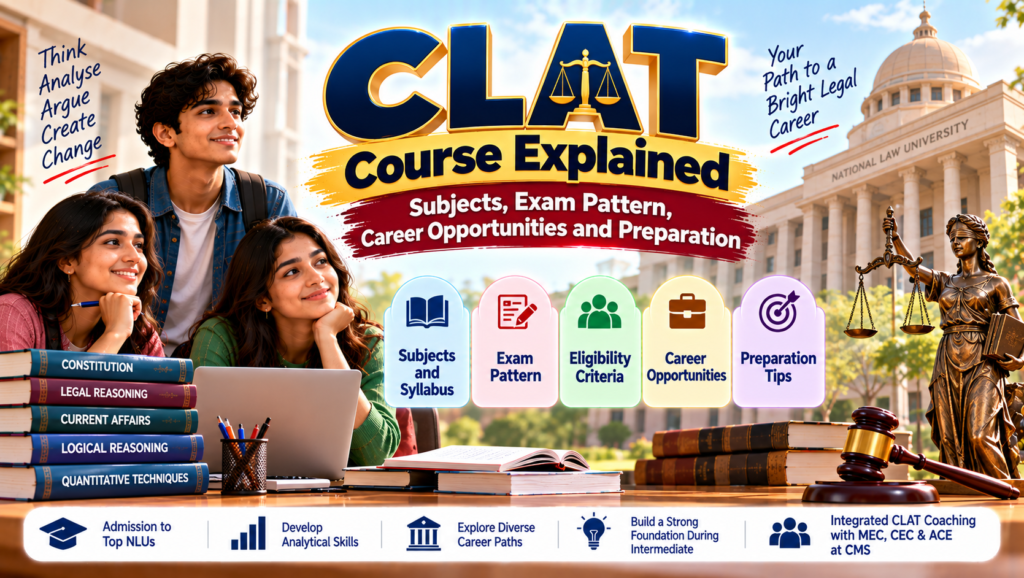
The Common Law Admission Test (CLAT) is a national-level entrance examination for students who want to pursue undergraduate law programmes at participating National Law Universities (NLUs) and other institutions that accept CLAT scores. It provides an opportunity for students to enter the legal profession through courses such as the five-year integrated BA LL.B., BBA LL.B. and other eligible integrated law programmes offered by participating institutions. For students interested in law, public policy, corporate affairs, legal research and advocacy, understanding CLAT early can help them plan their education and career more effectively.
Preparing for CLAT involves much more than memorising legal terms or studying laws. The examination evaluates reading comprehension, current affairs, logical thinking, legal reasoning and quantitative ability. Students must learn to analyse passages, identify important information, evaluate arguments and apply principles to different situations. Starting CLAT preparation during Intermediate can provide time to develop these skills alongside board studies. At CMS, students can explore integrated CLAT coaching with MEC, CEC and ACE, helping them work towards their Intermediate qualification while preparing for a competitive law entrance examination.
1. What Is CLAT and Why Is It Important?
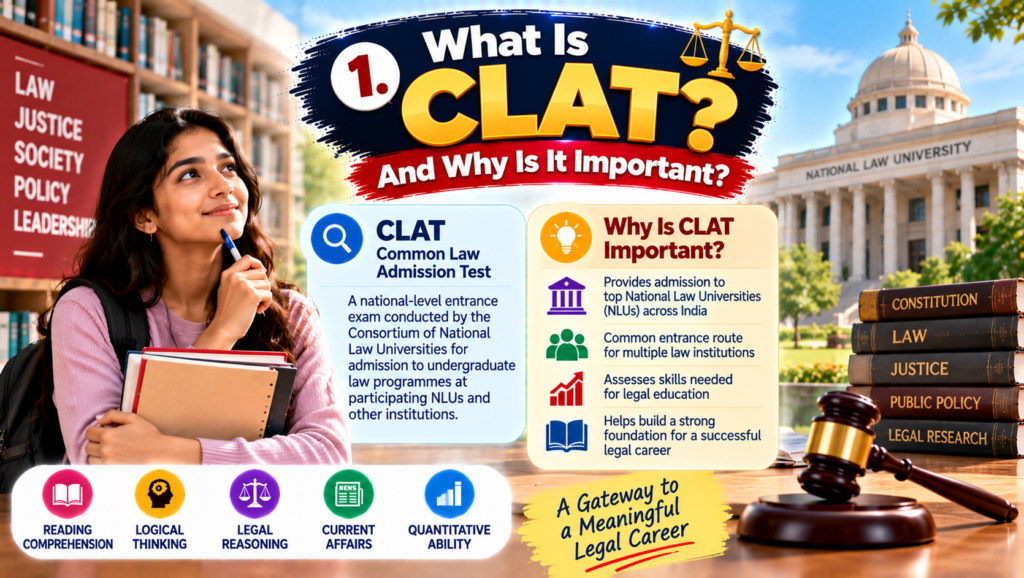
CLAT stands for Common Law Admission Test and is conducted by the Consortium of National Law Universities. The undergraduate examination, commonly known as CLAT UG, is used for admission to eligible five-year integrated undergraduate law programmes at participating NLUs. Several other universities and institutions may also accept CLAT scores for their law programmes. Students should check the admission criteria of individual institutions because participating institutions, available courses, seat allocation and admission requirements can differ.
CLAT is important because it provides a common entrance route for students seeking admission to several recognised law institutions. Instead of relying only on school marks, candidates compete through an examination that assesses the reading, reasoning and analytical abilities required for legal education. A good preparation strategy helps students understand the question format, improve their accuracy and manage time effectively. For students considering law after Class 12, learning about CLAT early can help them identify their target institutions, understand admission requirements and prepare in a structured way.

2. Why Should Students Choose CLAT After Class 12?
Law is a suitable career option for students who enjoy reading, analysing situations, understanding rules, constructing arguments and solving problems. Legal education introduces students to constitutional principles, contracts, criminal law, civil law, legal research and the functioning of courts and institutions. Depending on their interests and qualifications, law graduates may explore careers in litigation, corporate law, legal consultancy, compliance, policy research, legal journalism, public service and further academic study. Career pathways vary according to the role, qualifications, experience and applicable professional requirements.
Choosing CLAT also gives students an opportunity to develop skills that are valuable beyond legal practice. Reading comprehension improves their ability to understand complex information, logical reasoning helps them evaluate arguments, and current-affairs preparation builds awareness of national and international developments. Quantitative techniques develop the ability to interpret numerical information and solve data-based questions. These skills can be useful in a variety of professional settings. Students should, however, choose law because the subject and its career pathways genuinely interest them, rather than only because the examination is popular.

3. CLAT Eligibility: Who Can Apply?
Students who have completed Class 12 or are appearing for their Class 12 qualifying examination can generally apply for CLAT UG, subject to the eligibility conditions prescribed for the relevant examination and admission year. Under the published CLAT 2027 eligibility criteria, candidates must satisfy the minimum qualifying examination marks specified by the Consortium. The usual minimum is 45% for General-category candidates and 40% for candidates belonging to SC/ST/PwD categories. Candidates appearing for their qualifying examination may apply provisionally but must provide proof of passing as required for admission.
There is no requirement to have studied a particular Intermediate stream to take CLAT UG. Students from MEC, CEC, ACE and other recognised streams can consider the examination if they meet the eligibility requirements. This allows students to explore law regardless of whether their school subjects focus on mathematics, commerce, economics or civics. Since eligibility rules, documentation and admission requirements must be checked for the relevant year, students should review the latest CLAT notification and the admission brochure of their preferred universities before applying.
4. CLAT Exam Pattern: Duration, Marks and Marking Scheme
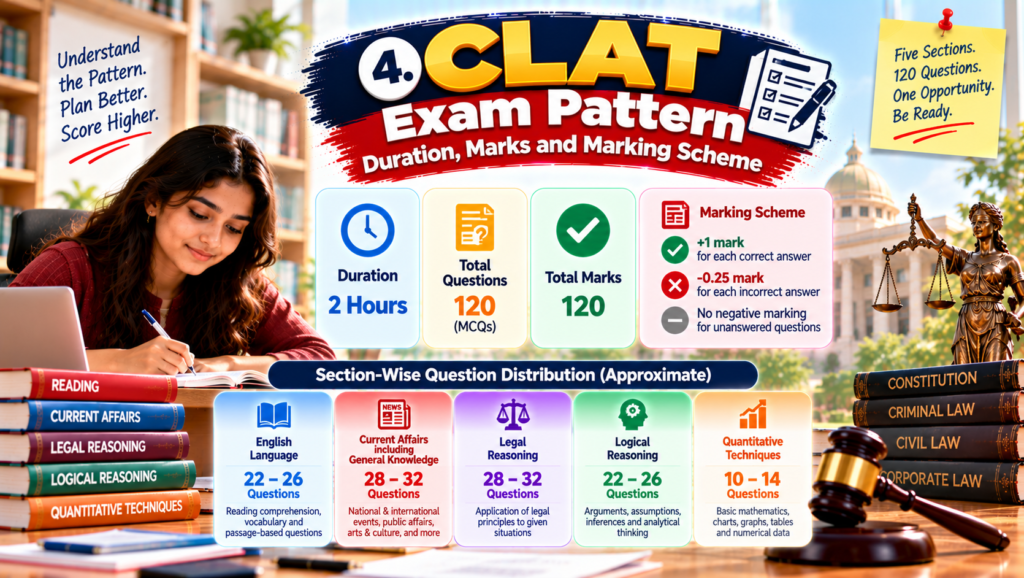
Understanding the examination pattern is an important part of CLAT preparation because it helps students plan their time and practise in the correct format. Under the CLAT 2027 undergraduate pattern, the examination consists of 120 multiple-choice questions for a total of 120 marks. Candidates receive two hours to complete the test. One mark is awarded for each correct answer, while 0.25 marks are deducted for each incorrect answer. Unanswered questions do not attract a penalty.
The CLAT 2027 examination is scheduled to be conducted in offline, pen-and-paper mode, according to the published examination instructions. The question paper is passage-based, so candidates need to read carefully and answer questions using the information, reasoning and context provided. The approximate distribution of questions across the five sections is as follows:
- English Language: 22–26 questions
- Current Affairs, including General Knowledge: 28–32 questions
- Legal Reasoning: 28–32 questions
- Logical Reasoning: 22–26 questions
- Quantitative Techniques: 10–14 questions
The exact number of questions in each section may vary within the published ranges. Students should practise full-length mock tests under timed conditions to understand how to distribute their time between sections. They should also learn when to move on from a difficult question, how to avoid careless mistakes and how to make considered decisions when negative marking applies.
5. CLAT Subjects and Syllabus: What Do Students Need to Study?
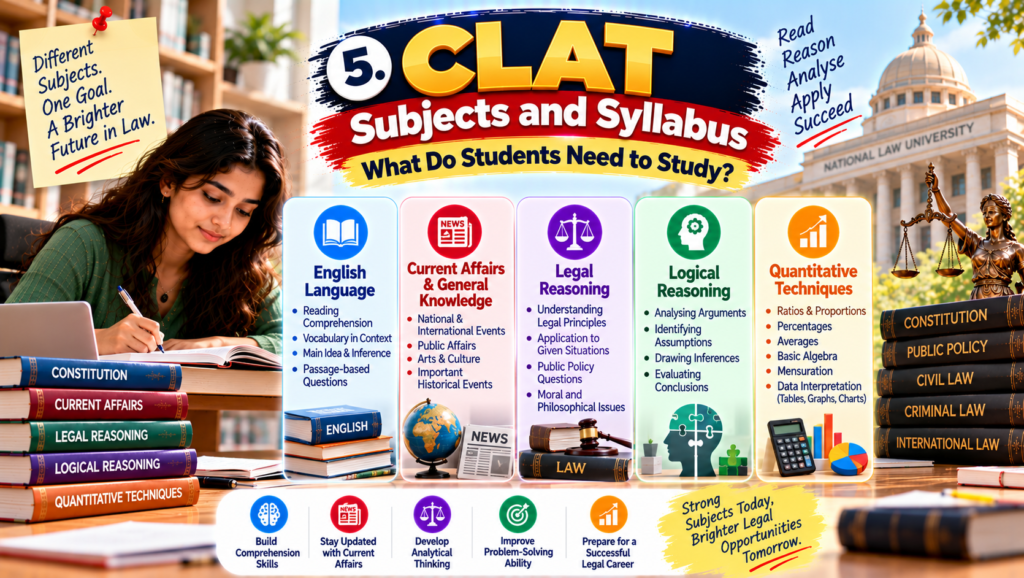
The CLAT UG examination contains five sections, each designed to assess a different set of skills. The syllabus focuses primarily on comprehension and reasoning rather than requiring candidates to memorise a large body of specialised legal knowledge. Students who understand the purpose of each section can organise their preparation more effectively and identify the areas that need regular practice.
English Language
The English Language section assesses reading comprehension, vocabulary in context, the ability to identify central ideas and the understanding of arguments presented in passages. Students may be asked to draw conclusions, compare viewpoints, summarise information or identify the meaning of words and phrases as used in a passage. Strong reading skills are important because the examination requires candidates to understand written information accurately and respond within a limited time.
Students can improve their performance by reading editorials, opinion articles, essays and other suitable non-fiction material regularly. After reading, they should practise identifying the main argument, supporting evidence, tone and conclusions. Vocabulary should be learnt through context rather than memorised as isolated word lists alone. Regular comprehension exercises and timed passage practice can help students improve both reading speed and accuracy.
Current Affairs, Including General Knowledge
This section tests awareness of important national and international events, public affairs, arts and culture, international developments and significant historical events. Questions are presented through passages drawn from news and other non-fiction sources. Students need to understand the event described, identify the relevant details and connect the information in the passage with broader general awareness.
Effective preparation requires a consistent current-affairs routine rather than last-minute reading. Students can follow reliable news sources, maintain concise notes on major events and revise important developments regularly. They should focus on understanding the background, significance and consequences of events instead of collecting facts without context. Weekly revision and practice questions can help them retain information and apply it more confidently during the examination.
Legal Reasoning
Legal Reasoning evaluates a student’s ability to understand legal principles or propositions and apply them to given situations. The questions may involve legal issues, public policy or moral and philosophical questions. Candidates need to identify the rule described in a passage, understand the facts of a situation and determine how the rule applies. Formal legal education is not required to begin preparing for this section.
Students should focus on careful reading, accurate interpretation and consistent application of the principles given in the question. They should avoid choosing answers based only on personal opinion or assumptions about what the law should be. Instead, they must analyse the facts and follow the principle presented in the passage. Practising legal reasoning questions can help students develop the structured thinking and attention to detail needed for the examination and later legal studies.
Logical Reasoning
Logical Reasoning assesses the ability to understand arguments, identify assumptions, draw inferences and evaluate whether evidence supports a conclusion. Questions may require students to identify an argument’s central claim, recognise weaknesses in reasoning, distinguish between facts and opinions or determine how new information affects an argument. These skills are important for analysing complex information and considering different viewpoints.
Students can prepare by solving reasoning exercises regularly and reviewing the logic behind each answer. They should learn to identify the conclusion of an argument, separate it from supporting statements and examine whether the evidence is sufficient. When an answer is incorrect, understanding why it is incorrect is more useful than simply checking the right option. Over time, this approach can improve analytical ability, accuracy and confidence with unfamiliar passages.
Quantitative Techniques
The Quantitative Techniques section tests the ability to understand and work with numerical information presented in passages, tables, graphs or other formats. The mathematics is generally based on concepts up to the Class 10 level and can include ratios and proportions, percentages, averages, basic algebra, mensuration and statistical estimation. Candidates must interpret the information correctly, identify the relevant calculations and solve the questions efficiently.
Students should practise fundamental mathematical operations before moving on to timed data-based questions. They can improve their performance by learning common calculation methods, revising formulas and practising questions involving charts, tables and numerical comparisons. Accuracy matters because a small calculation error can affect the final answer. Regular practice is especially useful for students who have not studied mathematics in depth during Intermediate, as it gives them time to strengthen the necessary fundamentals.
6. How to Prepare for CLAT Alongside Intermediate Studies
Preparing for CLAT while studying Intermediate requires a realistic timetable that balances board subjects with entrance examination practice. Students should not treat the two goals as competing priorities. Instead, they can build a daily routine that includes schoolwork, reading, current-affairs revision and a short session of reasoning or quantitative practice. A consistent schedule helps them improve gradually without leaving the entire CLAT syllabus until the months immediately before the examination.
An effective weekly plan should include all five CLAT sections, with additional time allocated to weaker areas. Students can begin with short comprehension exercises and topic-wise questions, then gradually introduce timed sectional tests and full-length mock examinations. They should review every mock test to understand mistakes, missed questions and time-management problems. This review process helps them refine their approach and ensures that practice leads to measurable improvement rather than becoming a routine of repeatedly attempting questions without learning from them.
7. When Should Students Start CLAT Coaching? Why Intermediate Is the Right Time
Starting CLAT preparation during Intermediate can give students more time to develop the skills tested in the examination. Reading comprehension, legal reasoning and logical analysis improve through repeated practice, while current-affairs preparation benefits from consistent reading and revision over an extended period. Students who begin early can gradually become familiar with the examination format and learn how to approach passage-based questions without putting unnecessary pressure on themselves during Class 12.
Early preparation should remain balanced with board examination studies. Students can begin by developing a reading habit, following current affairs, practising reasoning questions and strengthening quantitative fundamentals. As their confidence grows, they can add timed tests and more structured mock examinations to their schedule. Integrated CLAT coaching can help students organise these activities alongside Intermediate classes. Beginning during MEC, CEC or ACE gives students an opportunity to build the necessary skills over time while continuing their regular academic education.
8. MEC, CEC and ACE with Integrated CLAT Coaching at CMS
MEC, CEC and ACE students can all consider CLAT as a pathway towards undergraduate legal education, provided they meet the examination’s eligibility requirements. MEC includes Mathematics, Economics and Commerce; CEC includes Civics, Economics and Commerce; and ACE is another Intermediate stream offered at CMS . These streams provide different academic combinations, but none prevents an eligible student from pursuing law. Students should select their Intermediate stream based on their interests and academic goals while preparing separately for the skills required in CLAT.
CMS offers integrated CLAT coaching with MEC, CEC and ACE, enabling students to work towards their Intermediate qualification while preparing for the law entrance examination. A planned approach can help students connect their academic timetable with CLAT practice, including English comprehension, current affairs, legal reasoning, logical reasoning and quantitative techniques. For students and parents evaluating Intermediate options after Class 10, understanding the integrated course structure can make it easier to plan both board studies and competitive examination preparation within one academic journey.
9. What Should Students Look for in a CLAT Coaching Course?
When choosing a CLAT coaching course, students should look beyond the number of classes or the volume of study material. They should consider whether the teaching approach explains the reasoning behind answers, helps them understand passage-based questions and gives them sufficient opportunities to practise. Faculty guidance, structured preparation, topic-wise exercises and doubt-solving support can help students identify their weaknesses and develop a more effective approach to the examination.
Mock tests and performance feedback are also important because they show how well students manage time, maintain accuracy and respond to different question types. Regular evaluation helps students identify which sections need more attention and whether their preparation strategy is working. At CMS, students considering integrated MEC, CEC or ACE with CLAT coaching can explore how the academic timetable, entrance examination preparation and practice activities fit together. A suitable course should support consistent progress while allowing students to meet their Intermediate academic responsibilities.
10. Career Opportunities After Studying Law Through CLAT
Students who secure admission through CLAT UG can pursue a five-year integrated undergraduate law programme at an eligible institution. Depending on the university and course, students may study law alongside subjects such as arts, business administration or commerce. The degree develops an understanding of legal principles, research, writing, negotiation and argumentation. Students should review each university’s programme structure, admission conditions and curriculum before deciding which course best matches their interests.
After completing a qualifying law degree and meeting the applicable professional requirements, graduates may explore different career pathways. These can include litigation, corporate legal work, legal research, compliance, legal consultancy, policy-related roles and further study. Some roles require additional qualifications, registration or examinations, and career progression depends on experience, skills and the area of law chosen. Students who are interested in business may find corporate law, commercial contracts and compliance particularly relevant, while others may prefer courtroom practice, public policy or research. Exploring these options early can help students understand how legal education connects with different professional goals.
11. Starting Your CLAT Preparation Journey with CMS
CLAT offers students an opportunity to pursue undergraduate legal education through a competitive entrance examination that focuses on comprehension, reasoning, current affairs and quantitative skills. Preparing effectively requires a clear understanding of the syllabus, a consistent study routine and regular practice with questions and mock tests. Starting during Intermediate gives students time to strengthen these skills while continuing their board studies. By learning about the course and the legal career pathways available, students can make a more informed decision about their future.
CMS CLAT Coaching Institute in Hyderabad offers integrated CLAT coaching with MEC, CEC and ACE, helping students plan their Intermediate education alongside preparation for the law entrance examination. A structured approach to subject learning, reasoning practice and examination preparation can help students work towards their academic goals with greater clarity. Students exploring law after Class 10 can consider the integrated options at CMS, understand the course structure and choose a preparation plan that suits their learning needs and future ambitions.