
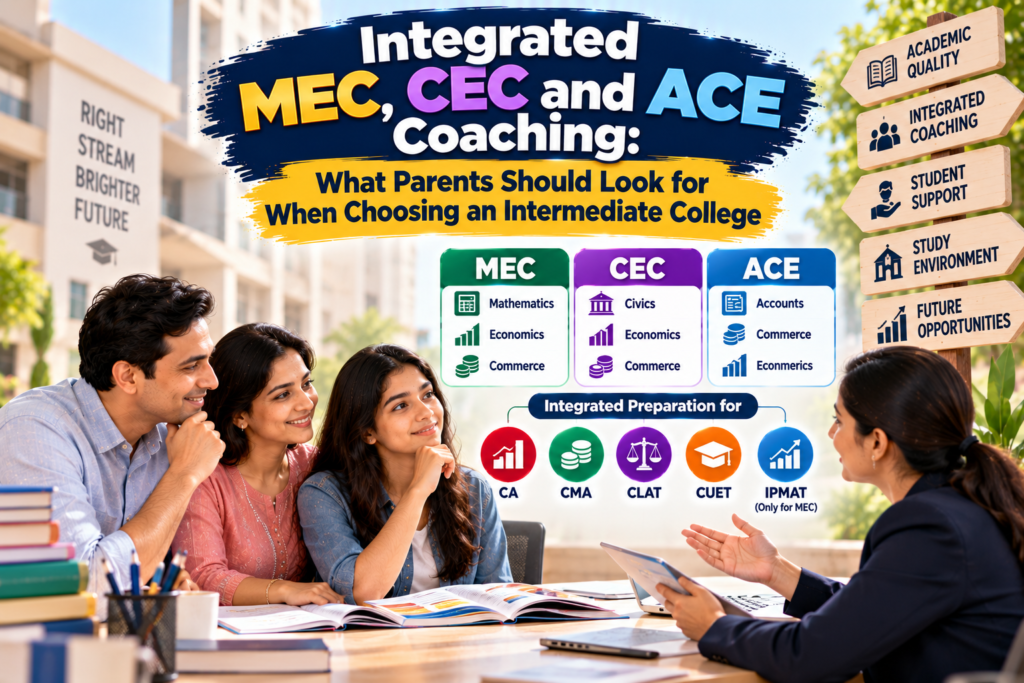
Choosing an Intermediate college after Class 10 is an important decision for both students and parents. Along with academic performance, families increasingly consider how a college can help students explore future education and career opportunities. For students interested in commerce, finance, law, business and management, streams such as MEC, CEC and ACE offer different subject combinations that can support their academic interests. Selecting a college that provides appropriate guidance and a structured learning environment can help students approach these two years with greater clarity.
Integrated coaching is one factor parents may consider when comparing Intermediate colleges. It brings regular Intermediate education together with preparation for selected professional courses or entrance examinations, allowing students to work towards multiple academic goals within a planned routine. However, not every stream offers the same preparation options, and parents should understand the specific combinations available before making a decision. Evaluating the curriculum, teaching approach, study schedule, student support and relevance of the integrated courses can help families choose an option that suits their child’s interests and long-term plans.
Understanding MEC, CEC and ACE Before Choosing a College
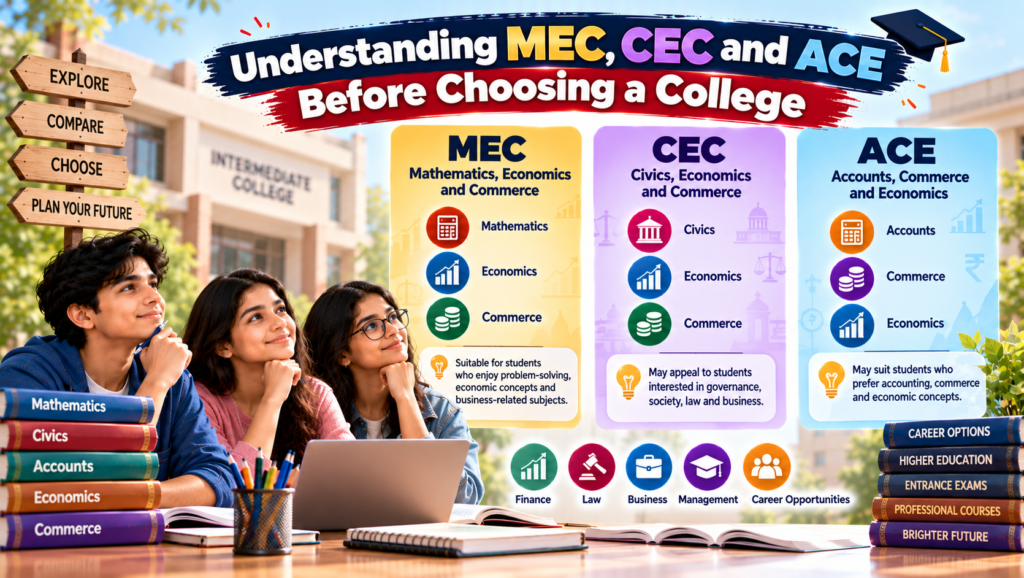
MEC stands for Mathematics, Economics and Commerce. It can be a suitable option for students who enjoy mathematical problem-solving, economic concepts and business-related subjects. Mathematics can help develop quantitative reasoning, while Economics and Commerce introduce students to markets, financial activities and business fundamentals. Students interested in accounting, finance, economics or management may consider MEC while exploring professional courses and entrance examinations that align with their goals.
CEC combines Civics, Economics and Commerce, while ACE combines Accounts, Commerce and Economics. CEC may appeal to students interested in governance, society, law and business, whereas ACE may suit students who prefer accounting, commerce and economic concepts. These streams can provide different academic foundations, but students should not feel that their options are limited to one career. Parents can help by discussing their child’s interests, reviewing possible future courses and understanding the eligibility requirements associated with each pathway before finalising an Intermediate stream.
What Integrated Coaching Means for Intermediate Students
Integrated coaching connects Intermediate learning with preparation for a selected professional course or entrance examination. Instead of managing every learning goal without a plan, students can follow a coordinated schedule that includes classroom lessons, subject revision, entrance-exam practice and assessments. This approach can help students develop consistent study habits and understand how their academic learning connects with future opportunities. For parents, it can also provide a clearer framework for monitoring progress and discussing study goals with their children.
However, integration should not mean that Intermediate subjects receive less attention. Students still need to understand their board syllabus, complete assignments and prepare adequately for examinations. Professional courses and entrance tests have their own requirements, so the college should explain how these will be accommodated within the timetable. Parents should look for a realistic academic plan that balances both responsibilities rather than assuming that additional coaching automatically guarantees strong results.
MEC With CA, CMA, CLAT, CUET and IPMAT
At CMS, students choosing MEC can explore integrated preparation for CA, CMA, CLAT, CUET and IPMAT alongside their Intermediate education. This combination allows students to consider different directions, including professional accounting, cost and management accounting, law, undergraduate university programmes and integrated management education. Having these options available can be useful for students who are still evaluating their long-term interests, provided they understand the differences between the courses and the preparation each one requires.
Parents should encourage students to investigate each pathway before deciding which preparation option deserves priority. CA and CMA are professional qualifications with distinct syllabuses and career applications. CLAT is an entrance route to participating law universities, CUET-UG supports admission to undergraduate programmes at participating universities, and IPMAT is used by certain institutions for integrated management admissions. A suitable preparation plan should reflect the student’s interests, academic strengths, target institutions and workload rather than attempting to pursue every option without a clear objective.
CEC With CA, CMA, CLAT and CUET
At CMS, CEC students can explore integrated preparation for CA, CMA, CLAT and CUET alongside their Intermediate studies. The combination provides opportunities for students interested in professional accounting, management accounting, legal education and undergraduate degree programmes. CEC subjects can introduce students to commerce, economics and civic institutions, helping them explore different areas of interest while they develop their academic foundation.
Parents should understand that each pathway requires a different type of preparation. Students considering CA or CMA need to learn about the relevant professional-course structure and develop the study discipline required for the examinations. Those interested in CLAT should work on reading comprehension, logical reasoning, legal reasoning and current-affairs awareness. CUET aspirants need to identify their target undergraduate programmes and check the required examination subjects. Understanding these differences can help families choose a preparation plan that fits the student’s goals and available study time.
ACE With CA, CMA, CLAT and CUET
ACE students at CMS can explore integrated preparation for CA, CMA, CLAT and CUET. With Accounts, Commerce and Economics as their Intermediate subjects, students can develop an academic foundation relevant to several business and finance-related interests. Those considering CA or CMA can investigate how their subject knowledge connects with professional accounting and management accounting, while also learning about the additional preparation required for each qualification.
Students interested in law or university degree programmes can also explore CLAT and CUET, subject to the relevant eligibility requirements. CLAT preparation involves developing reading and reasoning skills, understanding arguments and staying informed about important current affairs. CUET preparation requires students to research undergraduate programmes and confirm the subject combinations accepted by their preferred universities. Parents should ensure that their child understands the requirements of the selected pathway instead of assuming that Intermediate subjects alone are sufficient for admission.
Teaching Quality and Academic Support Matter
One of the most important factors to consider when selecting an Intermediate college is the quality of teaching. Students need teachers who explain concepts clearly, encourage questions and help them understand difficult topics rather than simply completing the syllabus. Strong classroom teaching can support academic confidence and provide the foundation students need when they begin professional-course or entrance-exam preparation. Parents can ask about the teaching approach, assessment schedule, doubt-clearing support and how the college helps students who need additional guidance.
Regular feedback is equally valuable. Assessments can help students and teachers identify areas that require more attention before gaps become difficult to correct. Parents should look for a learning environment where progress is reviewed constructively and students are encouraged to improve consistently. The purpose of assessment should be to strengthen understanding and identify practical next steps, not simply to compare students with one another or create unnecessary pressure.
Study Timetables, Practice and Student Well-Being
Balancing Intermediate academics with integrated coaching requires careful time management. Parents should ask how the college schedules board-subject lessons, professional-course or entrance preparation, revision and practice tests. A timetable that includes regular learning sessions and enough time for self-study is more useful than one that leaves students with an unmanageable workload. Students also need time to rest, participate in normal activities and maintain a sustainable routine throughout Intermediate.
A supportive college should help students understand how to plan their studies and respond when they fall behind. Regular practice, revision and review of mistakes can improve preparation, but students need guidance on how to use these activities effectively. Parents can support their children by discussing weekly progress, encouraging realistic goals and avoiding excessive pressure. A balanced approach helps students remain engaged with their studies while gradually building the discipline required for higher education and professional examinations.
How Parents Can Evaluate an Integrated Intermediate College
Before choosing a college, parents should compare the available stream and coaching combinations, teaching support, academic schedule and preparation resources. They should confirm exactly which courses are offered with each Intermediate stream and ask how the college coordinates board examinations with professional-course or entrance-exam preparation. Understanding these details can prevent confusion and help families select an arrangement that matches the student’s actual interests.
Parents should also encourage their children to participate in the decision. A stream or preparation option may appear attractive, but the student should understand what it involves and be willing to study the relevant subjects. Families can research course requirements, discuss career interests with teachers and review official eligibility criteria for target programmes. Choosing an Intermediate college is not simply about selecting the largest number of coaching options; it is about finding an academic environment that helps the student learn consistently and make informed decisions.
Why Parents Can Explore Integrated Learning at CMS
CMS MEC Best Colleges in Hyderabad offers MEC with integrated preparation for CA, CMA, CLAT, CUET and IPMAT, while CEC and ACE are available with integrated preparation for CA, CMA, CLAT and CUET. This stream-specific approach gives students and parents a clearer way to explore the available combinations according to their academic interests and future goals. By understanding the options associated with each stream, families can compare possible pathways before choosing a suitable Intermediate programme.
Parents considering CMS can begin by discussing the student’s preferred subjects, career interests and willingness to prepare for a professional course or entrance examination. They can then explore the relevant stream and coaching combination, clarify the academic schedule and understand how progress is monitored. The aim is to help students approach Intermediate with a clear plan, appropriate guidance and a realistic understanding of the work involved in preparing for both board examinations and their chosen future pathway.
Conclusion
Choosing an Intermediate college involves more than comparing streams or looking at the number of courses available. Parents should consider teaching quality, academic support, study schedules, student well-being and the relevance of integrated coaching to their child’s interests. MEC, CEC and ACE offer different subject combinations, and understanding how each connects with professional courses and entrance examinations can help families make a better-informed choice.
At CMS, MEC students can explore CA, CMA, CLAT, CUET and IPMAT preparation, while CEC and ACE students can explore CA, CMA, CLAT and CUET preparation. By comparing these options carefully and involving students in the decision, parents can help them choose a stream and preparation plan that aligns with their strengths. A well-considered decision at the beginning of Intermediate can provide a more organised starting point for the student’s next stage of education.