
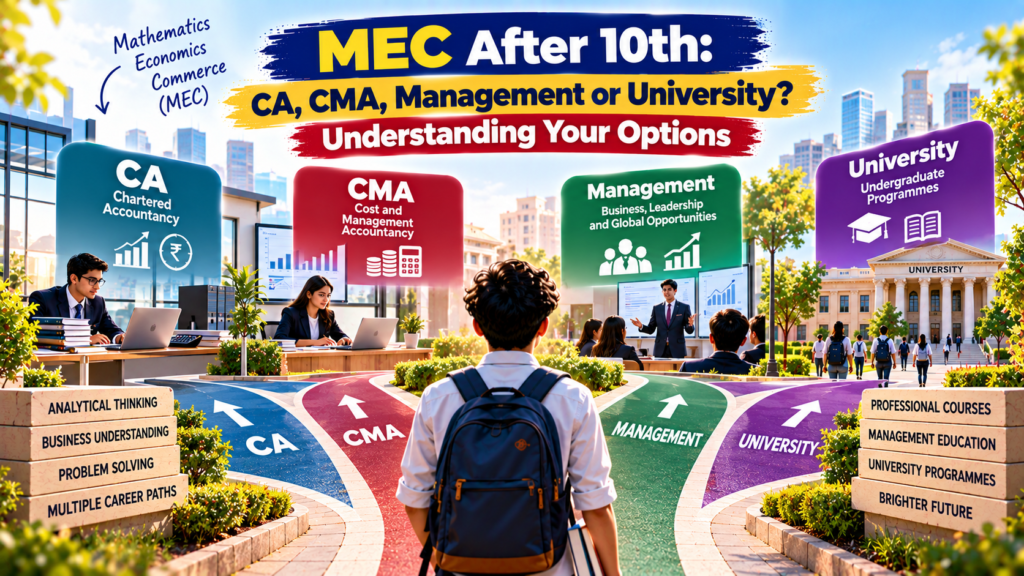
Choosing a stream after 10th is one of the first major academic decisions students make. For students interested in mathematics, economics and commerce, MEC can provide a combination of subjects that keeps several higher-education and career pathways open. However, choosing MEC is only the beginning. Students also need to understand how the stream can connect with professional courses, management education and university programmes after Intermediate.
A student taking MEC does not necessarily have to decide on a single career immediately. CA, CMA, management education and university-based undergraduate programmes are all possible directions to explore, depending on individual interests and strengths. Understanding these options during Intermediate can help students gradually identify the pathway that suits them rather than making a rushed decision after completing their studies.
What Does MEC Offer Students?
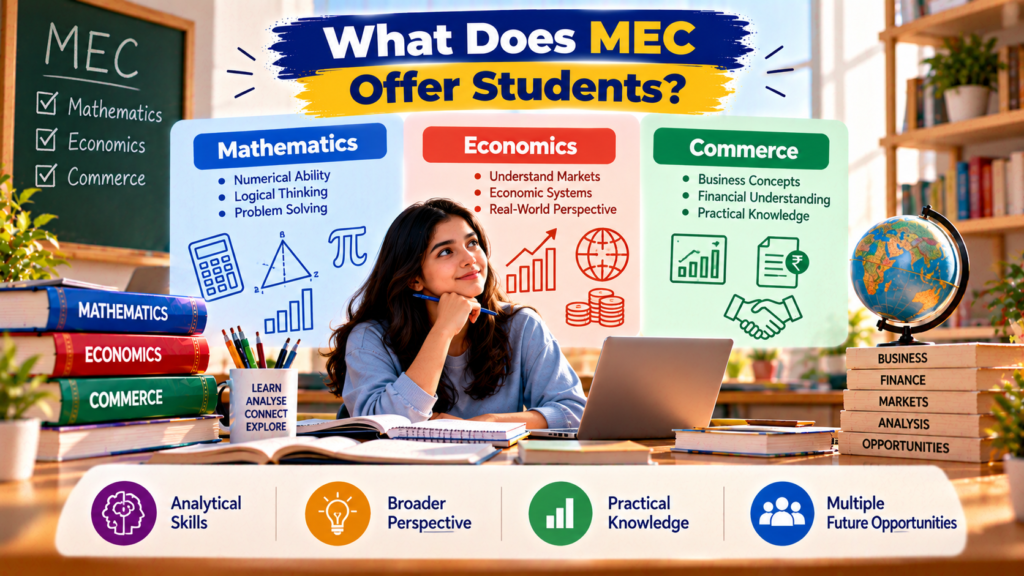
MEC stands for Mathematics, Economics and Commerce. The combination brings together quantitative thinking, economic understanding and knowledge of business and commerce. Mathematics encourages students to work with numbers and solve problems, Economics introduces them to how markets and economic systems function, while Commerce provides an understanding of business activities and related concepts.
Together, these subjects can develop a useful combination of analytical and commercial skills. Students can learn to interpret information, understand relationships between economic and business factors, work with quantitative concepts and approach problems systematically. These foundations can be relevant to several future pathways, although each professional course or entrance examination requires additional specialised preparation.
MEC and Chartered Accountancy
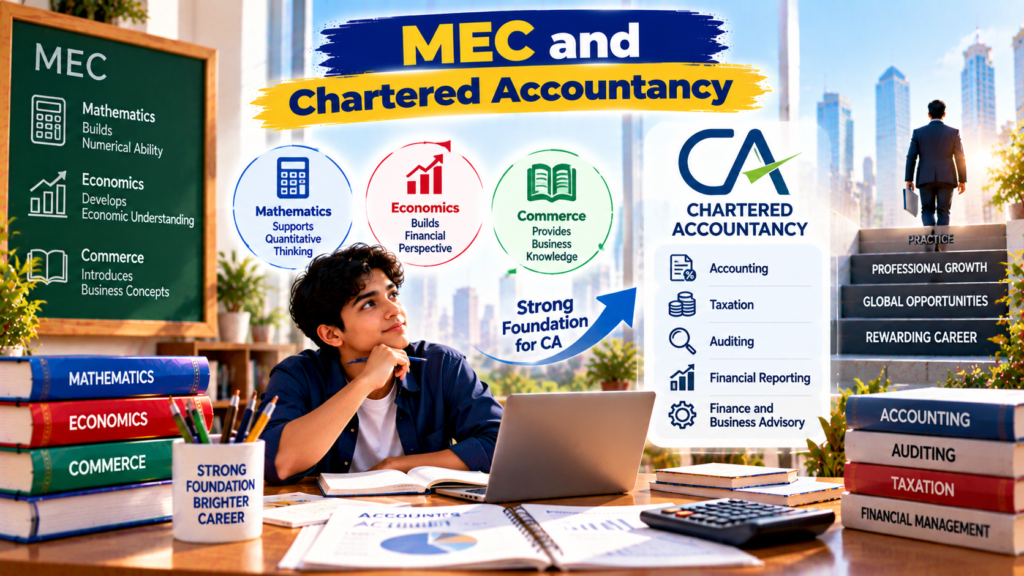
Chartered Accountancy can be an option for MEC students who are interested in accounting, taxation, auditing, financial reporting and finance-related areas. The pathway requires students to develop strong conceptual understanding along with accuracy, numerical ability and consistent practice.
The subjects studied in MEC can provide useful academic exposure for students considering CA. Commerce introduces business-related concepts, Economics develops an understanding of economic activity, and Mathematics can strengthen quantitative thinking. However, students should understand that CA is a professional pathway with its own curriculum and examination requirements, so Intermediate subjects provide a foundation rather than replacing dedicated CA preparation.
MEC and Cost and Management Accountancy
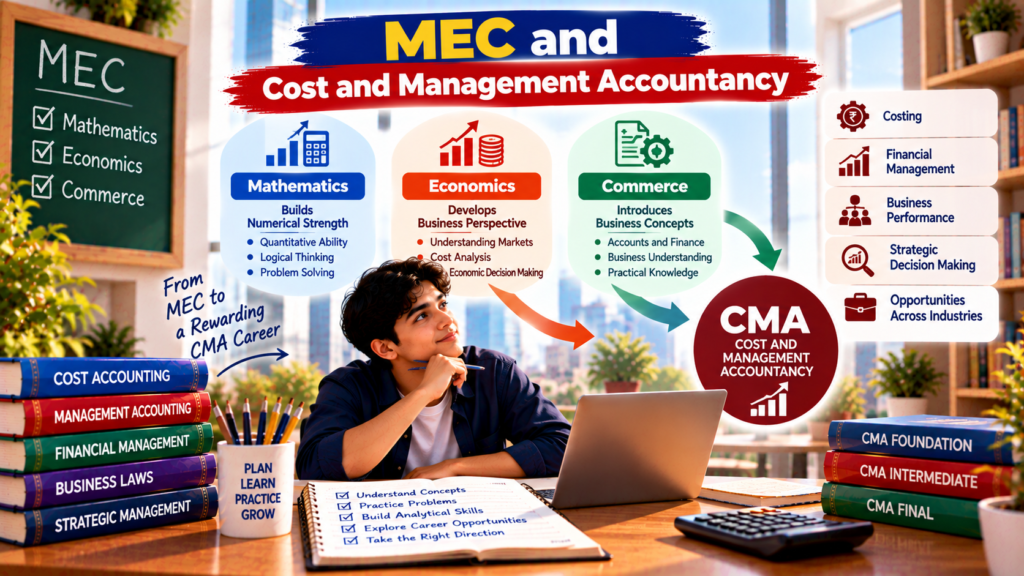
Students interested in costing, financial management, business performance and decision-making can also consider the CMA pathway. Cost and Management Accountancy combines financial understanding with the analysis of costs and business performance, making it relevant to organisations across different industries.
MEC can provide a useful starting point because Mathematics encourages numerical reasoning, Economics introduces economic concepts and Commerce develops business awareness. Students interested in CMA can use their Intermediate years to strengthen these fundamentals while gradually becoming familiar with the concepts and preparation methods associated with the professional course.
MEC and Management Education
Management is another broad career direction that MEC students can explore. Management careers can involve areas such as finance, marketing, operations, human resources, business analytics, strategy and entrepreneurship. Students interested in understanding how organisations work and how business decisions are made may find this field appealing.
The mathematical and economic components of MEC can be useful for students interested in management because business decisions often involve numbers, data, markets and financial considerations. Commerce can also provide exposure to business concepts. Students considering management entrance examinations can additionally work on quantitative ability, logical reasoning, verbal ability, reading and communication skills.
Exploring IPMAT After MEC
Students who are interested in an integrated management education can explore entrance pathways such as IPMAT. These programmes are designed for students who want to enter management education at an earlier stage rather than completing a separate undergraduate degree before pursuing management studies.
MEC can be particularly relevant for students who enjoy mathematics and analytical problem-solving, although students from other backgrounds can also develop the required skills. Preparation for management entrance examinations may involve quantitative ability, logical reasoning and verbal ability, so students should gradually build skills beyond their regular Intermediate syllabus.
MEC and University Education
Not every MEC student needs to pursue a professional course or management entrance examination. University education can provide another broad pathway after Intermediate. Students can explore undergraduate programmes in areas such as commerce, economics, business, finance and other disciplines depending on their interests and eligibility.
Entrance examinations such as CUET can also be relevant for students seeking admission to participating universities and programmes. The exact requirements can vary by university and course, so students should examine the current eligibility and subject requirements of the programmes they are considering. MEC can provide a useful academic base while students prepare for relevant entrance requirements.
How Mathematics Adds Value to MEC
Mathematics is one of the distinctive components of MEC and can help students develop quantitative reasoning and structured problem-solving abilities. These skills can be useful beyond examinations because finance, economics, business analysis and management frequently involve numerical information and data.
For students considering CA, CMA or management-related pathways, quantitative confidence can be an advantage. It can also support entrance-examination preparation where numerical reasoning is tested. At the same time, students should not assume that mathematics alone determines their future pathway. Reading, communication, reasoning, conceptual understanding and consistent practice are equally important for many career directions.
The Role of Economics in Future Career Paths
Economics can help students understand how individuals, businesses and governments make decisions when resources are limited. Concepts involving demand, supply, markets, inflation, production, consumption and economic activity can provide students with a broader understanding of the environment in which businesses and organisations operate.
This knowledge can become useful across several career directions. A student interested in finance may want to understand economic conditions, while someone interested in management may need to understand markets and business environments. Even students considering university programmes unrelated to professional commerce courses can benefit from developing the habit of analysing economic and social developments.
Why Commerce Matters in the MEC Combination
Commerce introduces students to the practical side of business and financial activity. It can help them understand how businesses operate, how transactions are recorded and how different commercial activities are connected. These concepts can provide an early introduction to areas that students may encounter in greater depth in professional courses and undergraduate programmes.
For students considering CA or CMA, Commerce can provide relevant academic exposure. For management aspirants, it can introduce business concepts that may later be connected to finance, operations, marketing and strategy. This makes Commerce an important part of the broader MEC combination rather than simply another subject to complete for Intermediate examinations.
How to Choose Between CA, CMA, Management and University
The right choice depends less on which option is considered the most popular and more on what kind of learning and career environment suits the student. Students who enjoy accounting, finance, auditing and taxation may want to investigate CA. Those interested in costing, financial analysis and business performance can explore CMA. Students who are drawn towards leadership, business strategy and organisational decision-making may consider management education.
University education can be the right choice for students who want to explore a broader undergraduate degree before deciding on a professional specialisation. There is also no requirement for students to finalise every detail of their future immediately after 10th. MEC can give them time during Intermediate to explore their interests, understand different pathways and gradually make a more informed decision.
Why Starting Career Preparation During Intermediate Can Help
Career preparation does not always mean beginning intensive examination preparation immediately. It can simply mean understanding what a particular career requires and identifying the skills that students can start developing early. For an MEC student, this might involve strengthening Mathematics, improving conceptual understanding in Economics and Commerce, developing reading habits or practising logical reasoning.
Students can also use Intermediate to understand the structure of different professional courses and entrance examinations. This awareness can prevent last-minute preparation and make it easier to decide whether CA, CMA, IPMAT, CUET or another pathway is a good fit. The objective should be to build a strong academic foundation while keeping future options open.
How Integrated Preparation Can Help MEC Students
Students who already have a clear career direction may choose to prepare for their future pathway alongside Intermediate. An integrated approach allows academic learning and entrance or professional preparation to be planned together instead of treating them as completely separate responsibilities.
At CMS MEC Colleges in Hyderabad, students pursuing MEC can explore integrated preparation options for pathways including CA, CMA, CUET and IPMAT alongside their Intermediate education. This gives students an opportunity to work on their Intermediate subjects while gradually developing the concepts and skills relevant to their intended professional or entrance pathway.
Making the Most of the MEC Years
The Intermediate years can be used to build more than examination marks. Students can develop habits that remain valuable throughout higher education and professional courses, such as regular revision, problem-solving, reading, note-making, time management and analysing mistakes after practice tests.
It is also useful to remain flexible. A student may enter MEC thinking about one career and discover a different interest during Intermediate. Learning about CA, CMA, management and university options can help students compare these directions before making a long-term decision. A strong foundation keeps more doors open and gives students greater confidence when they eventually choose one.
Conclusion
MEC can provide students with a broad academic foundation through Mathematics, Economics and Commerce. After Intermediate, students can explore professional pathways such as CA and CMA, management education through options such as IPMAT, or undergraduate university programmes through routes such as CUET and other admissions processes.
The most important step is not choosing a career as early as possible, but understanding the options well enough to make a thoughtful choice. By using their Intermediate years to strengthen concepts, develop useful skills and explore different pathways, MEC students can approach CA, CMA, management or university education with greater clarity and preparation.