
Introduction
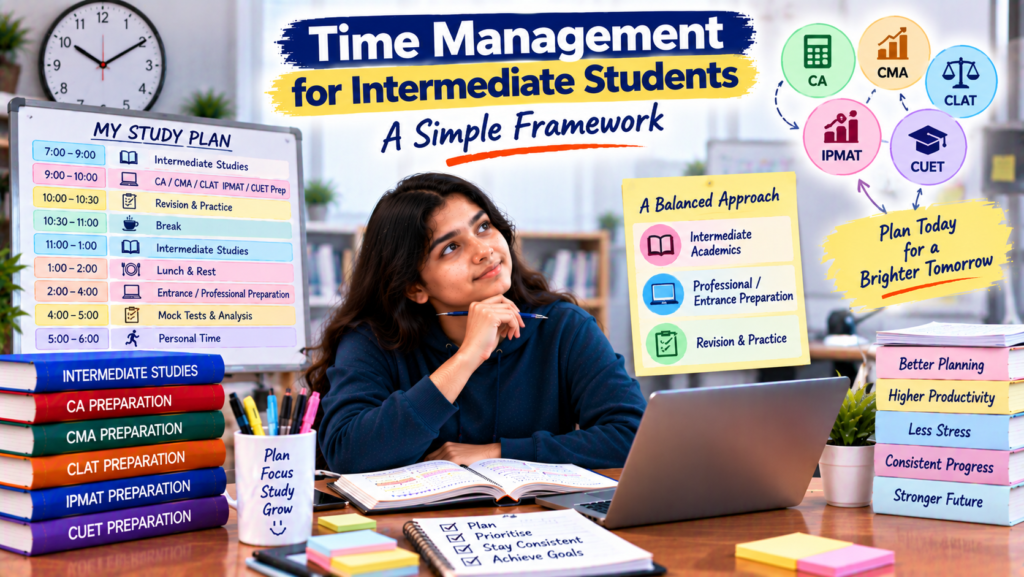
Intermediate is an important stage for students because it combines regular academic studies with the need to think about future education and career pathways. For many commerce students, these two years may also involve preparation for professional courses and entrance examinations such as CA, CMA, CLAT, IPMAT, or CUET. Managing all these responsibilities at the same time can initially feel difficult, particularly when students try to give equal attention to every subject and examination every day.
Effective time management does not mean studying continuously from morning to night. It means understanding priorities, dividing available time realistically, and creating a routine that allows students to make steady progress without neglecting their Intermediate education. A simple framework can help students organise their academic work, professional-course preparation, entrance-exam practice, revision, and personal time in a way that is practical and sustainable.

Why Time Management Matters During Intermediate
Intermediate students often have several responsibilities at the same time. They may have regular classes, assignments, internal examinations, practical work, homework, and board-examination preparation. If they are also preparing for CA, CMA, CLAT, IPMAT, or CUET, additional study and practice sessions need to fit around their academic schedule.
Without proper planning, students may spend too much time on one area and leave another until the last minute. A simple timetable can help create a balance between immediate academic responsibilities and longer-term preparation. The objective is not to study every subject every day, but to make sure that important areas receive attention consistently over a period of time.

Start With Your Fixed Commitments
The first step in managing time is identifying activities that cannot easily be changed. These may include Intermediate classes, coaching sessions, travel, meals, sleep, and other essential responsibilities.
Once these fixed commitments are identified, students can see how much flexible time is actually available. This is more practical than creating a timetable based on an imaginary day with unlimited study hours. A realistic schedule begins with the time that is genuinely available and then distributes it according to priorities.
Use the Three-Part Framework
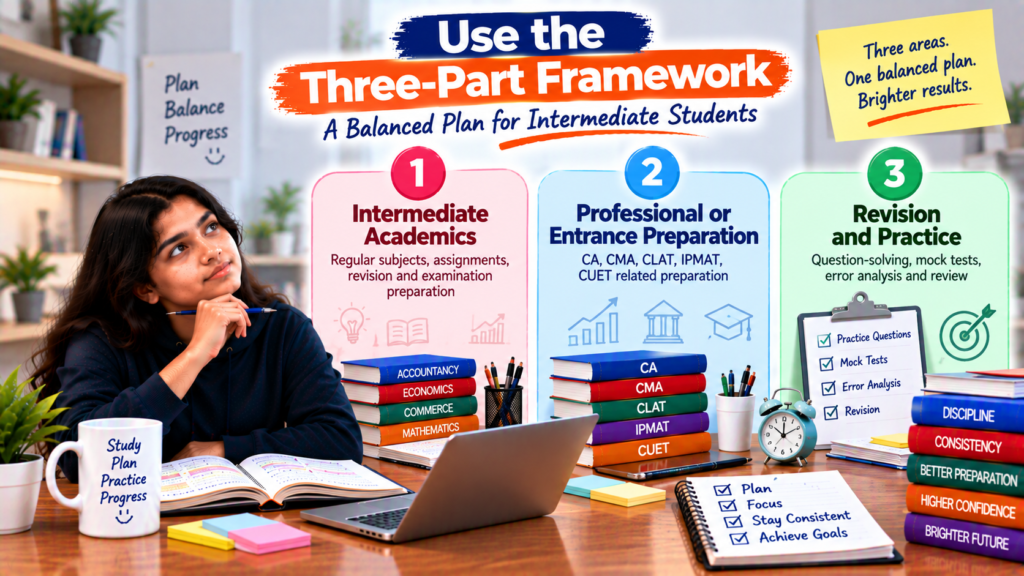
A simple way to organise an Intermediate student’s day is to divide study time into three broad categories:
- Intermediate academics – regular subjects, assignments, revision, and examination preparation
- Professional or entrance preparation – CA, CMA, CLAT, IPMAT, or CUET-related preparation
- Revision and practice – question-solving, mock tests, error analysis, and review of previously studied topics
The exact amount of time allocated to each category can change depending on the student’s current academic workload and upcoming examinations. The important point is to make all three areas part of the overall weekly plan rather than allowing one area to completely replace another.

Give Intermediate Studies a Strong Foundation
Intermediate should not be treated as something separate from future preparation. Subjects studied during these two years can provide useful foundations for several professional and entrance pathways.
For example, Commerce and Economics can support students interested in CA and CMA, while Mathematics in MEC can strengthen quantitative skills useful for aptitude-based examinations. Students preparing for CLAT may build reading and general awareness alongside their academic subjects, while CUET preparation can depend on the specific undergraduate programme and subject requirements being targeted.
Use Weekly Planning Instead of Planning Every Minute
Some students create extremely detailed timetables that assign every minute of the day to a particular activity. While this may look organised, it can become difficult to follow when classes run late, assignments take longer than expected, or unexpected responsibilities arise.
A weekly plan can provide greater flexibility. Students can decide which subjects and preparation areas need attention during the week and then distribute them across available study sessions. This allows them to adjust individual days without feeling that the entire schedule has failed.
Prioritise Based on Urgency and Importance
Not every task has the same level of priority. A board examination approaching in two weeks may require more attention than an entrance-exam topic that can be studied later. Similarly, a difficult Intermediate chapter may need immediate revision if it is affecting performance in other topics.
Students can divide tasks into categories such as:
- Important and urgent
- Important but not urgent
- Practice and revision
- Tasks that can be completed later
This simple classification can prevent students from spending too much time on low-priority activities while more important work remains unfinished.
Create Focused Study Blocks
Instead of trying to study for several hours without interruption, students can divide their preparation into focused blocks. A study block can be dedicated to one clear objective, such as completing an Economics topic, practising Mathematics questions, revising Accounting concepts, or solving a set of CLAT reasoning questions.
The length of a study block can vary according to the student and the subject. What matters is having a defined task and avoiding unnecessary distractions during that period. Short breaks between blocks can help students maintain concentration over longer study sessions.
Balance CA Preparation With Intermediate
Students preparing for CA alongside Intermediate need to manage two related but distinct academic requirements. Intermediate subjects provide the immediate academic foundation, while CA preparation introduces students to professional-course concepts and examination patterns.
A practical approach is to connect related areas wherever possible. Accounting concepts studied during Intermediate can reinforce professional preparation, while regular numerical practice can support both academic and professional learning. Students should also allocate separate time for CA-specific topics and question practice rather than assuming that Intermediate study alone will cover every professional-course requirement.
Balance CMA Preparation With Intermediate
Students preparing for CMA also need to combine their Intermediate studies with professional-course preparation. Commerce and Economics can provide useful background knowledge, while Mathematics can strengthen numerical and analytical abilities for students studying MEC.
Students can divide their preparation according to the level of difficulty and upcoming assessments. Professional topics can be introduced gradually rather than attempting to complete large portions at once. Regular practice and revision can help ensure that professional preparation develops alongside, rather than at the expense of, Intermediate academics.
Balance CLAT Preparation With Intermediate
CLAT preparation can involve areas such as English language, current affairs, legal reasoning, logical reasoning, and quantitative techniques. Some of these skills develop gradually, particularly reading comprehension and awareness of current events.
Students can therefore include small daily or alternate-day activities rather than trying to cover everything in long sessions. For example, regular reading can support comprehension and current-affairs preparation, while separate sessions can be used for legal and logical reasoning practice. This makes CLAT preparation easier to integrate into an Intermediate student’s routine.
Balance IPMAT Preparation With Intermediate
Students preparing for IPMAT may need to work on quantitative ability, verbal ability, and other components depending on the specific examination. Mathematics practice can be particularly relevant for students pursuing MEC, but entrance preparation may require a different style of problem-solving from regular Intermediate exercises.
Students can reserve specific weekly sessions for aptitude questions, reading comprehension, vocabulary, and timed practice. Building these skills gradually can be more manageable than attempting intensive preparation only during the final months before the examination.
Balance CUET Preparation With Intermediate
CUET preparation depends significantly on the undergraduate programme and university a student intends to apply to. Subject requirements and examination patterns should therefore be checked carefully using the current official information applicable to the chosen programme.
Students can integrate CUET preparation with their Intermediate studies where the relevant subjects overlap. Regular revision, practice questions, and mock tests can then be added as the examination approaches. This approach can reduce unnecessary duplication of study while still allowing students to prepare specifically for the entrance examination.
Use the 60–30–10 Principle as a Starting Point
Students looking for a simple framework can initially think of their flexible study time in terms of three broad portions: around 60% for Intermediate academics, 30% for professional or entrance preparation, and 10% for revision, testing, or catch-up work.
This is not a fixed rule and should not be followed rigidly by every student. During board-examination periods, Intermediate studies may require a much larger share of available time. Similarly, before a specific entrance examination, the balance may temporarily shift toward entrance preparation. The value of the framework is that it provides a starting point rather than a strict formula.
Keep One Day for Weekly Review
A short weekly review can help students understand whether their timetable is actually working. They can check which topics were completed, which tasks were postponed, where they made mistakes, and what needs greater attention during the following week.
This review should not become another stressful examination. Its purpose is simply to adjust the plan based on reality. If a particular subject consistently takes longer than expected, the schedule can be modified. If a preparation area is being neglected, additional time can be allocated to it during the following week.
Avoid Multitasking While Studying
Trying to study Accounting while checking messages, watching videos, or switching between multiple subjects can reduce concentration. Students may feel that they are doing several things at once, but divided attention can make learning less efficient.
During a focused study block, students can keep unnecessary notifications away and work on one specific task. Once the block is completed, they can take a break before moving to another activity. This simple habit can make available study time more productive.
Use Small Gaps in the Day Wisely
Not every useful learning activity requires a long study session. Short gaps between classes or other responsibilities can be used for activities such as reviewing vocabulary, reading current affairs, revising formulas, or going through previously studied concepts.
These short sessions should not replace focused study. Instead, they can provide additional revision opportunities without requiring students to create extra hours in an already busy schedule. Small amounts of repeated revision can also help students retain information over time.
Do Not Sacrifice Sleep for Extra Study Hours
Students sometimes extend their study hours late into the night when they feel that they are falling behind. While an occasional late session may happen during an important examination period, consistently reducing sleep can make concentration and learning more difficult.
A sustainable routine should include adequate sleep and regular breaks. Students need mental energy to understand concepts, solve problems, read passages, and remember information. Time management therefore includes managing rest as well as study time.
Use Mock Tests as Part of Time Management
Mock tests are not only useful for checking preparation; they can also help students understand how they use examination time. A student may discover that they spend too long on certain questions or sections, or that they leave insufficient time for revision.
After each test, students can analyse both accuracy and time usage. This can help them make practical changes to their examination strategy. CA, CMA, CLAT, IPMAT, and CUET preparation may require different testing approaches, so students should use mocks that match the specific examination they are preparing for.
Avoid Comparing Your Timetable With Others
Students may notice classmates studying for many hours or preparing for several examinations simultaneously. However, study schedules depend on individual circumstances, academic levels, travel time, school or college schedules, and personal learning speed.
Instead of comparing the number of hours studied, students can track their own progress. Questions such as “Did I complete the planned topics?” and “Am I improving in my practice tests?” provide more useful information than comparing daily study hours with another student.
Build Flexibility Into the Schedule
A good timetable should allow for unexpected events. Classes may take longer, assignments may require additional time, or a student may need a day of lighter study because of fatigue or other responsibilities.
Leaving a small amount of catch-up time during the week can make the schedule more flexible. If a task is postponed, it can be moved into this buffer rather than disrupting the entire timetable. Flexibility makes it easier to maintain a routine over several months.
How CMS Can Support an Integrated Approach
For students who want to pursue professional and entrance pathways alongside Intermediate, having academic and preparation requirements organised within a structured learning environment can make planning easier. CMS offers MEC Coaching in Hyderabad and CEC Coaching in Hyderabad programmes with integrated preparation options for CA, CMA, CLAT, IPMAT, and CUET, allowing students to work toward their Intermediate academic goals while developing relevant skills for professional and entrance examinations. With regular classes, practice, revision, assessments, and guidance planned alongside Intermediate learning, students can build a routine that supports both present academic requirements and future goals.
A Simple Daily Framework
A student’s routine does not need to be complicated. After accounting for classes and other fixed commitments, a day could include one focused session for Intermediate academics, another session for professional or entrance preparation, and a shorter period for revision or question practice.
For example, a student might study an Intermediate subject in one session, work on CA, CMA, CLAT, IPMAT, or CUET preparation in another, and spend 20–30 minutes reviewing previously learned material. The exact schedule can vary, but having a clear purpose for each study block can prevent students from spending their available time deciding what to study.
Conclusion
Time management during Intermediate is ultimately about creating a sustainable balance between current academic responsibilities and future goals. Students preparing for CA, CMA, CLAT, IPMAT, or CUET do not need to study every subject every day or follow an extremely rigid timetable. They need a realistic system that gives consistent attention to Intermediate academics, professional or entrance preparation, revision, and rest.
A simple framework can make this process easier: identify fixed commitments, plan the week, prioritise important tasks, use focused study blocks, review progress regularly, and adjust the schedule when circumstances change. With consistency and flexibility, Intermediate students can prepare for their academic examinations while gradually building the knowledge and skills required for their chosen professional or entrance pathway.