
Introduction
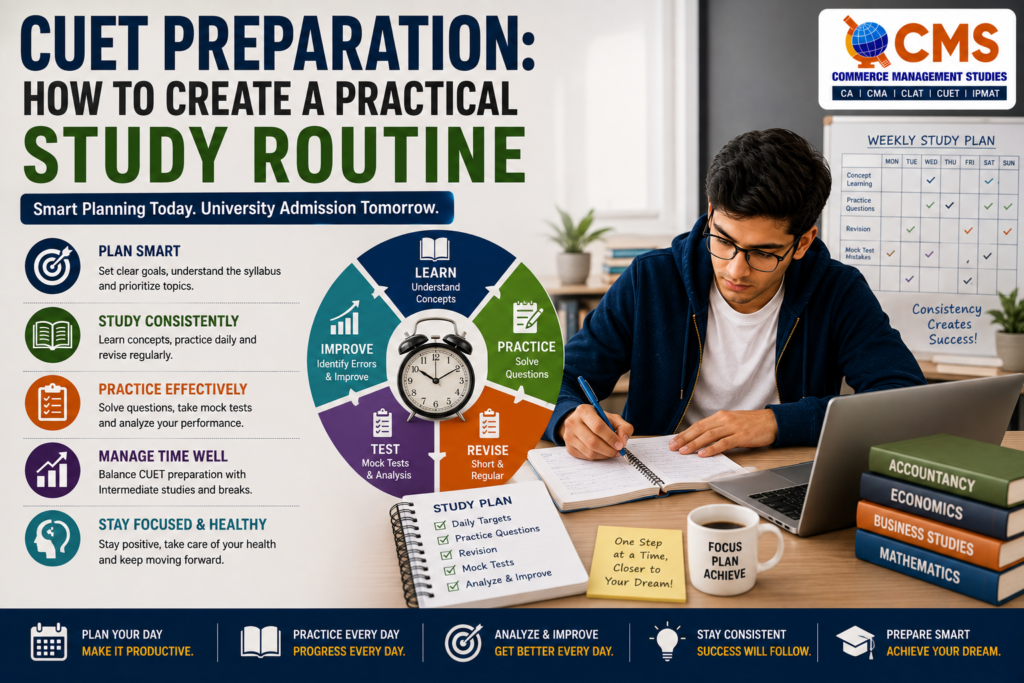
The Common University Entrance Test (CUET) has become an important pathway for students seeking admission to undergraduate programmes offered by participating universities. Since students may prepare for CUET alongside their Intermediate education, managing both academic studies and entrance preparation requires a practical and sustainable routine. Rather than studying for long hours without a clear plan, students can benefit from dividing their preparation into manageable tasks and maintaining consistency.
A good CUET study routine should take into account the student’s selected subjects, current academic level, preparation time, strengths, and areas that need improvement. The objective is not to create an extremely demanding timetable but to build a routine that allows students to learn concepts, practice questions, revise regularly, and take mock tests while continuing their Intermediate studies effectively.
Understand Your CUET Requirements First
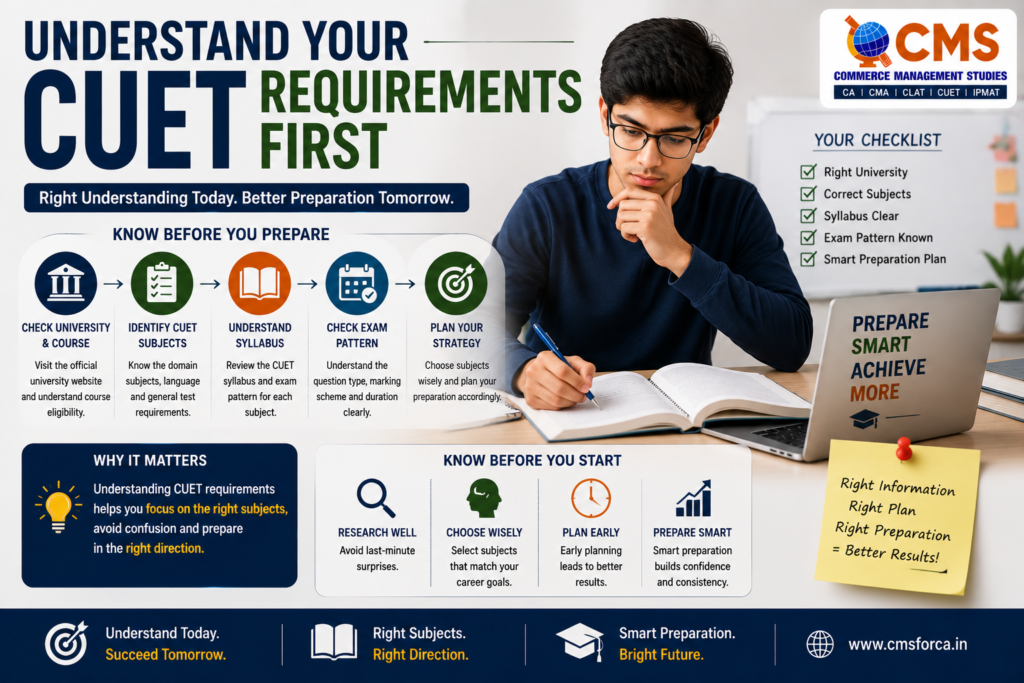
Before creating a study schedule, students should understand which CUET subjects and test components are relevant to the undergraduate programme they are targeting. Requirements can vary depending on the university and programme, so students should refer to the latest official information before finalizing their subject choices and preparation strategy.
Once the requirements are clear, students can divide their preparation into individual subjects and identify the areas that require the most attention. This prevents students from spending excessive time on topics they already understand while leaving important areas insufficiently prepared.

Set Clear and Realistic Goals
A practical study routine begins with achievable goals. Instead of deciding to “study CUET for five hours every day,” students can set specific targets such as completing a particular topic, solving a certain number of questions, or revising a chapter.
Clear goals make progress easier to measure and can help students stay motivated. Weekly goals can be particularly useful because they provide enough flexibility to accommodate Intermediate classes, assignments, tests, and other responsibilities.
Students can divide their goals into:
- Daily learning targets
- Weekly subject targets
- Revision targets
- Practice-question targets
- Mock-test targets
- Areas requiring improvement
The targets should be challenging enough to encourage progress but realistic enough to maintain consistently.
Create a Balanced Daily Schedule
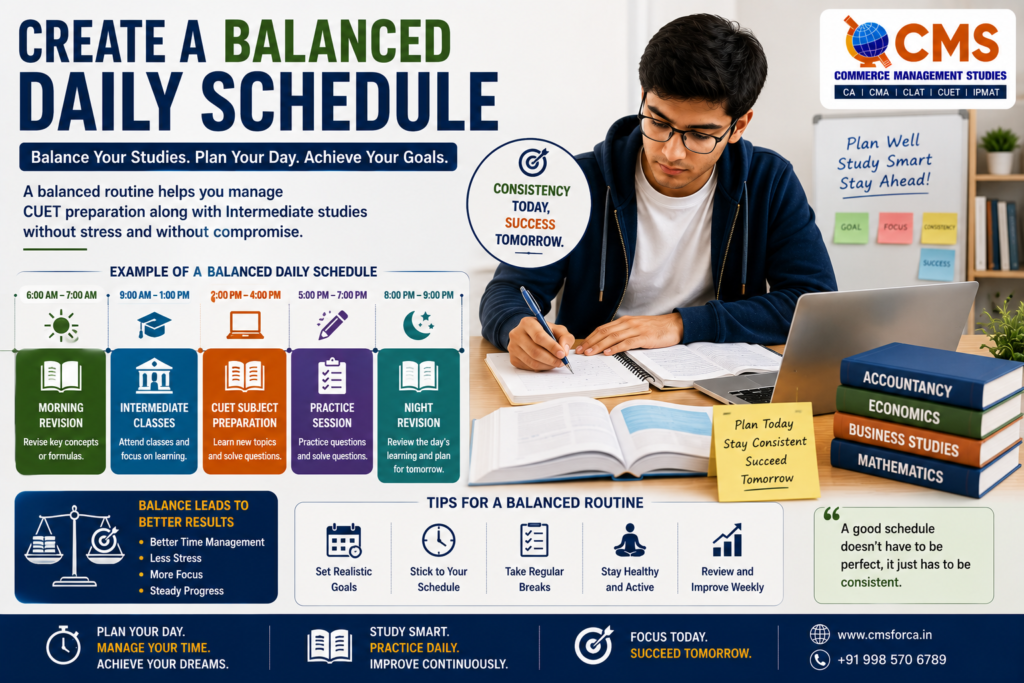
Students preparing for CUET alongside Intermediate should avoid treating entrance preparation and academic studies as completely separate activities. Several concepts studied during Intermediate can also support preparation for relevant CUET subject tests.
A balanced schedule can include dedicated time for regular academic subjects, CUET-focused practice, revision, and rest. The exact number of hours required will vary from student to student, so the emphasis should be on productive study rather than simply counting hours.
For example, a student’s routine could include:
- Morning: Revision or reading
- During classes: Focused academic learning
- Afternoon/evening: Subject preparation and practice
- Night: Short revision and review of the day’s work
Students can adjust this structure according to their school or college schedule and individual concentration patterns.
Prioritize Subjects According to Your Needs
Not every subject requires the same amount of preparation time. Students should identify subjects in which they are confident and those where they frequently make mistakes.
A subject that is already strong may require regular revision and practice, while a weaker subject may need additional conceptual study. This does not mean ignoring strong subjects; instead, it means distributing time according to individual requirements.
A simple approach is to divide subjects into three categories:
- Strong: Focus mainly on revision and practice
- Moderate: Combine concept learning with regular questions
- Needs Improvement: Allocate additional learning and practice time
This approach makes a study plan more personalized and efficient.
Build Strong Conceptual Understanding
Students should not rush into solving large numbers of questions without understanding the underlying concepts. A strong conceptual foundation can make question-solving easier and reduce dependence on memorization.
For subject-based CUET preparation, students can begin by understanding their Intermediate syllabus and identifying the concepts relevant to their selected CUET subjects. After learning a topic, they can solve practice questions to determine whether they can apply what they have studied.
This creates a simple learning cycle:
Learn → Practice → Identify Mistakes → Revise → Practice Again
Following this process regularly can make preparation more effective than repeatedly reading the same material.
Include Daily Practice
Regular practice is one of the most important parts of entrance-examination preparation. Even a short practice session every day can help students remain familiar with question formats and maintain consistency.
Students can begin with topic-wise questions and gradually move toward mixed-question practice. As the examination approaches, they can increase the frequency of timed tests and full-length mock examinations.
Daily practice can include:
- Multiple-choice questions
- Topic-wise exercises
- Previous-style questions
- Reading and comprehension practice
- Numerical problems where applicable
- Timed question sets
The purpose is to gradually improve both accuracy and speed.
Develop a Reading Habit
For students preparing for CUET components involving language and comprehension, regular reading can be particularly useful. Reading improves vocabulary, comprehension, concentration, and the ability to understand information quickly.
Students can read newspapers, informative articles, essays, magazines, and other reliable sources. They should not focus only on reading quickly. Understanding the central idea, identifying important information, and recognizing the meaning of unfamiliar words are equally important.
Even 20–30 minutes of focused reading each day can become a useful part of a long-term preparation routine.
Use Short Revision Sessions
Revision does not always require several hours. Short and frequent revision sessions can help students reinforce information while keeping previously studied concepts active.
Students can revise important formulas, definitions, concepts, vocabulary, notes, and previously attempted questions at regular intervals. Revisiting difficult topics several times can be particularly useful because familiarity often improves with repeated exposure.
A weekly revision session can also help students identify what they have forgotten and what needs additional practice.
Practice Time Management
CUET preparation should eventually include timed practice because knowing the material and completing questions efficiently are two different skills. Students need to become comfortable working within the applicable examination time limits.
Initially, students can focus on accuracy without imposing strict time limits. Once they become comfortable with the concepts, they can introduce timed question sets and gradually work toward complete mock tests.
Time-based practice can help students understand:
- How long they take to answer different questions
- Which question types slow them down
- Whether they spend too much time on difficult questions
- How accurately they work under pressure
- Which sections require more practice
This information can help students develop a more effective examination strategy.
Take Regular Mock Tests
Mock tests provide an opportunity to evaluate preparation in an examination-like environment. They can help students become familiar with the structure of the test and understand how well they perform when working under time constraints.
However, students should not focus only on their scores. The most useful part of a mock test is often the analysis afterward. Students should review incorrect answers, questions that took too long, unanswered questions, and repeated mistakes.
A simple post-test review can answer three questions:
What did I do well?
Where did I lose marks?
What should I change before the next test?
This turns every mock test into a learning opportunity.
Keep a Record of Mistakes
Maintaining a mistake notebook or digital record can make revision more targeted. Students can note down questions they answered incorrectly, concepts they misunderstood, formulas they forgot, or errors they repeatedly make.
The record does not need to contain every question from every test. It should focus on mistakes that provide useful learning points.
Before a mock test or examination, students can review this record to refresh the areas where they have historically struggled. This can be a more efficient use of revision time than going through the entire syllabus repeatedly.
Avoid Overloading the Timetable
A study timetable that looks impressive on paper may not always be practical in real life. Students may create schedules with very long study hours, very short breaks, and unrealistic daily targets. Such routines can become difficult to maintain.
A practical timetable should include breaks, meals, sleep, physical activity, and personal time. Students should also leave some flexibility for unexpected academic work, tests, or changes in their daily schedule.
Consistency is more valuable than following an extremely demanding routine for a few days and then abandoning it.
Balance CUET With Intermediate Studies
Students preparing for CUET alongside Intermediate need to maintain a balance between the two. Intermediate examinations remain important, and the academic concepts learned during Intermediate can also support preparation for relevant CUET subjects.
Instead of treating the two preparations as completely unrelated, students can identify areas where they overlap. A concept studied thoroughly for Intermediate can then be reinforced through CUET-style objective questions and timed practice.
This integrated approach can help students use their study time efficiently while maintaining focus on both academic and entrance goals.
Adjust the Routine as the Examination Approaches
A study routine should not remain exactly the same throughout the preparation period. During the initial stage, students may need more time for understanding concepts and completing the syllabus.
Once the syllabus is substantially covered, the focus can gradually shift toward revision, question-solving, mock tests, and time management. In the final stage, students can spend more time reviewing weak areas and practicing under examination-like conditions.
This gradual transition can make preparation more organized and prevent students from leaving mock tests and revision until the final weeks.
Use Technology Wisely
Digital resources can provide students with access to practice questions, educational videos, online assessments, digital notes, and other learning materials. However, students should use technology selectively rather than allowing it to become a source of distraction.
Students can decide in advance what they want to accomplish during an online study session. Notifications and unrelated applications can be minimized so that digital devices remain learning tools rather than interruptions.
The quality of the study session matters more than the number of online resources collected.
Take Care of Sleep and Health
A practical study routine must include adequate sleep and regular breaks. Students who consistently sacrifice sleep to increase study hours may find it difficult to concentrate, remember information, and maintain productivity.
Short breaks between study sessions can help students return to their work with better concentration. Regular physical activity, balanced meals, hydration, and sufficient rest can also support overall academic performance.
Preparation is a long-term process, so students should build routines they can maintain rather than relying on constant exhaustion.
Review Your Progress Every Week
A weekly review can help students understand whether their study routine is actually working. At the end of each week, students can look at what they planned, what they completed, and what still needs attention.
They can review:
- Topics completed
- Questions practiced
- Mock-test performance
- Repeated mistakes
- Time-management challenges
- Subjects requiring additional attention
- Goals for the following week
This allows the timetable to evolve according to actual progress rather than remaining a fixed schedule that may no longer match the student’s needs.
Integrated CUET Preparation Alongside Intermediate
For students who want to prepare for CUET while continuing their Intermediate education, an integrated approach can provide a structured way to manage both academic and entrance-examination goals. Students can strengthen their subject fundamentals while gradually developing objective-question solving, time management, and examination skills.
At CMS CUET Coaching in Hyderabad, students can pursue MEC or CEC with integrated CUET preparation, allowing them to work toward their Intermediate academic goals while preparing for relevant entrance requirements. A structured learning environment can help students maintain consistency, practice regularly, and review their performance throughout the preparation process.
Conclusion
Creating a practical CUET study routine is less about studying for the maximum number of hours and more about using available time effectively. Students should begin by understanding their examination requirements, setting realistic goals, dividing time between subjects, strengthening concepts, practicing questions, revising regularly, and gradually introducing timed tests and mock examinations.
The most effective routine is one that students can follow consistently while continuing their Intermediate education and maintaining adequate rest. By reviewing progress regularly and adjusting the schedule according to changing needs, students can make their preparation more organized and manageable. With steady effort, focused practice, and a balanced routine, CUET preparation can become a structured part of a student’s academic journey rather than a last-minute challenge.