
Introduction
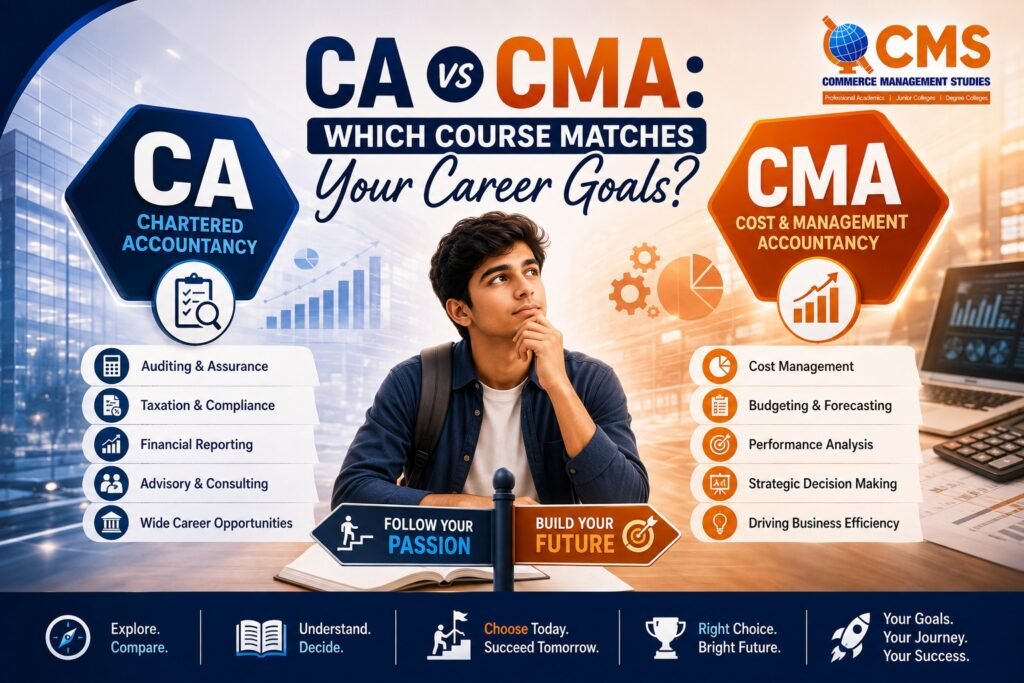
Choosing between Chartered Accountancy (CA) and Cost and Management Accountancy (CMA) is an important decision for students interested in accounting, finance, taxation, business, and management. Both are respected professional qualifications that can lead to rewarding careers, but their areas of focus and professional responsibilities are not exactly the same. Understanding these differences can help students look beyond the popularity of a course and consider which pathway better matches their interests, strengths, and long-term career goals.
CA generally has a strong focus on accounting, auditing, taxation, financial reporting, and financial advisory, while CMA places greater emphasis on cost management, budgeting, financial planning, performance analysis, and strategic decision-making. Both qualifications require dedication, conceptual understanding, and consistent preparation. The right choice therefore depends less on which course is considered “better” and more on the type of work and professional responsibilities a student sees themselves pursuing in the future.
Understanding Chartered Accountancy
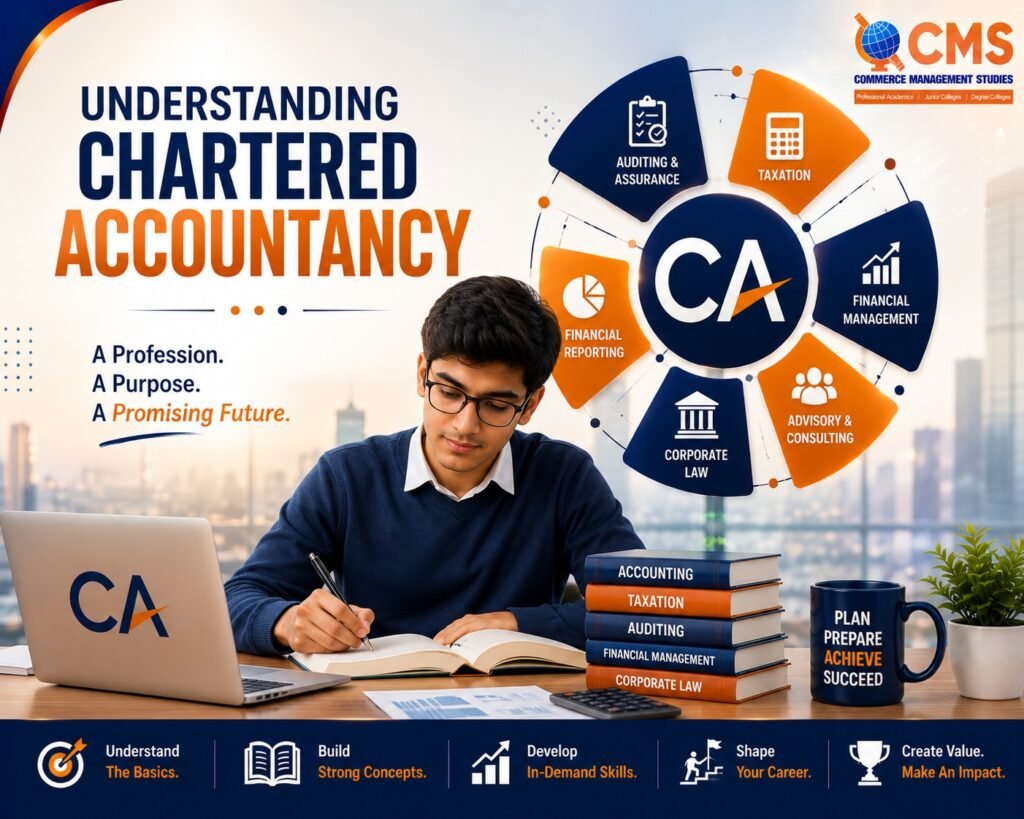
Chartered Accountancy is a professional qualification that prepares students for various areas of accounting, auditing, taxation, financial reporting, and business advisory. Chartered Accountants can work with organizations of different sizes and across different industries, handling financial information and helping businesses meet accounting, taxation, regulatory, and reporting requirements.
The profession can also extend beyond traditional accounting. With experience and specialization, CAs can explore areas such as corporate finance, consulting, risk management, forensic accounting, financial analysis, and business advisory. Students who enjoy understanding financial statements, taxation rules, auditing processes, and the regulatory side of business may find CA particularly aligned with their interests.
Understanding Cost and Management Accountancy
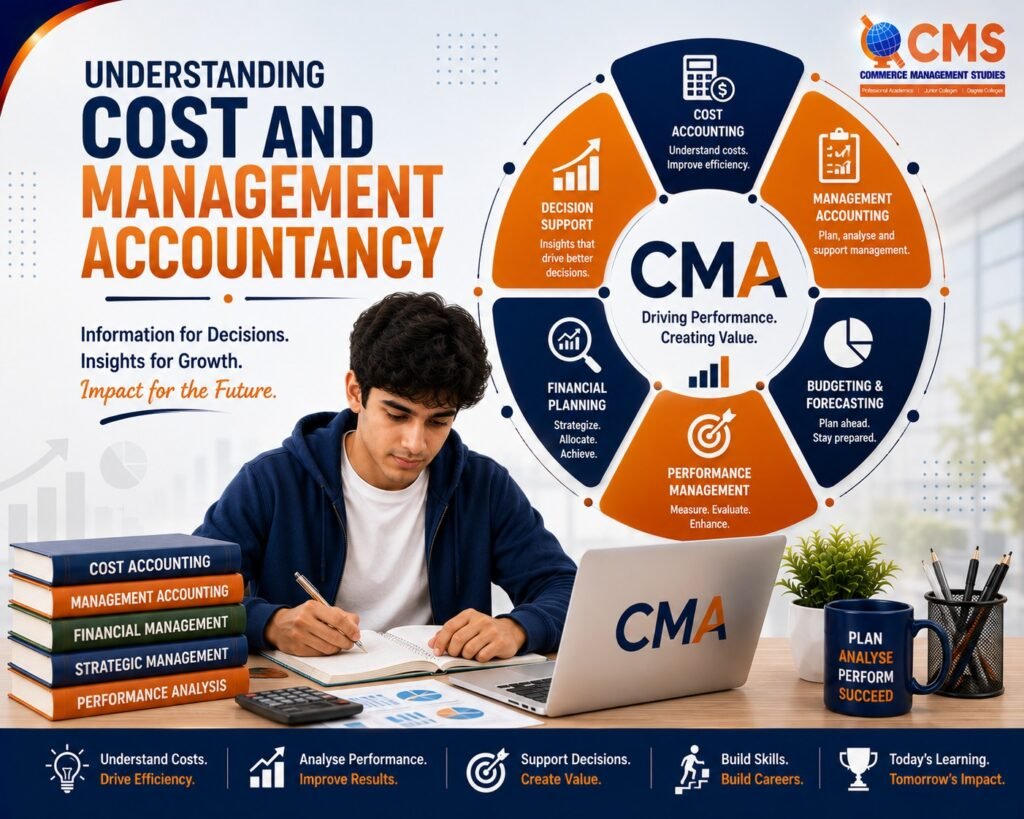
Cost and Management Accountancy focuses on helping organizations understand and manage their costs and financial performance. CMAs work with information related to budgeting, cost analysis, financial planning, performance evaluation, and strategic decision-making. Their work can help management understand where resources are being used and how business operations can become more efficient.
The role of a CMA therefore involves looking beyond the recording of financial transactions. A CMA may analyze costs, evaluate business performance, prepare budgets, support pricing decisions, and provide financial insights that assist management. Students who enjoy analyzing business operations, understanding costs, and using financial information to support decisions may find CMA an interesting professional pathway.
CA vs CMA: The Main Difference
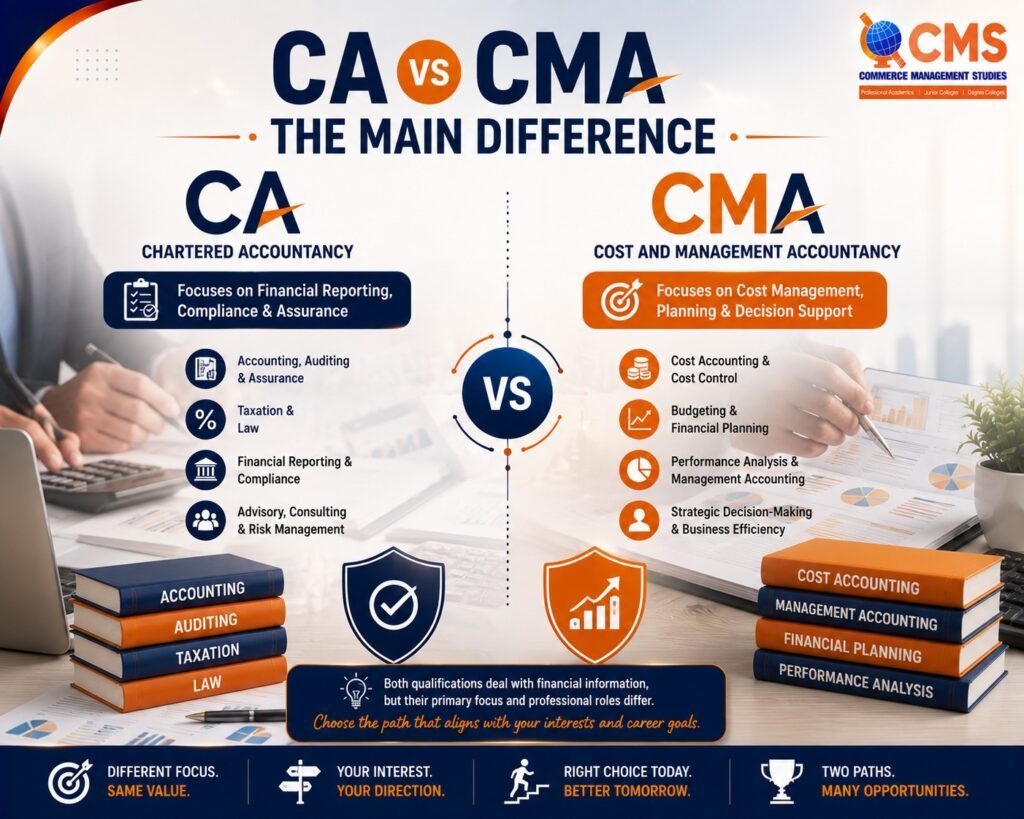
The simplest way to understand the difference is to consider the primary perspective from which each profession approaches financial information. CA has a strong emphasis on accounting, auditing, taxation, financial reporting, and compliance, whereas CMA places greater emphasis on cost management, financial planning, budgeting, performance analysis, and decision support.
There can certainly be overlap between the two professions. Both CA and CMA professionals work with accounting and financial information, and both can develop careers in organizations across various industries. However, the nature of their professional focus can differ, which is why students should examine the subjects, career roles, and work environments associated with each qualification before making a decision.
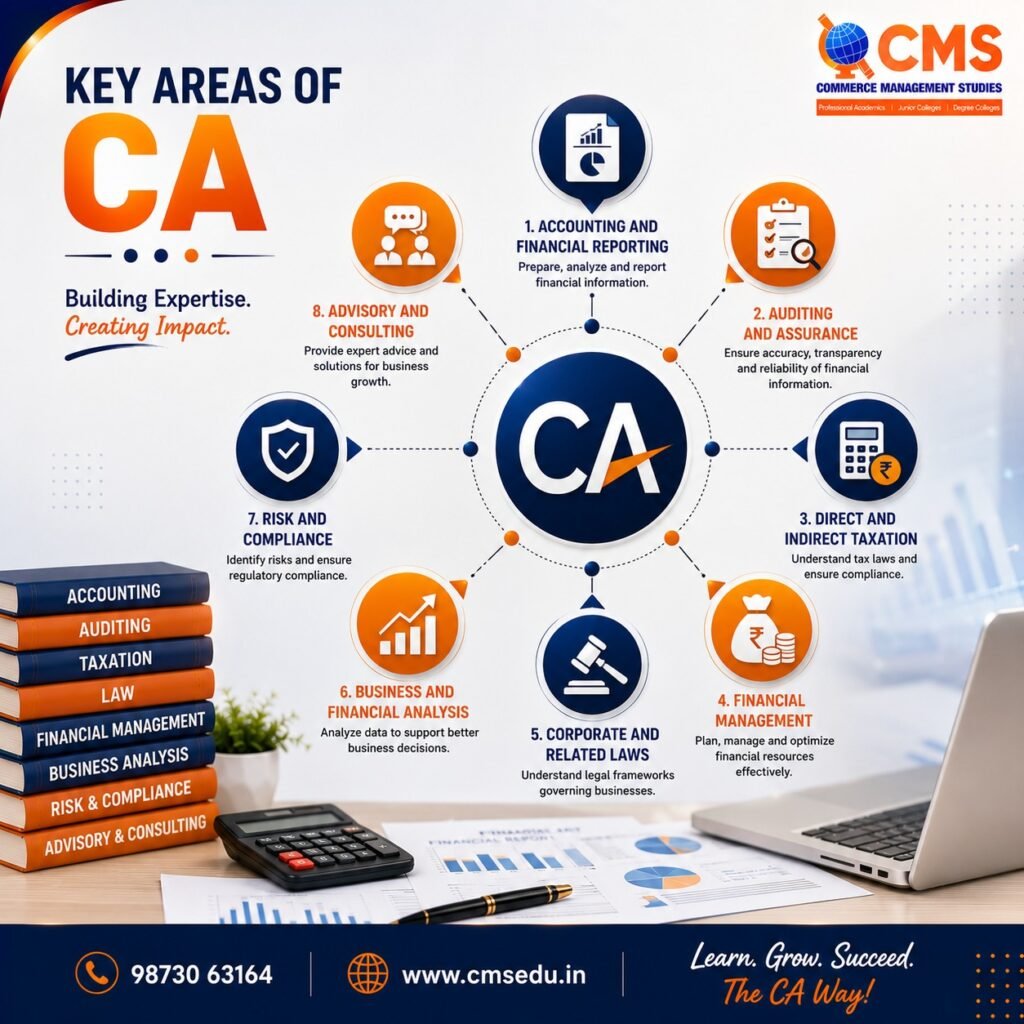
Key Areas of CA
CA covers several areas of professional accounting and finance. Students pursuing the qualification develop knowledge in areas prescribed under the applicable CA education scheme, including accounting, auditing, taxation, financial management, law, and other professional subjects.
Some major areas associated with CA include:
- Accounting and financial reporting
- Auditing and assurance
- Direct and indirect taxation
- Financial management
- Corporate and related laws
- Business and financial analysis
- Risk and compliance
- Advisory and consulting
The combination of these areas allows Chartered Accountants to work across different aspects of financial management and reporting.
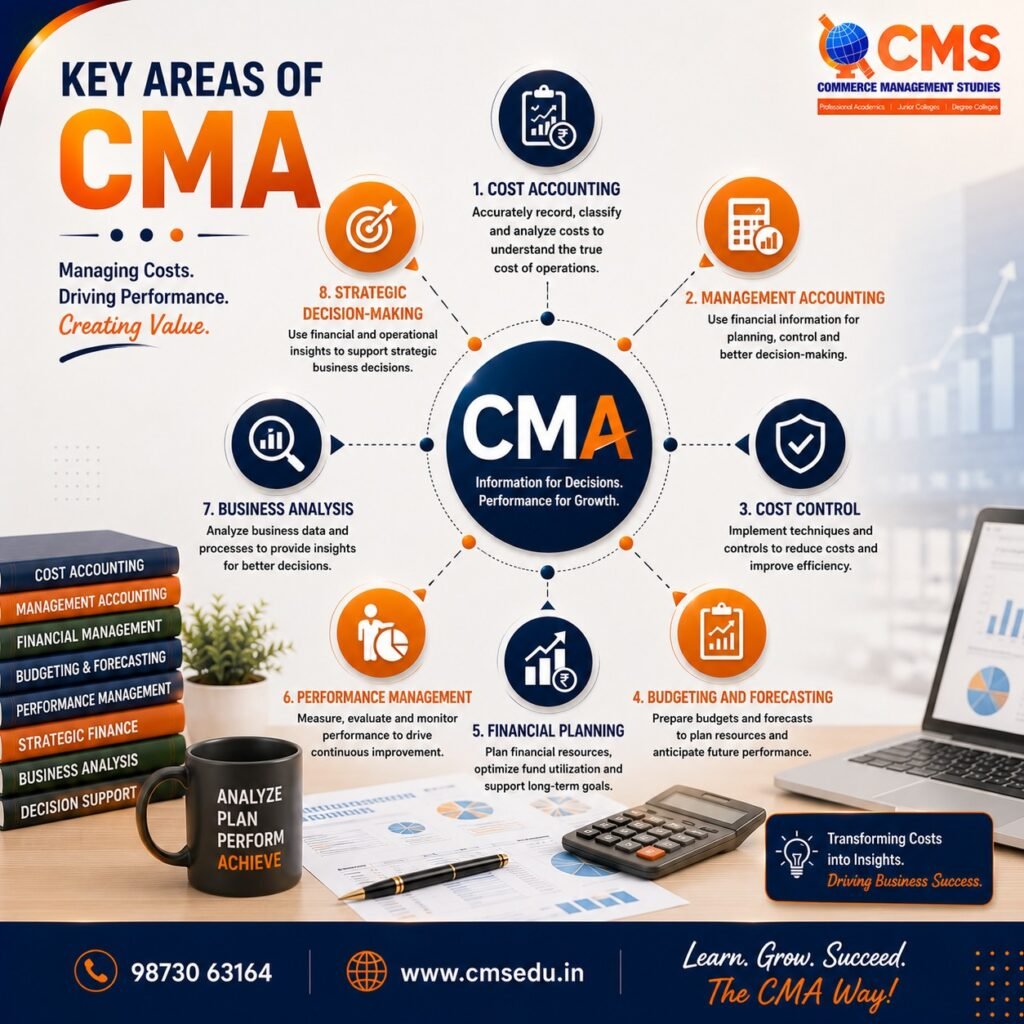
Key Areas of CMA
CMA focuses strongly on understanding costs and using financial information to improve organizational performance. Students develop knowledge in areas such as cost accounting, management accounting, financial management, budgeting, performance analysis, and strategic decision-making.
Some major areas associated with CMA include:
- Cost accounting
- Management accounting
- Cost control
- Budgeting and forecasting
- Financial planning
- Performance management
- Business analysis
- Strategic decision-making
These areas are particularly relevant to organizations that need to monitor costs, improve operational efficiency, evaluate performance, and make financially informed business decisions.
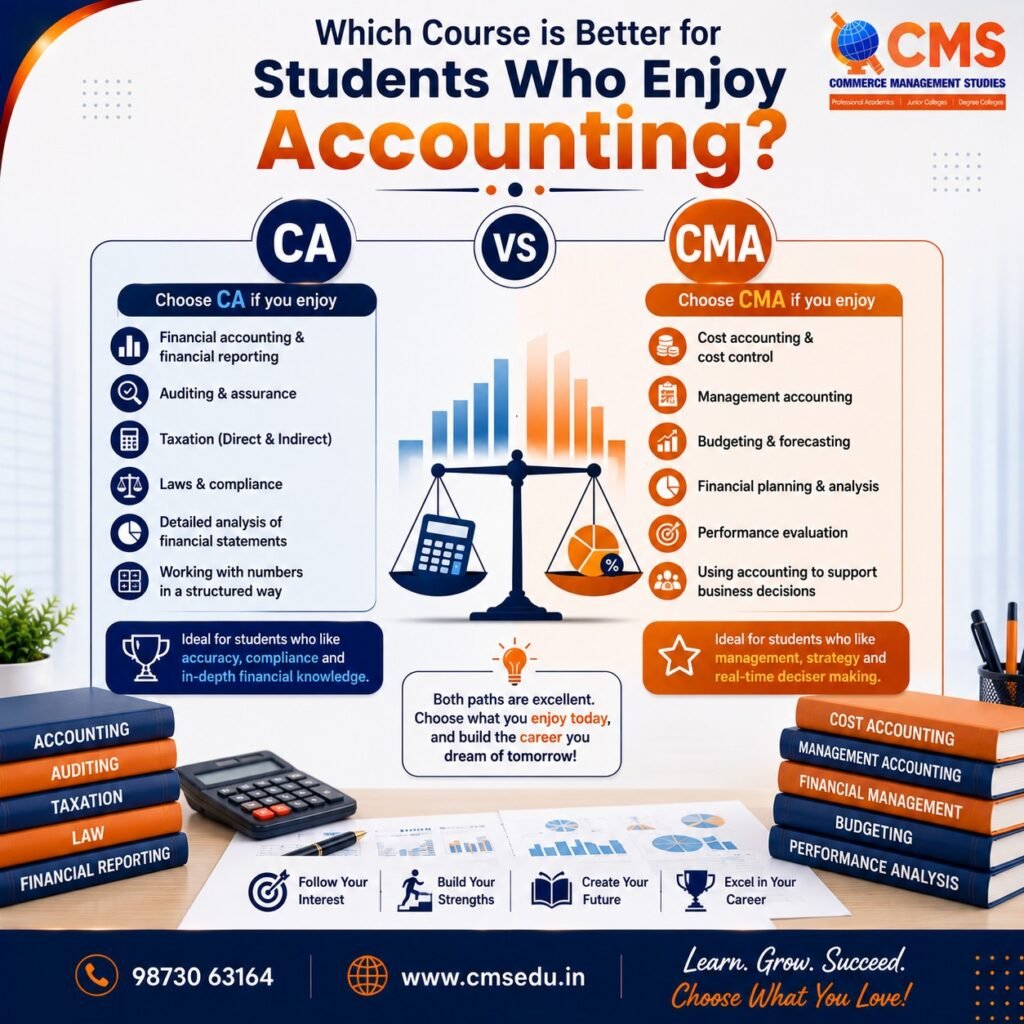
Which Course is Better for Students Who Enjoy Accounting?
Students who enjoy accounting and want to explore areas such as auditing, taxation, financial reporting, and compliance may find CA a natural fit. CA provides extensive exposure to accounting-related concepts and allows professionals to develop expertise in financial reporting and assurance as well as several other areas.
Students who enjoy accounting but are particularly interested in understanding how costs influence business decisions may prefer CMA. Cost accounting and management accounting require students to analyze financial information and understand how organizations can use resources more efficiently. Therefore, students should consider the type of accounting work they find more interesting rather than assuming that one qualification is universally better.
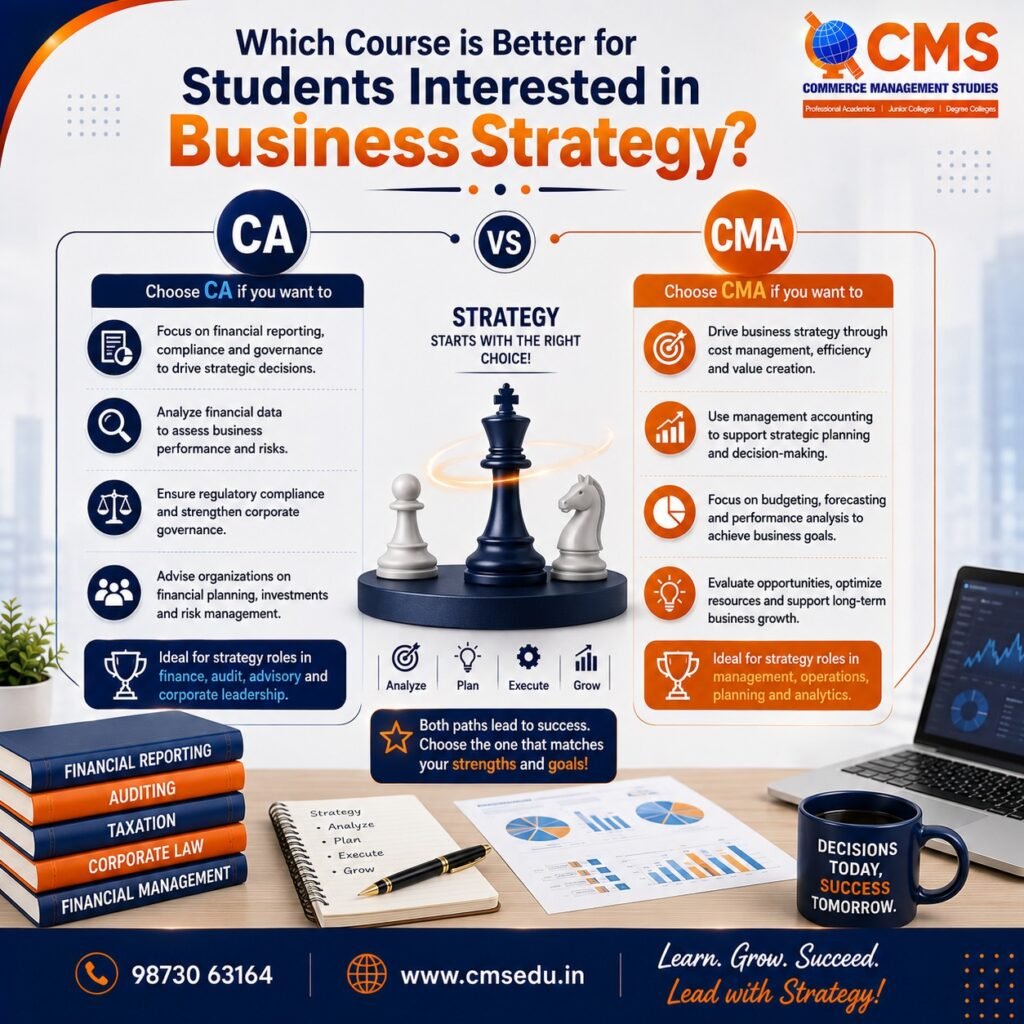
Which Course is Better for Students Interested in Business Strategy?
Both CA and CMA can provide exposure to business and financial decision-making, but CMA has a particularly strong connection with management-oriented financial analysis. CMAs can support management by analyzing costs, preparing budgets, evaluating performance, and providing financial information for strategic decisions.
CA professionals can also work in consulting, corporate finance, advisory, and business strategy roles, particularly as they gain experience and specialization. Therefore, students interested in strategy should look at the specific career roles they want to pursue rather than choosing solely based on the course title.
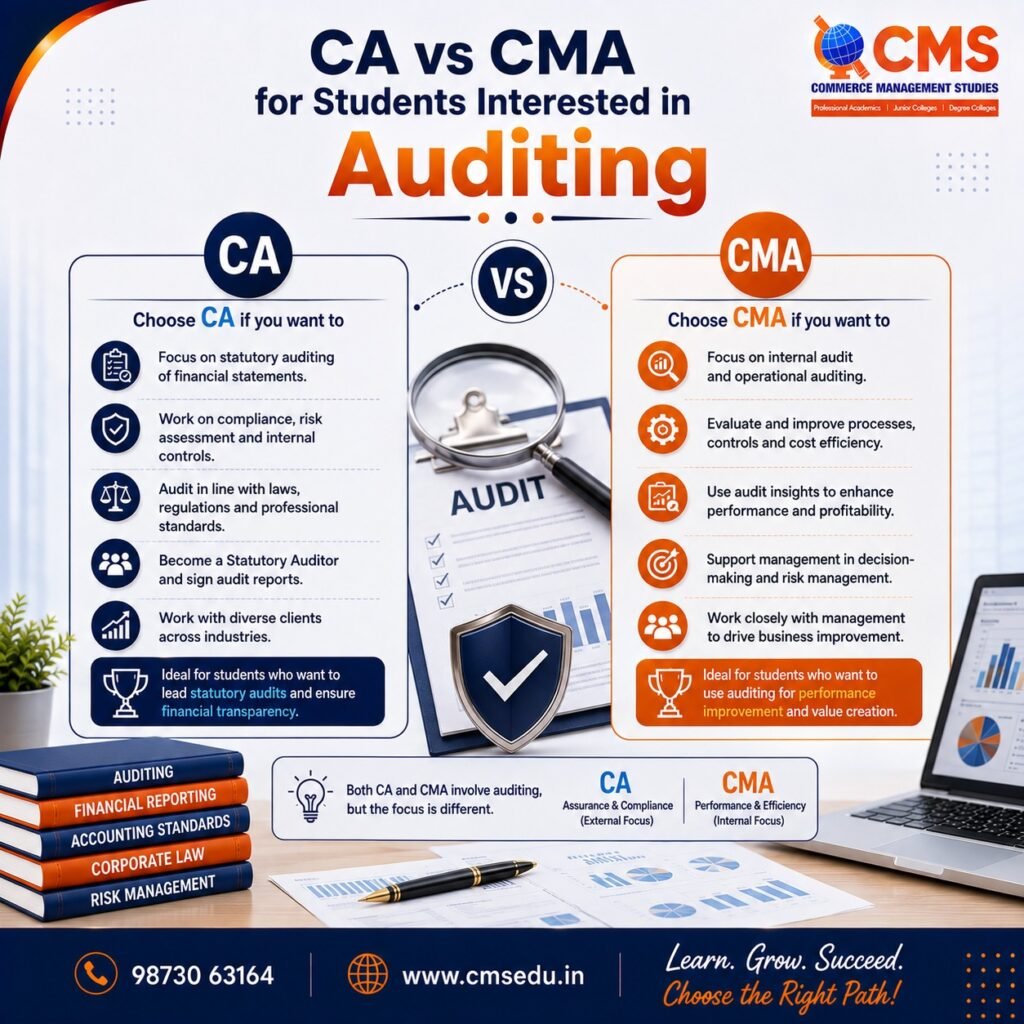
CA vs CMA for Students Interested in Auditing
Auditing is one of the areas strongly associated with Chartered Accountancy. Students who are interested in examining financial records, evaluating financial reporting, understanding controls, and working in assurance-related roles may find CA particularly relevant to their career goals.
CMA has a different primary focus, with greater emphasis on cost and management accounting. While CMAs can work with financial controls, cost systems, performance information, and related areas, students specifically interested in building a career around auditing and assurance should explore the CA pathway carefully.
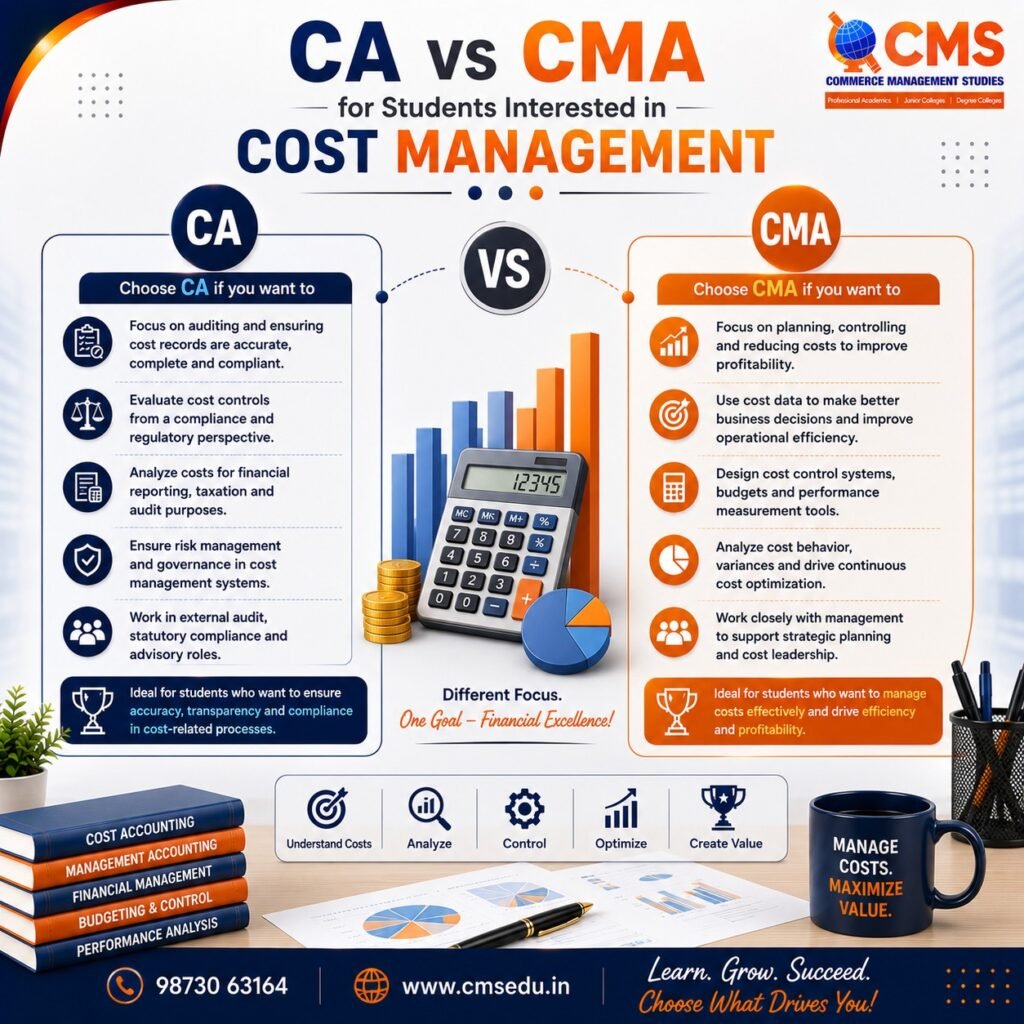
CA vs CMA for Students Interested in Cost Management
Students who are particularly interested in understanding how organizations calculate, monitor, and control costs may find CMA closely aligned with their interests. Cost management involves analyzing expenditure, evaluating production and operational costs, preparing budgets, and identifying opportunities to improve efficiency.
This area can be especially relevant in industries where cost control is critical to profitability. Manufacturing, infrastructure, healthcare, logistics, retail, and many other sectors require professionals who can analyze costs and support efficient resource allocation. Students who enjoy this type of analytical business work may find CMA an attractive career option.
Career Opportunities After CA
A CA qualification can provide opportunities across accounting, auditing, taxation, finance, consulting, and business advisory. The exact career path depends on the individual’s interests, specialization, professional experience, and additional skills developed over time.
Some potential career areas include:
- Auditing and assurance
- Taxation
- Financial reporting
- Corporate finance
- Financial analysis
- Risk management
- Consulting
- Business advisory
- Forensic accounting
- Independent professional practice
The diversity of these roles allows CAs to work in professional firms, companies, financial institutions, public-sector organizations, and other business environments.
Career Opportunities After CMA
CMA professionals can explore careers where financial information is used to improve business performance and support management decisions. Their knowledge of cost management, budgeting, financial planning, and performance analysis can be relevant across a wide range of industries.
Potential career areas include:
- Cost accounting
- Management accounting
- Financial planning and analysis
- Budgeting and forecasting
- Cost control
- Business analysis
- Performance management
- Strategic finance
- Financial consulting
- Management decision support
The growing importance of data-driven business decisions also creates opportunities for professionals who can interpret financial information and convert it into useful business insights.
How MEC Can Support CA and CMA Preparation
Students pursuing MEC, which combines Mathematics, Economics, and Commerce, can develop a foundation that is relevant to both CA and CMA. Mathematics strengthens numerical and analytical thinking, Economics provides an understanding of markets and economic conditions, and Commerce introduces students to accounting and business concepts.
This does not mean that MEC automatically determines which professional qualification a student should choose. Instead, it gives students exposure to several areas that can help them explore both pathways. Students can then decide whether their interests lean more toward auditing, taxation, and financial reporting or toward cost management, budgeting, performance analysis, and strategic financial decision-making.
How CEC Can Support CA and CMA Preparation
CEC, which combines Civics, Economics, and Commerce, can also provide a commerce-oriented foundation for students considering CA or CMA. Commerce introduces accounting and business concepts, while Economics develops an understanding of markets and economic systems. Civics adds knowledge of government institutions and social systems, providing a broader academic perspective.
Students from CEC can also pursue professional qualifications based on their interests and eligibility. The important factor is not simply the Intermediate stream but the student’s willingness to build strong fundamentals, develop numerical and analytical skills, and prepare consistently for the professional course they eventually choose.
Factors to Consider Before Choosing CA or CMA
Students should consider several factors before deciding between CA and CMA. Looking only at salary expectations or general perceptions about a profession may not provide enough information to make a suitable choice. Understanding the actual work involved and identifying the subjects and professional responsibilities that genuinely interest them can lead to a better decision.
Consider the following:
- Which subjects do you enjoy most?
- Are you more interested in auditing and taxation or cost and management?
- Do you enjoy financial reporting and compliance?
- Are you interested in budgeting and business strategy?
- Do you prefer assurance-oriented work or management-oriented analysis?
- What type of work environment interests you?
- Are you willing to commit to a demanding professional qualification?
- What kind of long-term career do you envision?
There is no universal answer because career preferences differ from student to student.
Importance of Choosing Based on Career Goals
CA and CMA should be viewed as professional pathways rather than simply examination courses. The qualification a student chooses can influence the type of subjects they study, the skills they develop, and the professional roles they initially explore. Therefore, students should think about where they want the qualification to take them rather than focusing only on the qualification itself.
A student who wants to work extensively in auditing, taxation, financial reporting, or assurance may find CA more closely aligned with their goals. A student who is more interested in cost analysis, budgeting, performance management, financial planning, and strategic decision-making may find CMA more suitable. Understanding this distinction can make the decision more thoughtful and career-oriented.
Integrated Preparation for CA and CMA
Students who are considering professional qualifications during Intermediate can benefit from understanding both CA and CMA before making a final decision. An integrated academic approach can allow students to strengthen their Intermediate concepts while becoming familiar with the professional subjects and examination requirements associated with their chosen pathway.
At CMS, MEC and CEC students can pursue Intermediate education with integrated preparation for professional pathways such as CA Coaching in Hyderabad and CMA Coaching in Hyderabad. This gives students an opportunity to build strong academic fundamentals while developing the conceptual understanding, analytical ability, and study habits needed for professional education.
Conclusion
CA and CMA are both valuable professional pathways, but they serve different areas of accounting, finance, and business. CA has strong connections with auditing, taxation, financial reporting, assurance, and advisory, while CMA focuses more heavily on cost management, budgeting, financial planning, performance analysis, and management decision-making. There is also considerable overlap between the two, and professionals from either pathway can build diverse careers depending on their interests and experience.
Ultimately, the best choice is the one that matches a student’s interests, abilities, and long-term career goals. Students should take time to understand the subjects, professional responsibilities, examination structure, and career opportunities associated with both qualifications before deciding. With a clear understanding of what each course offers, students can choose a professional pathway with greater confidence and build the skills needed for a successful career in finance and business.