
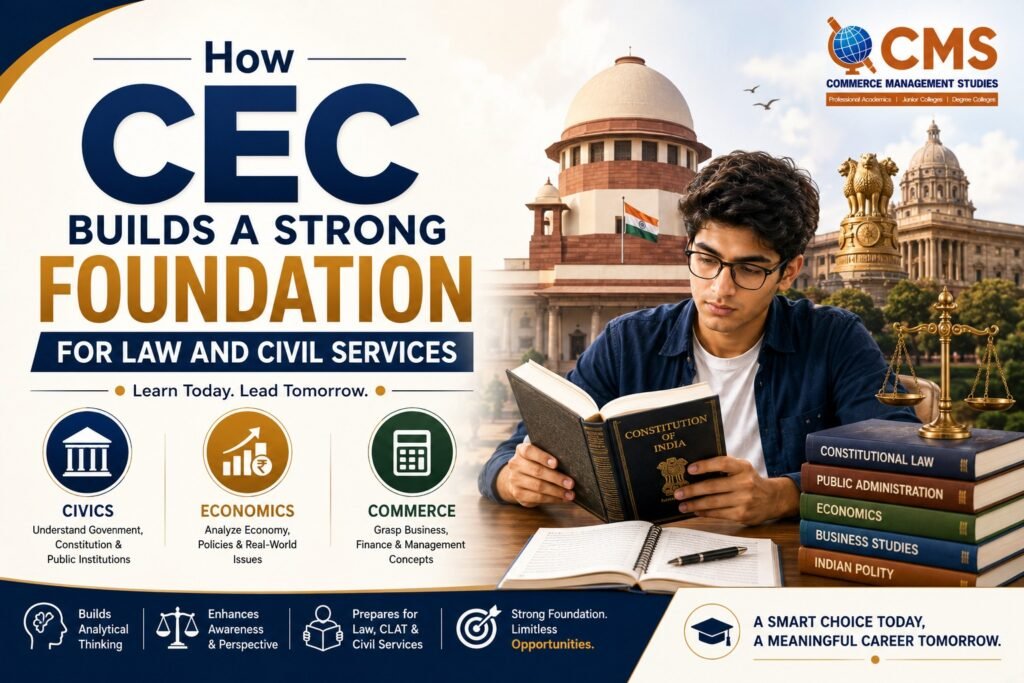
Introduction
Choosing the right academic stream after Class 10 can influence the subjects students study, the skills they develop, and the professional opportunities they can explore later. CEC, which stands for Civics, Economics, and Commerce, is one of the streams that can provide a useful foundation for students interested in careers connected with law, public administration, government services, business, and related fields. The combination of subjects introduces students to how governments function, how economies operate, how businesses are managed, and how different institutions interact with society.
For students considering careers in law or civil services, CEC can provide exposure to several concepts that are relevant to their future studies. Civics introduces students to government, democracy, constitutional principles, and public institutions, while Economics develops an understanding of markets, resources, and economic policies. Commerce adds knowledge of business, accounting, and financial concepts. Together, these subjects can help students develop analytical thinking, awareness of society, and an understanding of how economic and administrative systems function.
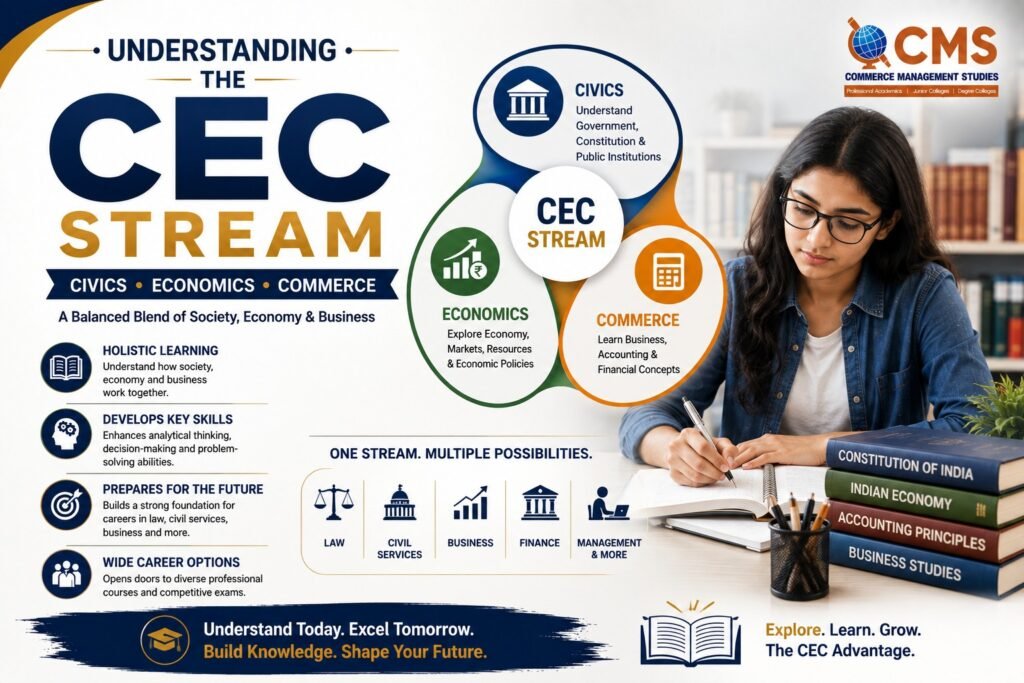
Understanding the CEC Stream
CEC combines Civics, Economics, and Commerce, giving students exposure to social, economic, and business-related concepts. Civics helps students understand government structures, democratic institutions, rights and responsibilities, and the functioning of public administration. Economics introduces concepts such as demand and supply, national income, markets, development, and economic policies, while Commerce provides an introduction to accounting, business activities, and financial management.
This combination creates a broad academic foundation rather than limiting students to one specific area. Students can develop an understanding of how society, government, and businesses are interconnected. Such interdisciplinary knowledge can be useful when studying professional courses and competitive examinations that require candidates to understand issues from multiple perspectives.
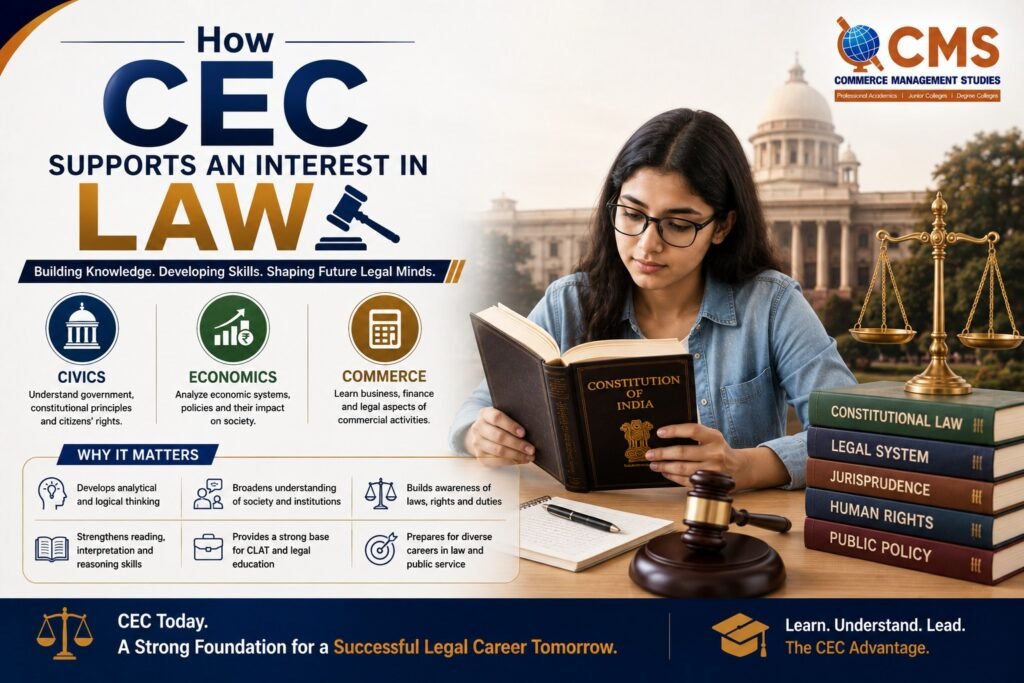
How CEC Supports an Interest in Law
Law is closely connected with society, government, business, economics, and individual rights. Students interested in pursuing legal education need to develop the ability to understand different viewpoints, analyze situations, interpret information, and think logically. The subjects included in CEC can contribute to the development of these abilities by introducing students to social institutions, economic systems, and business practices.
Civics can be particularly useful for students interested in understanding constitutional principles, government institutions, and the relationship between citizens and the state. Economics and Commerce can further broaden this understanding by showing students how financial systems, businesses, markets, and regulations influence society. This background can provide useful context for students who later pursue legal studies through entrance examinations such as CLAT.
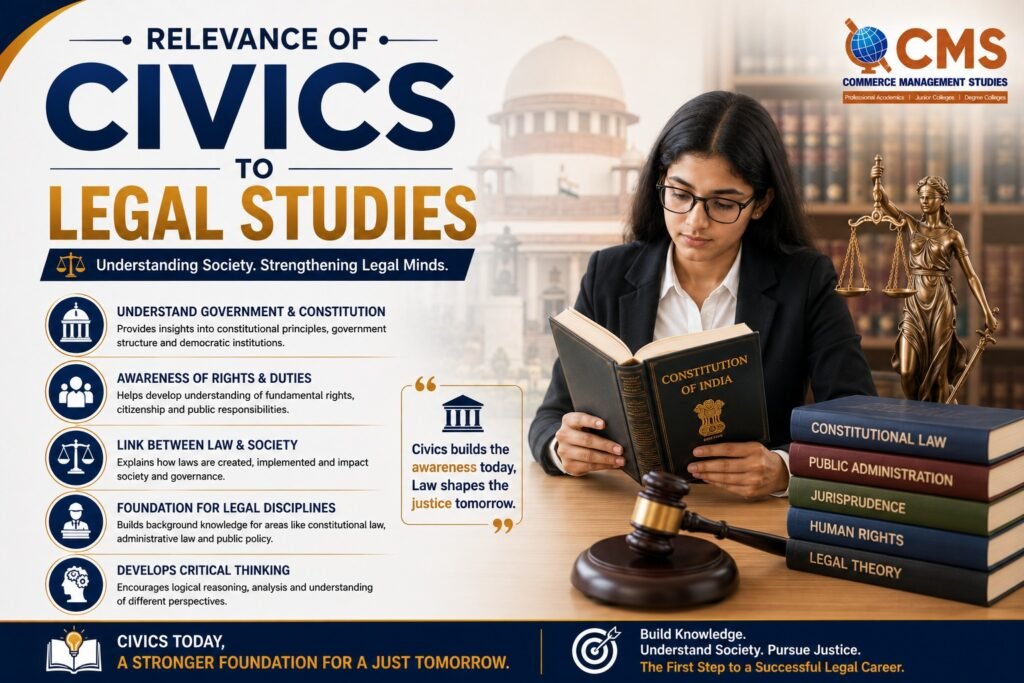
Relevance of Civics to Legal Studies
Civics introduces students to fundamental ideas surrounding democracy, government, citizenship, institutions, and public administration. Students learn about the structure and functioning of government and develop an understanding of how laws and policies influence society. These concepts can create useful background knowledge for students who eventually study constitutional law, administrative law, public policy, or related areas.
Legal education requires students to understand the relationship between law and society. A student who is already familiar with concepts such as constitutional institutions, fundamental rights, governance, and public responsibilities may find it easier to understand some of the broader contexts discussed during legal studies. Civics therefore provides an academic foundation that can complement later learning in law.
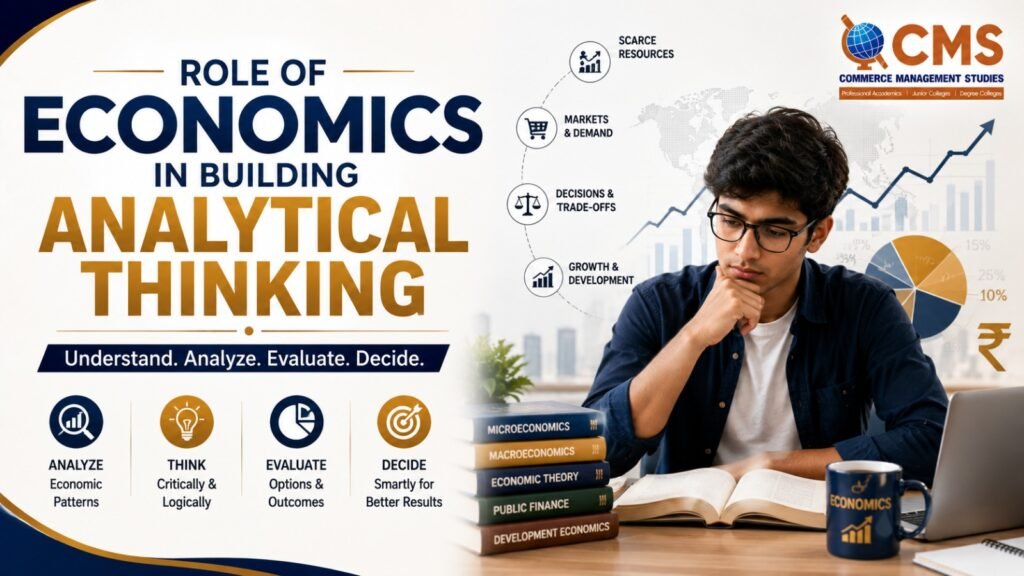
Role of Economics in Building Analytical Thinking
Economics encourages students to understand how individuals, businesses, governments, and markets make decisions about limited resources. Topics involving production, consumption, markets, economic development, taxation, and public policy require students to interpret information and understand relationships between different factors. These concepts encourage students to look beyond individual facts and consider the larger effects of economic decisions.
This analytical approach can be useful for both law and civil services. Legal professionals frequently deal with business regulations, taxation, contracts, competition, and economic policies, while civil servants work with government programmes, budgets, development policies, and economic issues. A basic understanding of economics can therefore help students appreciate the practical impact of policies and regulations on individuals and organizations.
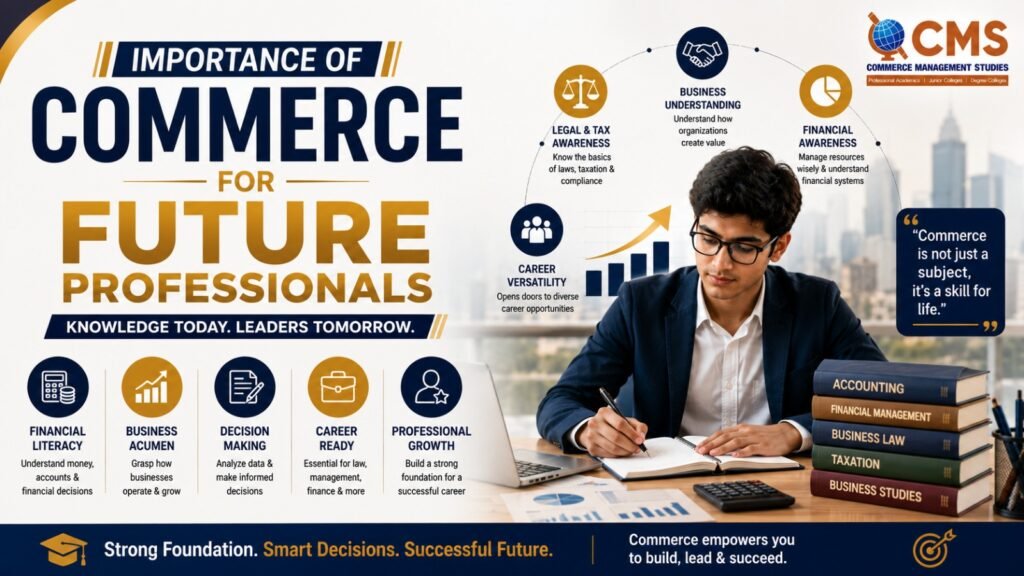
Importance of Commerce for Future Professionals
Commerce introduces students to the fundamental principles of accounting, business, finance, and commercial activities. Understanding how organizations manage money, record transactions, generate revenue, and control expenses can be valuable for students entering several professional fields. Even students who eventually choose law or public administration can benefit from having a basic understanding of financial and business concepts.
For future legal professionals, commerce knowledge can be particularly relevant in areas such as corporate law, taxation, banking law, insolvency, financial regulation, and commercial contracts. For students interested in government services, an understanding of business and financial concepts can also help them appreciate how government policies influence industries, businesses, employment, and economic development.
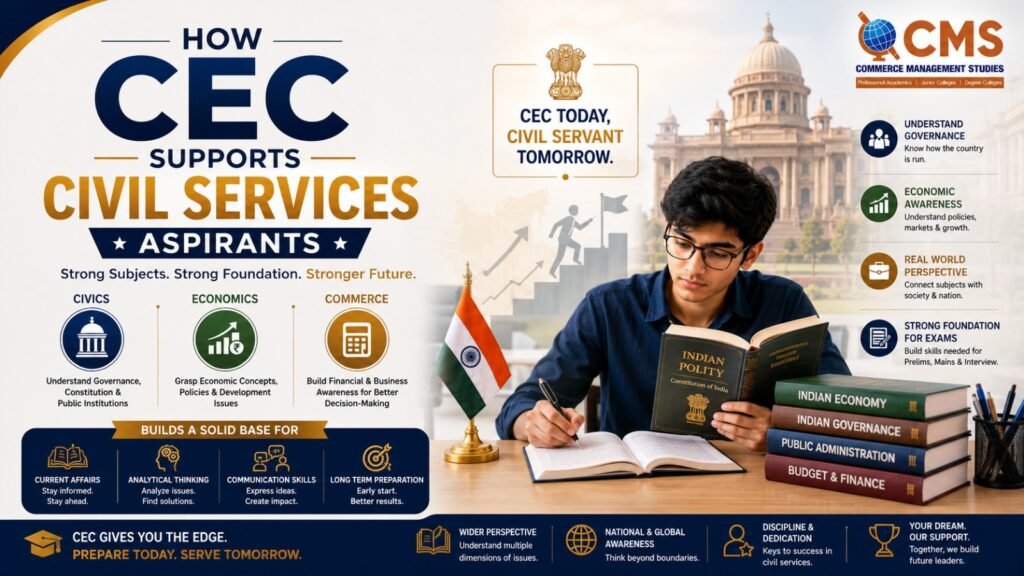
How CEC Supports Civil Services Aspirants
Civil services examinations require candidates to develop broad awareness of society, governance, economics, history, geography, current affairs, and public administration. Although preparing for civil services requires extensive study beyond Intermediate-level subjects, CEC can provide useful early exposure to some areas that students may encounter later in their preparation.
Civics helps students understand government and public institutions, while Economics introduces them to important economic concepts and policy-related issues. Commerce provides additional awareness of financial and business systems. This combination can encourage students to develop an interest in current affairs and public issues from an early stage, which can become valuable as they progress toward competitive examinations.
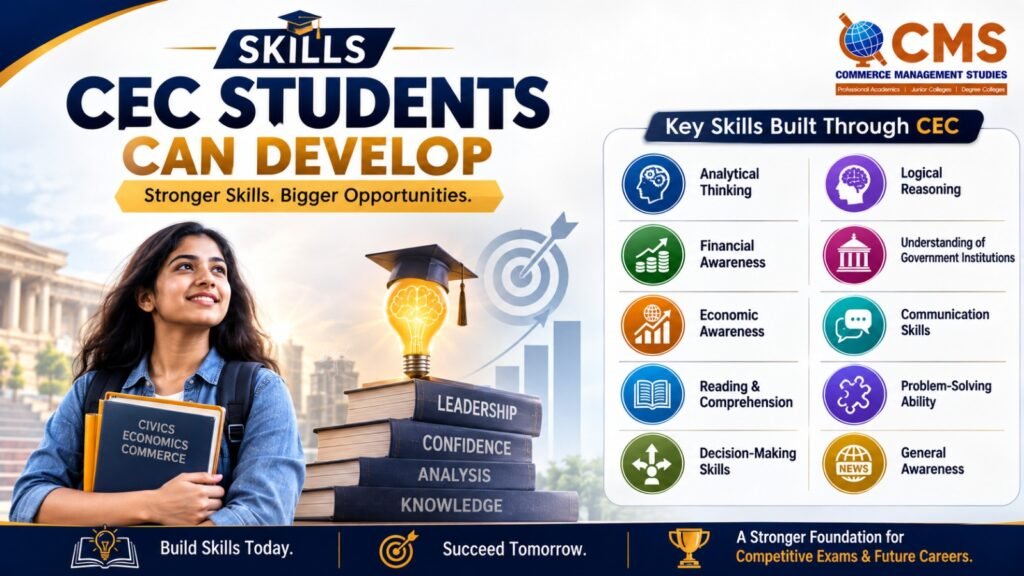
Skills CEC Students Can Develop
The value of CEC is not limited to the information contained in individual subjects. The stream can also help students develop transferable skills that are useful across professional courses and competitive examinations. Reading, interpretation, numerical understanding, logical analysis, and awareness of social and economic issues can all contribute to stronger academic performance.
Some important skills students can develop through CEC include:
- Analytical thinking
- Logical reasoning
- Financial awareness
- Understanding of government institutions
- Economic awareness
- Communication skills
- Reading and comprehension
- Problem-solving ability
- Decision-making skills
- General awareness
These skills can provide a useful foundation for students who later pursue professional qualifications, entrance examinations, or undergraduate programmes.
CEC and CLAT Preparation
Students interested in pursuing law can consider CLAT as one of the major entrance examinations for undergraduate law programmes. CLAT assesses abilities including English language, current affairs, legal reasoning, logical reasoning, and quantitative techniques. While Intermediate subjects alone cannot replace dedicated CLAT preparation, the skills developed through CEC can complement entrance-examination preparation.
Regular exposure to civics and economics can encourage students to take an interest in government, public policy, economic developments, and current affairs. Commerce can strengthen numerical and analytical understanding, while consistent reading and discussion of social issues can improve comprehension. Students still need structured CLAT preparation, practice, mock tests, and examination-specific strategies to perform effectively.
CEC and Long-Term Civil Services Preparation
Civil services preparation is a long-term process that requires extensive knowledge across multiple disciplines. Students cannot rely solely on their Intermediate subjects to prepare for these examinations. However, developing a habit of reading, understanding public issues, following current events, and analyzing government policies at an early stage can provide a valuable foundation for future preparation.
Students interested in civil services can gradually develop these habits alongside their regular academics. Reading reliable newspapers, understanding important government initiatives, following economic developments, and learning about constitutional institutions can help them become more aware of national and international issues. Over time, these habits can contribute to the broad perspective required for public service careers.
Importance of Early Career Planning
Students do not need to finalize their entire professional career immediately after choosing CEC. However, understanding possible career pathways early can help them make informed academic decisions. A student interested in law may gradually explore CLAT and legal education, while another student interested in public administration may begin developing an interest in civil services and related subjects.
Early awareness also allows students to identify the skills they need to develop. Instead of preparing only immediately before an entrance examination, students can gradually improve their reading habits, communication skills, analytical thinking, and general awareness. This approach can make the transition from Intermediate education to professional or competitive examinations more organized.
The Role of Integrated Learning
Students pursuing professional courses alongside Intermediate education need to manage their academic subjects and entrance-examination preparation effectively. An integrated learning approach can help students build their Intermediate-level knowledge while simultaneously developing skills required for future professional courses and competitive examinations.
At CMS CEC Coaching in Hyderabad, CEC students can pursue their Intermediate education alongside integrated preparation for professional pathways such as CLAT and other competitive examinations. A structured academic environment, regular assessments, practice, and guidance can help students strengthen their fundamentals while gradually preparing for their future career goals.
Conclusion
CEC can provide a broad academic foundation for students interested in law, civil services, public administration, business, and several other professional fields. The combination of Civics, Economics, and Commerce introduces students to government institutions, economic systems, financial concepts, and business activities. These areas of knowledge can help students develop a wider understanding of how society and organizations function while strengthening analytical and communication skills.
However, choosing CEC is only the beginning of a student’s career journey. Students interested in law or civil services must continue developing their knowledge through dedicated preparation, reading, practice, and continuous learning. With early career awareness and a disciplined approach to academics, CEC students can build a strong foundation and explore diverse professional opportunities that align with their interests and long-term goals.