
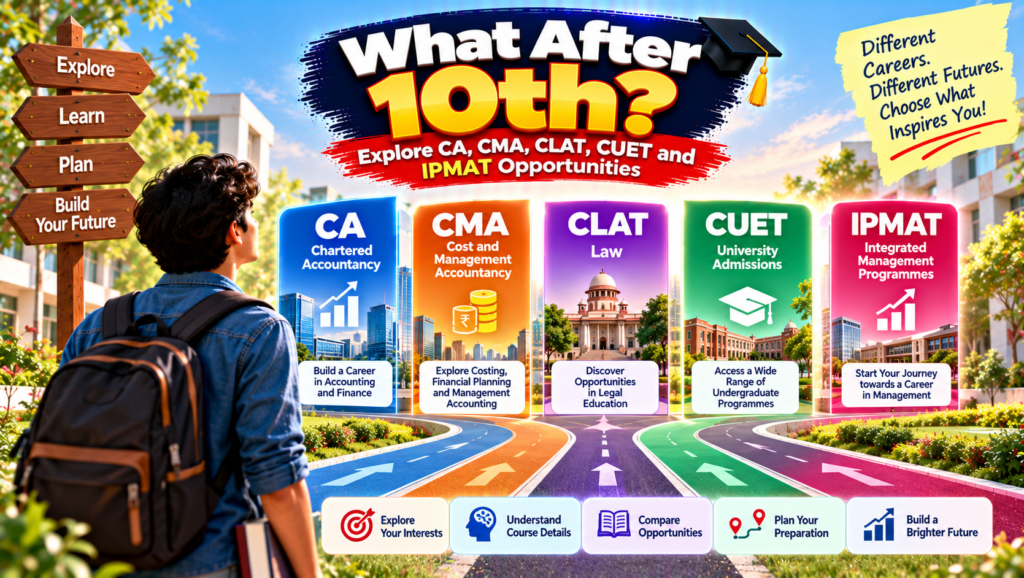
Completing Class 10 marks the beginning of an important stage in a student’s academic journey. Along with choosing an Intermediate stream, students can start exploring the professional courses and entrance examinations that may shape their future education and career opportunities. Understanding these options early can help students identify their interests, learn about eligibility requirements and plan their studies more effectively. Rather than waiting until Class 12 to think about the next step, students can use their Intermediate years to build subject knowledge and prepare for their preferred pathways.
Among the options students can explore are Chartered Accountancy (CA), Cost and Management Accountancy (CMA), the Common Law Admission Test (CLAT), the Common University Entrance Test (CUET) and the Integrated Programme in Management Aptitude Test (IPMAT). Each follows a different route and serves different academic or professional goals. At CMS, students can explore MEC, CEC and ACE Intermediate streams alongside relevant integrated coaching programmes, helping them connect their current studies with their future aspirations.

Why Should Students Explore Career Pathways After 10th?
Choosing an Intermediate stream is an important decision, but understanding what comes after it can make that choice more meaningful. Students who explore career pathways early can identify the subjects they need to focus on, understand the entrance examinations relevant to their goals and make a realistic preparation plan. This also gives them time to discuss their options with parents, teachers and academic counsellors before making important decisions.
Early exploration does not mean that students must finalise their entire career immediately. Interests may change as they learn more about different subjects and professions. The purpose is to understand the available opportunities, compare the requirements and develop a clear direction for the next two years. Students should also remember that eligibility criteria differ across courses and institutions, so they need to verify the official requirements before selecting a specific pathway.
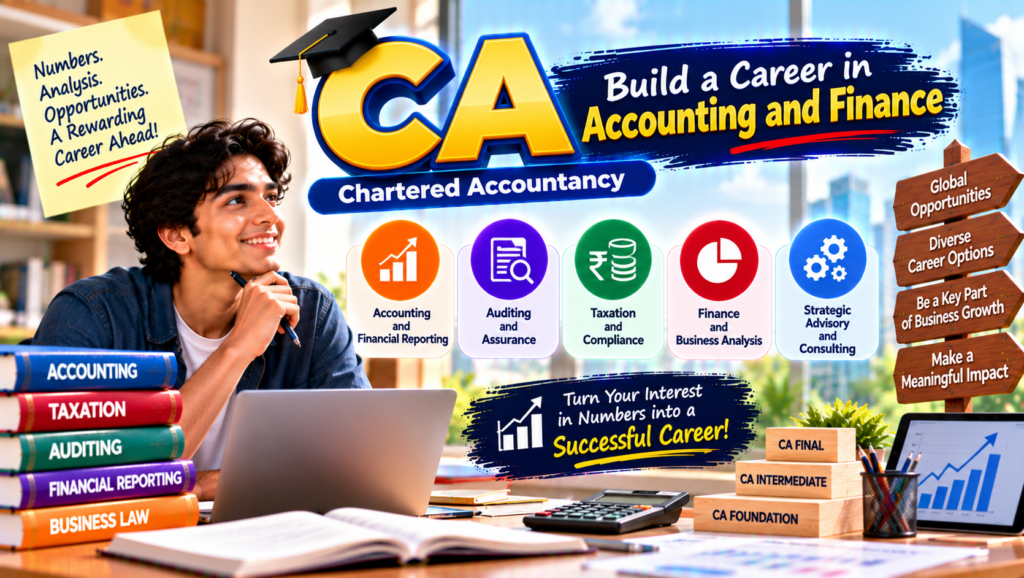
CA: Build a Career in Accounting and Finance
Chartered Accountancy is a professional qualification for students interested in accounting, auditing, taxation, financial reporting and related areas. The CA pathway offered by the Institute of Chartered Accountants of India (ICAI) includes Foundation, Intermediate and Final stages, along with applicable practical training and other requirements. Students who enjoy working with numbers, analysing financial information and understanding how businesses manage their finances may find this pathway worth exploring.
Students can begin learning about CA during Intermediate and develop a stronger understanding of commerce and accounting concepts. They should become familiar with the examination structure, registration requirements and preparation expectations before planning their studies. CA preparation requires consistency, conceptual understanding and regular practice, so learning about the qualification early can help students make informed decisions about their future.
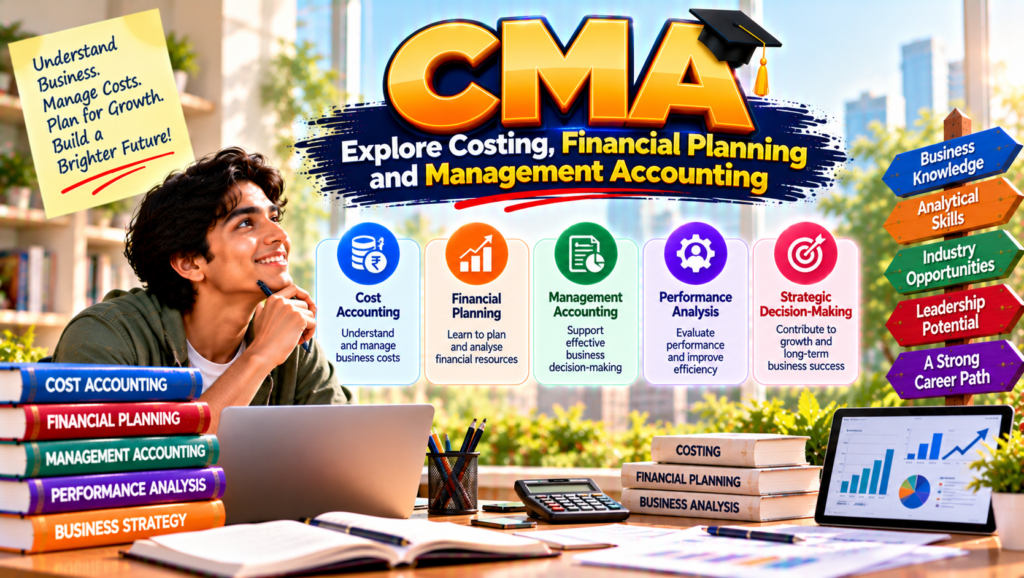
CMA: Explore Costing, Financial Planning and Management Accounting
Cost and Management Accountancy is a professional qualification offered by the Institute of Cost Accountants of India (ICMAI). It focuses on areas such as cost accounting, management accounting, financial planning, performance analysis and business decision-making. Students interested in understanding how organisations manage costs, improve efficiency and use financial information to plan business activities may wish to explore the CMA pathway.
The CMA course has Foundation, Intermediate and Final stages, subject to the applicable eligibility and exemption rules. Students can use their Intermediate years to learn about the qualification, understand its syllabus and develop effective study habits. Exploring CMA alongside their academic subjects can help students assess whether management accounting and financial analysis match their interests before committing to a longer professional qualification.
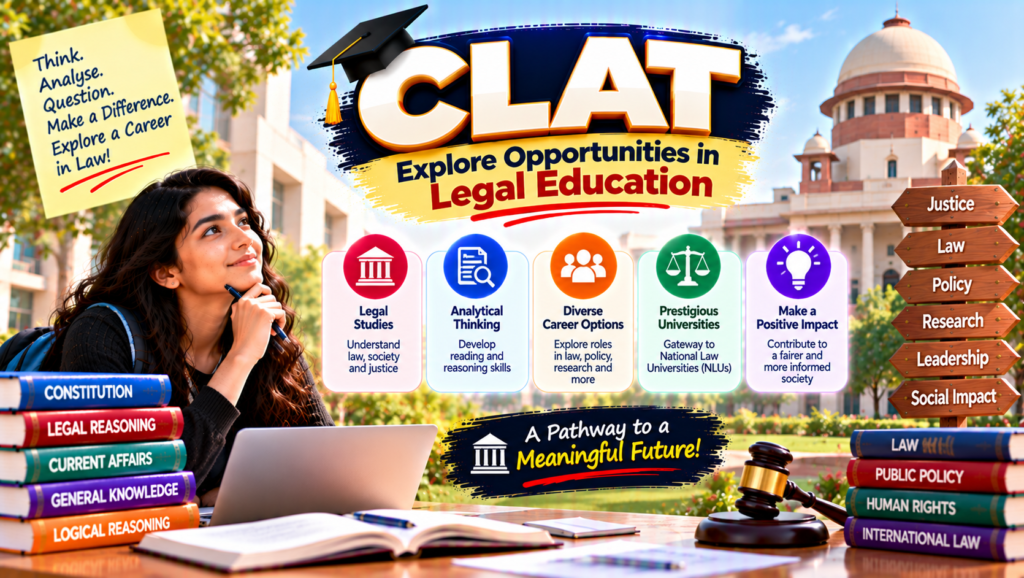
CLAT: Explore Opportunities in Legal Education
The Common Law Admission Test (CLAT) is a national-level entrance examination used by participating institutions for admission to eligible law programmes, including undergraduate law programmes offered by participating National Law Universities. It is relevant to students who are interested in legal studies, public policy, legal research, advocacy and related fields. Students who enjoy reading, analysing information, understanding arguments and examining social issues may find law an interesting area to explore.
CLAT preparation generally involves areas such as English language, current affairs and general knowledge, legal reasoning, logical reasoning and quantitative techniques. Students interested in this pathway can begin developing reading comprehension, analytical thinking and awareness of current events during Intermediate. Since admission requirements and examination arrangements may change, students should check the official CLAT notification for the relevant admission year and confirm the eligibility criteria for their intended programme.

CUET: Explore Undergraduate Programmes at Participating Universities
The Common University Entrance Test (CUET-UG) provides an entrance route for undergraduate admissions at participating universities and other institutions that use the examination. It can be useful for students who want to compare eligible degree programmes across different institutions rather than relying on a single admission route. Depending on the university and course, students may explore programmes in commerce, economics, humanities, social sciences and other disciplines.
Preparing for CUET requires students to understand the subject requirements and admission rules of their target universities. The examination subjects selected should align with the eligibility criteria of the programmes they wish to pursue. Students can start researching potential degrees during Intermediate, strengthen their relevant academic subjects and practise examination-style questions as part of their preparation. Checking the official CUET-UG information bulletin and each university’s admission requirements is essential because participating institutions may have different subject and eligibility rules.
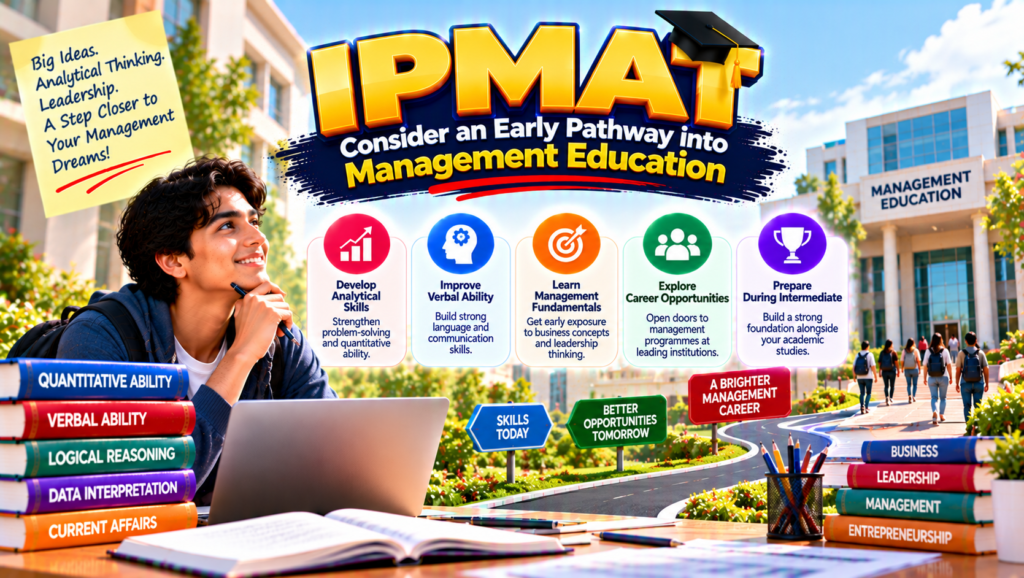
IPMAT: Consider an Early Pathway into Management Education
The Integrated Programme in Management Aptitude Test (IPMAT) refers to entrance examinations associated with admission to certain integrated management programmes, including programmes offered by institutions such as the Indian Institutes of Management. These programmes combine undergraduate-level learning with further management education through an integrated course structure. Students interested in business, leadership, entrepreneurship, economics and organisational decision-making may want to learn more about this option.
IPMAT preparation commonly involves quantitative ability and verbal ability, although the examination pattern and selection process vary by institution. Students interested in this pathway can begin developing mathematical reasoning, problem-solving skills, vocabulary and reading comprehension during Intermediate. Because institutions may conduct separate examinations or use different admission criteria, students should check the official admission information of each institution they intend to apply to. MEC students considering IPMAT should pay particular attention to the quantitative skills required and plan their preparation alongside their regular academic work.
CA, CMA, CLAT, CUET or IPMAT: How Do You Choose?
These options serve different purposes, so choosing between them starts with understanding the type of learning and future work that interests you. CA and CMA are professional qualifications focused on accounting, finance and related business functions. CLAT is an entrance examination for eligible law programmes, while CUET-UG supports undergraduate admissions at participating institutions. IPMAT is associated with admission to certain integrated management programmes. Comparing these differences can help students narrow their choices based on their strengths and long-term plans.
Students can consider the following questions when evaluating their options:
- Do you enjoy accounting and finance? Explore the subjects, examination stages and career areas associated with CA and CMA.
- Are you interested in law and public affairs? Learn about CLAT, legal education and the reading and reasoning skills involved.
- Do you want to compare undergraduate programmes across universities? Research CUET-UG and the admission requirements of your preferred institutions.
- Are you interested in business and management education? Explore integrated management programmes and the relevant IPMAT or institution-specific entrance requirements.
- Which subjects suit your strengths? Consider your comfort with numerical problem-solving, reading comprehension, reasoning, economics and commerce.
- What are the eligibility requirements? Check the required subjects, qualifying examinations, age rules where applicable and admission procedures for each course.
Students do not need to prepare for every examination at the same time. Some options may align more closely with their interests and subject strengths than others. Selecting a manageable preparation plan can help students balance Intermediate academics with entrance examination preparation and avoid spreading their time across too many unrelated goals.
Which Intermediate Stream Can Support These Pathways?
MEC, CEC and ACE provide different subject combinations, and understanding those differences can help students identify a suitable starting point. MEC includes Mathematics, Economics and Commerce, making it an option for students interested in numerical reasoning, business concepts and economic analysis. CEC combines Civics, Economics and Commerce, while ACE focuses on Accounting, Commerce and Economics in programmes that offer this combination. Students should confirm the exact curriculum with their chosen college.
The relevance of each stream depends on the intended course and its eligibility rules. MEC students can explore integrated preparation for CA, CMA, CLAT, CUET and IPMAT. CEC and ACE students can explore integrated preparation for CA, CMA, CLAT and CUET. Students should check the subject and admission requirements of their target institutions, particularly where a specific subject combination or entrance examination is required. Choosing a stream based on personal interests and future academic goals is more useful than assuming that one option is automatically best for everyone. If you are looking for the best institute offering CA Coaching, then look no further than CMS Top CA Coaching Institute in Hyderabad.
How Integrated Coaching Can Help During Intermediate
Preparing for board examinations and a competitive entrance examination at the same time requires planning, regular study and a realistic timetable. An integrated coaching programme can bring relevant preparation into a student’s academic routine, helping them work towards their Intermediate results while developing the knowledge and skills required for their selected examination. Regular practice, mock tests and performance feedback can also help students recognise areas that need improvement.
CMS offers MEC, CEC and ACE Intermediate options with integrated coaching pathways aligned with relevant professional courses and entrance examinations. MEC students can explore CA, CMA, CLAT, CUET and IPMAT preparation, while CEC and ACE students can explore CA, CMA, CLAT and CUET preparation. When evaluating a programme, students and parents should look at the syllabus coverage, teaching approach, assessment schedule, practice resources and academic support available. The right programme should help students maintain a balance between board examinations and entrance preparation rather than creating an unmanageable workload.
Conclusion
The period after Class 10 is an opportunity to understand different educational pathways and begin planning for the future. CA, CMA, CLAT, CUET and IPMAT each serve distinct purposes, from professional qualifications in accounting and management accounting to entrance routes for law, undergraduate degrees and integrated management programmes. Learning about their requirements during Intermediate can help students make informed choices and prepare with a clearer sense of direction.
The best path depends on a student’s interests, academic strengths, eligibility and long-term goals. By comparing the options, researching official admission requirements and choosing a suitable Intermediate stream, students can build a strong foundation for their next stage of education. With its MEC, CEC and ACE streams and relevant integrated coaching options, CMS can be part of that planning process as students work towards their chosen academic goals.