
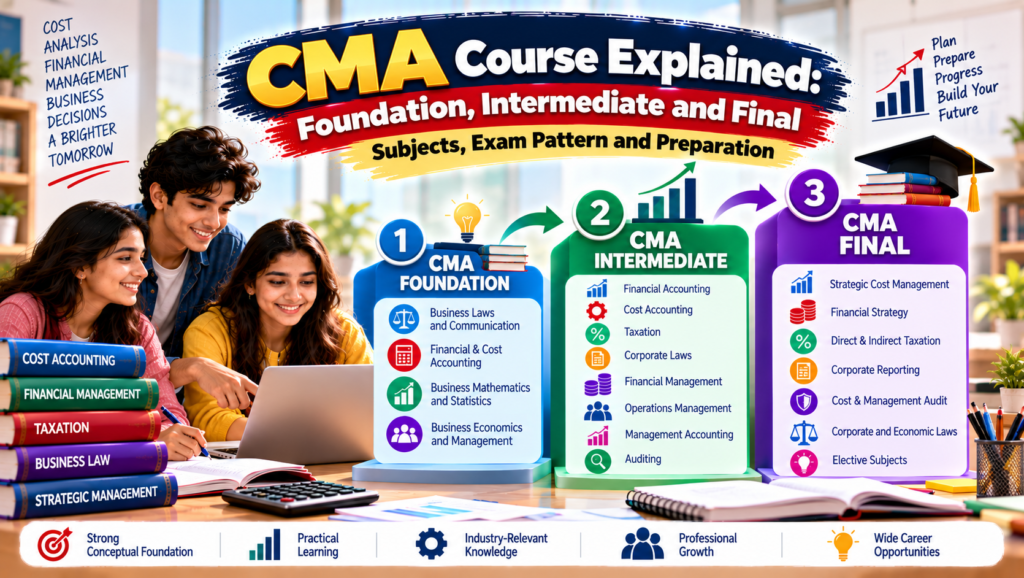
Cost and Management Accountancy (CMA) is a professional course for students interested in cost accounting, financial management, taxation, budgeting, business analysis and strategic decision-making. In India, the course is offered by the Institute of Cost Accountants of India (ICMAI). It prepares students to understand how businesses calculate costs, manage financial resources, improve operational efficiency and make informed business decisions. For students exploring professional courses after Class 12, understanding the CMA syllabus and examination structure is an important first step towards planning their career.
The CMA course has three levels: Foundation, Intermediate and Final. Each level builds on the knowledge gained at the previous stage, progressing from fundamental accounting and business concepts to advanced cost management, taxation, financial strategy and auditing. Students who begin exploring CMA during Intermediate can become familiar with the course requirements and develop a structured approach to preparation. With an understanding of the subjects, examination pattern and progression requirements, students can plan their studies more confidently and decide whether CMA aligns with their interests and long-term goals.
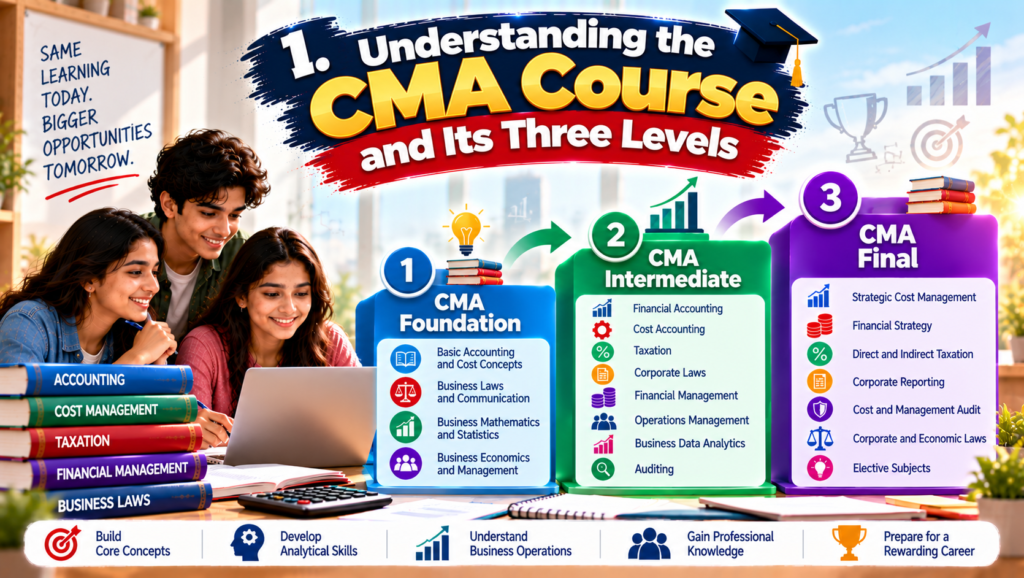
1. Understanding the CMA Course and Its Three Levels
The CMA course focuses on the financial and operational aspects of businesses. Cost accountants help organisations understand production costs, prepare budgets, analyse financial performance, control expenditure and support management decisions. The course develops knowledge in accounting, taxation, cost management, financial planning, business laws and strategic management. These areas are relevant across industries, including manufacturing, consulting, financial services and other organisations that need professionals to analyse costs and improve business performance.
The three levels gradually develop these skills. CMA Foundation introduces the fundamentals of accounting, business law, mathematics, statistics, economics and management. CMA Intermediate expands the syllabus to include financial accounting, cost accounting, taxation, corporate accounting and financial management. CMA Final develops advanced expertise in strategic cost management, financial strategy, corporate reporting, auditing and taxation. Understanding the purpose of each level helps students plan their preparation and recognise how the subjects connect with practical business responsibilities.
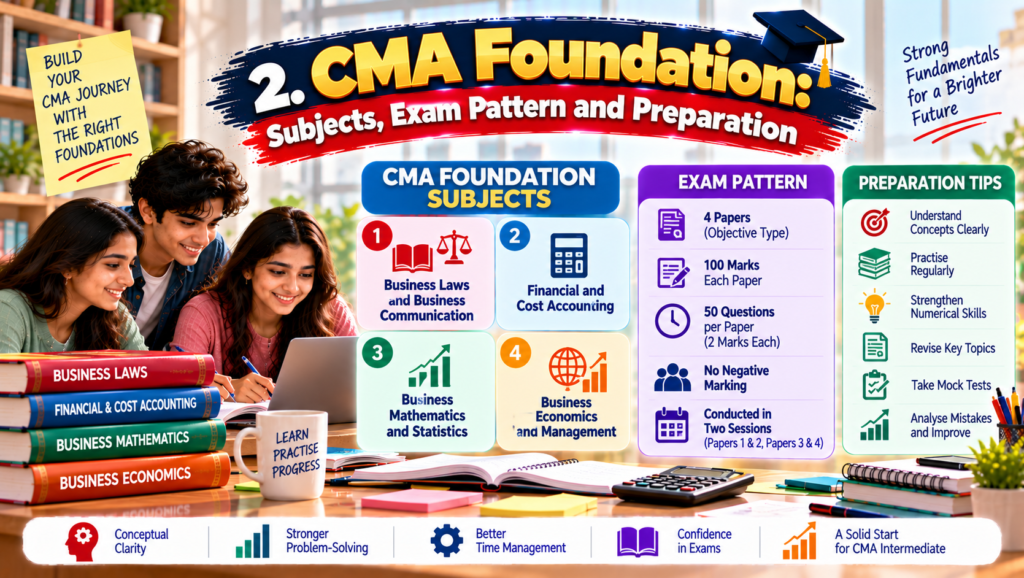
2. CMA Foundation: Subjects, Exam Pattern and Preparation
CMA Foundation is the entry-level stage for students pursuing the CMA course through the Foundation route. It introduces the basic principles that students will study in greater depth at the Intermediate and Final levels. The subjects combine accounting, quantitative skills, business communication, law, economics and management. Students who build a clear understanding of these fundamentals can find it easier to approach more specialised topics later in the course.
Under ICMAI’s Syllabus 2022, CMA Foundation consists of four papers:
- Paper 1: Fundamentals of Business Laws and Business Communication (FBLC) – Introduces business law concepts and the principles of effective professional communication.
- Paper 2: Fundamentals of Financial and Cost Accounting (FFCA) – Covers the basics of financial accounting and cost accounting, including recording transactions and understanding costs.
- Paper 3: Fundamentals of Business Mathematics and Statistics (FBMS) – Develops numerical skills and introduces statistical methods used in business.
- Paper 4: Fundamentals of Business Economics and Management (FBEM) – Covers fundamental economic concepts and the principles of management.
Each Foundation paper carries 100 marks, giving the level a total of 400 marks. The examination is objective and consists of multiple-choice questions. Under the notified pattern, each paper has 50 questions worth two marks each, with no negative marking. The papers are conducted in two sessions, with Papers 1 and 2 in one session and Papers 3 and 4 in another. Students should check the examination notification for their intended session to confirm the applicable mode, schedule and instructions.
Preparation for Foundation should focus on understanding the concepts and practising questions consistently. Students can strengthen accounting by solving numerical problems, improve quantitative aptitude through regular exercises, and revise business law and communication topics systematically. Economics and management become easier to understand when students connect the concepts with familiar business situations. Practice tests help students assess their understanding, improve time management and identify topics that need further revision before the examination.

3. CMA Intermediate: Subjects, Groups and Examination Structure
CMA Intermediate is a more detailed stage of the course, with subjects that develop students’ understanding of accounting, taxation, cost management, corporate law and financial decision-making. Students learn how financial information is prepared and analysed, how tax provisions affect businesses, and how costs can be measured and controlled. The syllabus also introduces operations management, business data analytics and strategic management, helping students connect financial knowledge with broader organisational performance.
Under Syllabus 2022, CMA Intermediate contains eight papers divided into two groups.
Group I
- Paper 5: Business Laws and Ethics (BLE) – Covers business, industrial and corporate laws, along with business ethics.
- Paper 6: Financial Accounting (FA) – Develops knowledge of accounting principles, financial statements, special transactions and relevant accounting standards.
- Paper 7: Direct and Indirect Taxation (DITX) – Covers the prescribed areas of direct taxation and indirect taxation.
- Paper 8: Cost Accounting (CA) – Focuses on cost concepts, costing methods and techniques used to measure and control business costs.
Group II
- Paper 9: Operations Management and Strategic Management (OMSM) – Covers operational efficiency, production and service processes, and strategic planning.
- Paper 10: Corporate Accounting and Auditing (CAA) – Combines corporate accounting concepts with auditing principles and practices.
- Paper 11: Financial Management and Business Data Analytics (FMDA) – Covers financial management techniques and the use of data analytics in business.
- Paper 12: Management Accounting (MA) – Focuses on budgeting, decision-making tools, variance analysis and performance measurement.
Each Intermediate paper carries 100 marks, giving the level a total of 800 marks. The examinations are generally descriptive and are conducted for three hours per paper under the applicable examination pattern. Students can prepare for the groups according to ICMAI’s rules and examination schedule. The usual passing requirement is at least 40% in each paper and 50% in aggregate for the relevant group, subject to the institute’s applicable rules and provisions.
A structured preparation plan is important at this level because the subjects require different approaches. Accounting, taxation, cost accounting and financial management need regular numerical practice, while business laws, auditing and strategic management require conceptual understanding and organised written answers. Students should revise each subject in stages rather than leaving the entire syllabus until the final weeks. Working through practice papers and reviewing mistakes can help improve accuracy, answer presentation and time management.
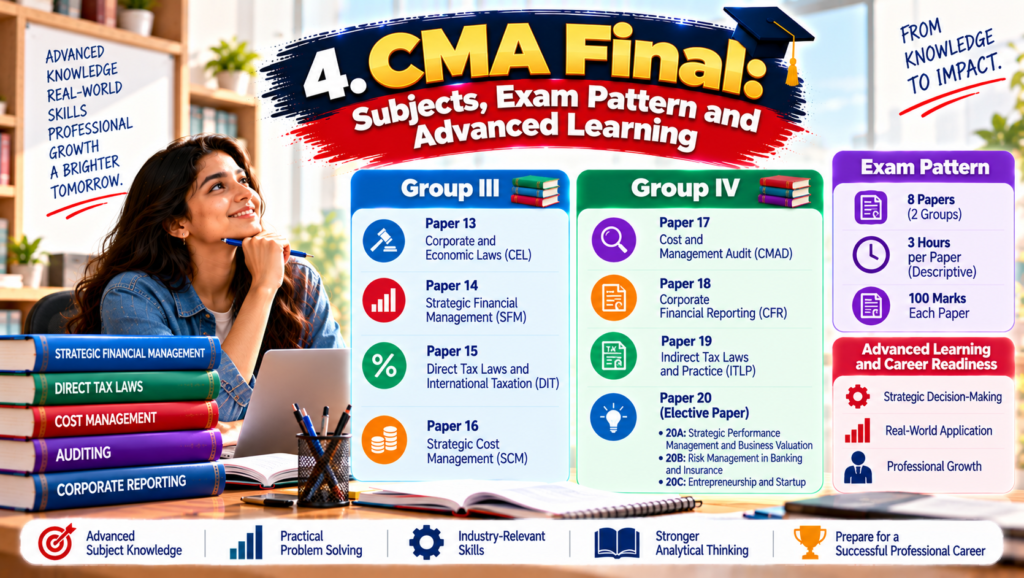
4. CMA Final: Subjects, Exam Pattern and Advanced Learning
CMA Final is the advanced stage of the course, where students develop the ability to apply cost management, finance, taxation, corporate law and auditing knowledge to complex business situations. The syllabus focuses on strategic decision-making, financial analysis, cost optimisation, corporate reporting and professional responsibilities. It encourages students to understand not only how financial information is prepared but also how it can be used to assess performance, manage risks and support an organisation’s long-term objectives.
Under Syllabus 2022, CMA Final includes seven core papers and one elective paper, divided into two groups.
Group III
- Paper 13: Corporate and Economic Laws (CEL) – Covers the prescribed corporate and economic law provisions relevant to businesses.
- Paper 14: Strategic Financial Management (SFM) – Focuses on advanced financial planning, investment decisions, risk and financial strategy.
- Paper 15: Direct Tax Laws and International Taxation (DIT) – Covers prescribed direct tax laws and international taxation.
- Paper 16: Strategic Cost Management (SCM) – Examines advanced cost management techniques and their use in strategic business decisions.
Group IV
- Paper 17: Cost and Management Audit (CMAD) – Covers cost audit, management audit and related professional practices.
- Paper 18: Corporate Financial Reporting (CFR) – Focuses on corporate financial reporting and the relevant accounting and reporting requirements.
- Paper 19: Indirect Tax Laws and Practice (ITLP) – Covers the prescribed indirect tax laws and their practical application.
- Paper 20: Elective Paper – Students choose one of the prescribed options:
- Paper 20A: Strategic Performance Management and Business Valuation (SPMBV)
- Paper 20B: Risk Management in Banking and Insurance (RMBI)
- Paper 20C: Entrepreneurship and Startup (ENTS)
Each Final paper carries 100 marks, giving the level a total of 800 marks. The examinations are generally descriptive and are conducted for three hours per paper under the applicable pattern. Students must meet the prescribed passing requirements for the relevant group, including the applicable minimum marks in individual papers and aggregate marks. They should confirm the current examination regulations and any relevant exemptions with ICMAI before planning an examination attempt.
Preparation for CMA Final requires a strong understanding of the subjects and the ability to apply concepts to practical situations. Students should practise advanced numerical questions, review case-based business problems and develop clear, well-structured answers for theoretical topics. Keeping up with applicable amendments and using the prescribed study materials can also be important, particularly in taxation and law. A planned revision schedule and regular mock examinations help students assess their progress and prepare for the demands of the final stage.
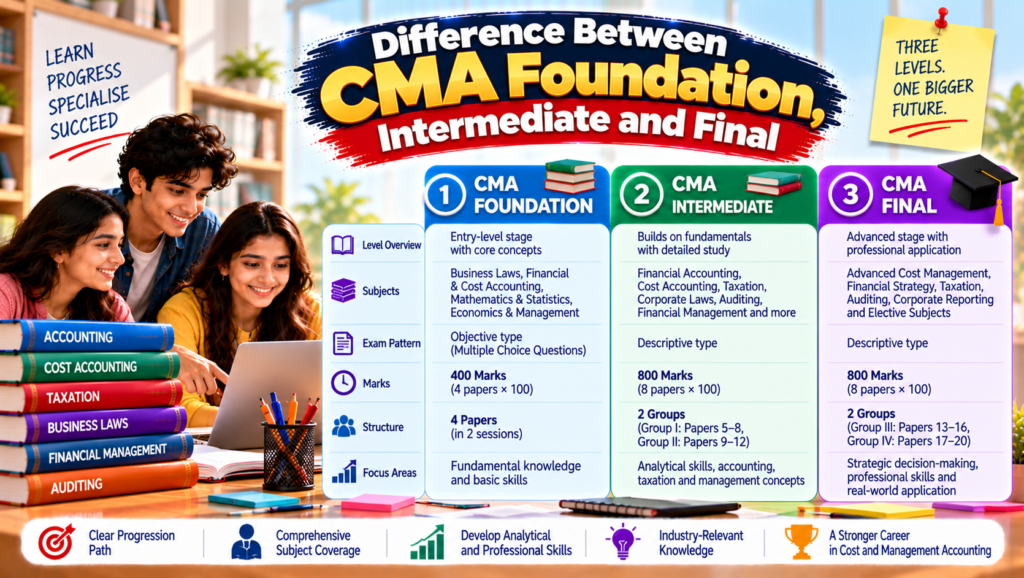
5. Difference Between CMA Foundation, Intermediate and Final
The three CMA levels differ in the depth of knowledge and the skills they develop. Foundation introduces basic accounting, business law, communication, mathematics, statistics, economics and management. Intermediate builds on these fundamentals through financial accounting, cost accounting, taxation, corporate accounting, auditing and financial management. Final moves towards advanced professional application through strategic cost management, corporate financial reporting, cost and management audit, advanced financial strategy and specialised taxation subjects.
The examination approach also changes as students progress. Foundation primarily tests knowledge through multiple-choice questions, while Intermediate and Final require students to demonstrate their understanding through descriptive answers and subject-based problem-solving. As the syllabus becomes more advanced, students need to develop stronger analytical skills, practise numerical questions and learn to explain their reasoning clearly. Recognising these differences helps students select appropriate study methods at each stage instead of relying on the same preparation strategy throughout the course.
6. How to Progress from One CMA Level to the Next
Students generally enter CMA Foundation after meeting the applicable educational eligibility requirements. After passing Foundation and fulfilling ICMAI’s registration and eligibility conditions, they can progress to Intermediate. Eligible graduates and candidates with specified qualifications may also qualify for entry through the applicable direct admission route. After clearing the required Intermediate groups and meeting the prescribed training and other requirements, students can progress to Final and complete the remaining course requirements.
Understanding the progression requirements helps students plan their studies and avoid missing important registration or examination deadlines. They should keep track of the current syllabus, examination notifications and any prescribed training requirements at each stage. Students should also remember that completing the examinations is not the only part of the professional journey; they must satisfy the applicable practical training and other requirements prescribed by ICMAI. Reviewing the latest official course guidance can help them make decisions based on the requirements that apply to their circumstances.
7. When Should Students Start CMA Coaching? Why Intermediate Is the Right Time
Starting to explore CMA during Intermediate can help students understand the professional course before they complete Class 12. Students studying commerce-related subjects may already be developing familiarity with economics, accounting or business concepts that connect with parts of the CMA syllabus. Early exposure gives them time to understand the course structure, strengthen numerical skills and develop a regular study routine. It can also help them assess whether they are interested in the financial and analytical responsibilities associated with cost and management accounting.
Beginning early does not mean students should compromise on their board examination preparation. Instead, they can follow a balanced timetable that gives priority to their Intermediate studies while gradually building familiarity with CMA Foundation topics. Consistent practice, basic accounting revision and an introduction to business mathematics, economics and management can make the transition to professional studies more manageable. For students considering CMA after Class 12, Intermediate is a practical time to explore coaching options and plan the next stage of their education.
8. How MEC and CEC Students Can Plan for CMA
MEC and CEC students can consider CMA as a professional pathway after Intermediate, subject to the course’s eligibility requirements. MEC includes Mathematics, Economics and Commerce, while CEC includes Civics, Economics and Commerce. Both streams can help students develop an understanding of business and economic concepts, although their preparation needs may vary depending on their previous exposure to mathematics and accounting. Students should focus on building the foundational knowledge and study habits needed for the CMA syllabus rather than assuming that one stream alone determines their suitability for the course.
A practical plan should combine board examination preparation with gradual exposure to CMA subjects. Students can start by strengthening accounting fundamentals, practising numerical questions, understanding business concepts and creating a manageable revision schedule. Those who need additional support in mathematics or accounting can spend more time on these areas before progressing to more advanced topics. At CMS, students can explore integrated CMA coaching with MEC and CEC, helping them plan their Intermediate education alongside preparation for a professional course.
9. How to Choose the Right CMA Coaching Program
Choosing a CMA coaching program requires students to consider how the teaching approach, course schedule and academic support fit their needs. Faculty expertise, clear explanations, structured study material and access to doubt-solving support can make a difference when students encounter difficult accounting, taxation or cost management topics. It is also useful to understand how the program balances subject teaching with revision and examination practice, especially for students who are managing board studies alongside professional course preparation.
Mock examinations, regular assessments and performance feedback can help students identify their strengths and areas for improvement. Before selecting a program, students and parents should review the timetable, subjects covered, practice opportunities and academic support available. CMS CMA Coaching in Hyderabad offers integrated CMA coaching options for MEC and CEC students, allowing them to explore a learning plan that connects Intermediate education with CMA preparation. Choosing a program that supports consistent learning and realistic study planning can help students approach the course with greater clarity.
10. Starting Your CMA Journey with CMS
Understanding the CMA course structure is a useful first step for students interested in accounting, cost management, finance and business analysis. Foundation develops the basics, Intermediate expands subject knowledge and Final focuses on advanced professional application. Each level requires consistent study, practice and revision, so students benefit from understanding the syllabus and planning their preparation well in advance. Exploring CMA during Intermediate can give students more time to assess their interests and prepare for the transition to professional education.
CMS offers integrated CMA coaching options for MEC and CEC students, helping them connect their Intermediate education with preparation for a professional qualification. With a suitable study plan, clear subject guidance and regular practice, students can work towards their academic goals while building an understanding of cost and management accounting. Students considering CMA can explore the available integrated coaching options at CMS and choose an approach that supports their current studies as well as their future ambitions.