
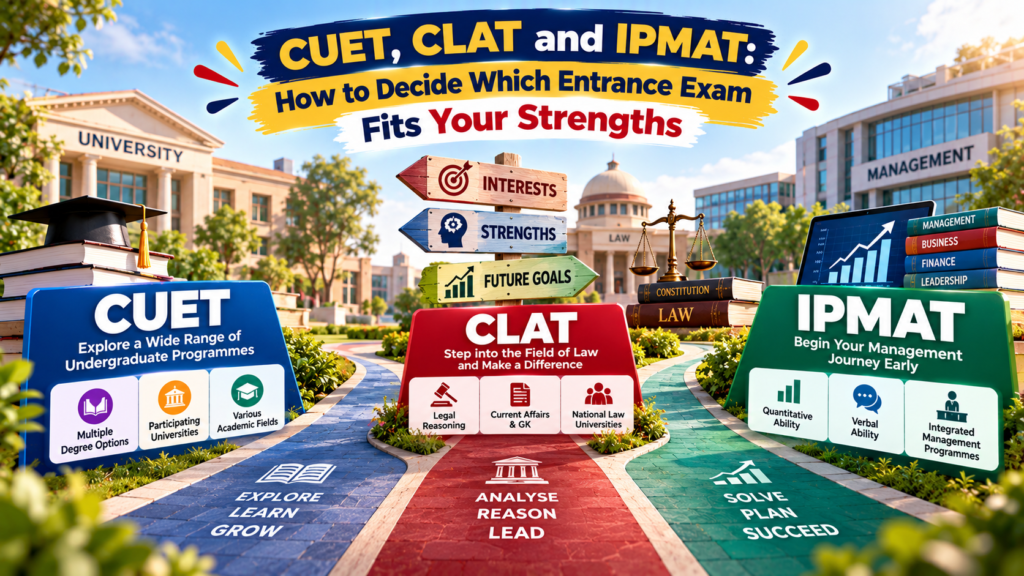
Choosing the right entrance examination after Intermediate is an important decision for students planning their higher education. With options such as CUET, CLAT and IPMAT, students can explore different academic and professional directions depending on their interests, abilities and long-term goals. However, each examination serves a different purpose. Understanding what each pathway involves can help students make a more informed decision rather than choosing an exam simply because their friends are preparing for it or because it is popular.
For students studying MEC, CEC or ACE, this decision becomes particularly relevant because their Intermediate subjects can connect with several higher-education opportunities. Some students may be interested in university degree programmes, others may want to pursue law, while some may see management education as their preferred direction. By evaluating their strengths, understanding the examination requirements and researching the courses available through each pathway, students can identify which entrance examination deserves their attention.

CUET: An Option for Students Exploring University Degree Programmes
The Common University Entrance Test (CUET-UG) provides an admission route to participating universities and their undergraduate programmes. It can be relevant for students who want to explore degree options in areas such as commerce, economics, business-related studies, humanities and other disciplines, depending on the universities and courses available. Rather than leading to one specific profession, CUET can help students pursue different academic pathways based on their interests and eligibility.
CUET may be worth exploring for students who want to compare several undergraduate programmes before committing to a particular professional direction. Students who enjoy learning academic subjects, preparing systematically and working towards university admission may find this pathway suitable. However, the subjects required for CUET vary according to the university and programme. Students should check the current eligibility criteria and subject requirements of their preferred courses before deciding which CUET papers to take.

CLAT: A Pathway for Students Interested in Law
The Common Law Admission Test (CLAT) is an entrance examination used by participating National Law Universities for admission to their undergraduate law programmes, subject to the applicable admission rules. It is particularly relevant for students who are curious about legal systems, public affairs, social issues, current events and the role of law in society. Students considering careers in legal practice or other law-related fields can explore CLAT as one route towards formal legal education.
Students who enjoy reading, analysing written information, understanding arguments and drawing conclusions from passages may find CLAT preparation engaging. The examination assesses areas that include English Language, Current Affairs including General Knowledge, Legal Reasoning, Logical Reasoning and Quantitative Techniques under the applicable pattern. Prior legal education is not generally required for the Legal Reasoning section, but students need to practise applying information and reasoning carefully. CEC students may find Civics and Economics useful for developing background awareness of government, society and economic issues, although students from MEC and ACE can also pursue CLAT if they meet the eligibility requirements.
IPMAT: Exploring Integrated Management Education
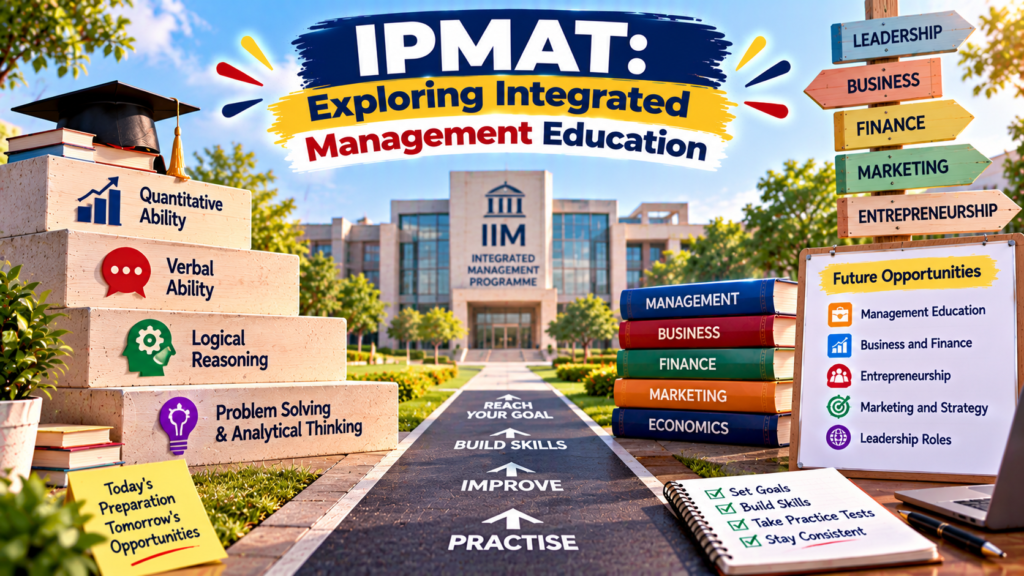
The Integrated Programme in Management Aptitude Test (IPMAT) is associated with admission to integrated management programmes offered by institutions such as IIM Indore and IIM Rohtak. These programmes allow eligible students to begin management education after Class 12. For students interested in business, leadership, entrepreneurship, marketing, finance or organisational decision-making, an integrated management programme may be worth considering as an alternative to the conventional undergraduate route.
Students who enjoy quantitative problem-solving, verbal reasoning and working through aptitude questions may find IPMAT preparation a good fit. Depending on the institution, the examination can assess areas such as quantitative ability, verbal ability and other aptitude skills. MEC students may find their Mathematics background useful when preparing for quantitative questions, while Commerce and Economics can help them develop an interest in business and markets. Nevertheless, IPMAT requires dedicated entrance preparation, and students should review the specific examination pattern and admission criteria of each target institution because they can differ.

How to Identify Your Strongest Skills
One practical way to compare CUET, CLAT and IPMAT is to consider the activities you naturally enjoy and the skills you are willing to develop further. Students who prefer studying academic subjects in depth and want to compare different undergraduate degrees may wish to explore CUET. Students who enjoy reading passages, following current affairs, examining arguments and understanding social or legal issues may be interested in CLAT. Those who like quantitative challenges, verbal aptitude and business-related problem-solving may want to investigate IPMAT.
Your current strengths should guide your research, but they should not become strict limits on what you can pursue. For example, a student who is not yet confident in Mathematics can improve through regular practice, while a student who finds reading difficult can develop comprehension skills gradually. Instead of deciding based on one test score or one subject, examine your interests, learning habits, willingness to practise and the type of course you want to study. This broader assessment can help you choose a pathway that matches both your present abilities and your future ambitions.
How MEC, CEC and ACE Connect With These Entrance Exams
MEC, CEC and ACE offer different combinations of subjects, but none of these streams automatically restricts students to a single entrance examination. MEC students study Mathematics, Economics and Commerce, which can provide a useful foundation for exploring quantitative aptitude, economics-related degrees, commerce programmes and management education. Students interested in CUET can research undergraduate courses aligned with their preferred subjects, while those considering CLAT can work on reading comprehension, reasoning and current affairs alongside their Intermediate studies.
CEC combines Civics, Economics and Commerce, making it relevant to students interested in society, governance, business and a range of university courses. These interests may encourage some students to explore law through CLAT, while others may prefer CUET or management programmes through IPMAT. ACE combines Accounts, Commerce and Economics, which can support students exploring business and finance-related degree programmes and management education. Ultimately, students from all three streams should verify the eligibility rules for each course and institution instead of assuming that their stream alone determines which entrance exams they can take.
Comparing Preparation Requirements Before Making a Choice
Before selecting an entrance examination, students should look beyond the name of the exam and understand the preparation it requires. CUET preparation depends on the papers needed for the intended university programmes, so students must identify relevant subjects and understand the admission criteria. CLAT requires consistent reading, reasoning practice and attention to current affairs, while IPMAT preparation may involve quantitative aptitude, verbal ability and other institution-specific requirements. Comparing these expectations can help students understand the time and effort needed for each route.
Students should also research the courses and institutions they hope to enter. Check whether the course matches your career interests, what eligibility criteria apply, which subjects are required, how admission decisions are made and what the programme involves after admission. If you are uncertain between two or more pathways, try introductory practice questions from each examination and reflect on which type of preparation interests you most. This gives you a more practical basis for deciding than relying only on general impressions or advice from friends.
Managing Intermediate Studies Alongside Entrance Preparation
Once students have identified a likely pathway, the next step is to build a preparation routine that works alongside Intermediate studies. Board examinations require consistent attention, and entrance preparation should be planned around school or college schedules, assignments and revision. A manageable timetable might include regular sessions for Intermediate subjects, dedicated entrance-exam practice, reading or current-affairs revision where relevant, and a weekly review of completed topics.
Students do not need to master every part of an entrance syllabus immediately. They can begin by strengthening foundational skills, gradually increase the difficulty of practice questions and use mock tests when they are familiar with the relevant exam pattern. Reviewing mistakes is especially important because it helps students identify whether they need better conceptual understanding, improved reading speed, greater accuracy or more effective time management. The timetable should be adjusted as examinations approach, with clear priorities for board preparation and entrance-test readiness.
How CMS Can Help Students Explore Their Options
At CMS, students pursuing MEC, CEC and ACE can explore how their Intermediate studies connect with different academic and professional opportunities. For students considering CUET Coaching in Hyderabad or CLAT or IPMAT, understanding the purpose of each examination is an important first step towards selecting a suitable preparation path. A structured approach can help students identify their target courses, understand the skills required and plan their learning without losing sight of their Intermediate responsibilities.
CMS offers preparation pathways connected with CUET, CLAT and IPMAT alongside its Intermediate streams, helping students explore these options as part of their broader academic planning. Students should begin by discussing their interests, reviewing their strengths and researching the current requirements of their preferred institutions. The aim is to make a considered choice based on the course they want to pursue, the skills they are prepared to develop and the opportunities each pathway can offer.
Conclusion
CUET, CLAT and IPMAT serve different purposes, so the right choice depends on the type of higher education a student wants to pursue. CUET can provide access to undergraduate programmes at participating universities, CLAT offers an entrance route to participating law universities, and IPMAT can lead to integrated management programmes at institutions that use the examination. Understanding these differences helps students connect their entrance preparation with a clear academic goal.
Students should consider their interests, current strengths, preferred courses and willingness to develop new skills before making a decision. MEC, CEC and ACE students can explore different pathways, provided they meet the relevant eligibility requirements. With careful research, a realistic preparation timetable and consistent practice, students can make a more confident choice and prepare for an entrance examination that aligns with their future plans.