
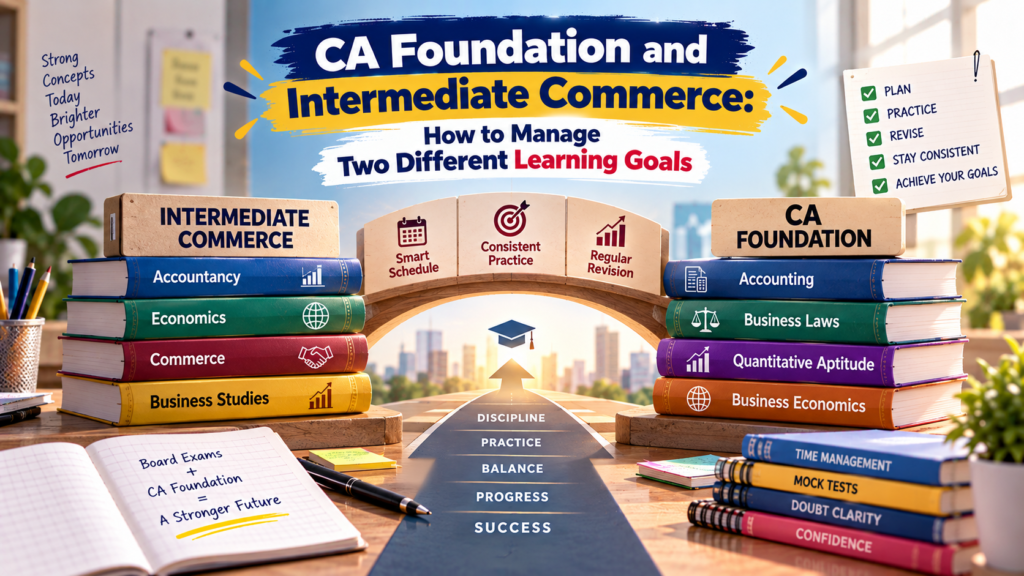
For students interested in accounting, finance and business, pursuing Intermediate Commerce alongside preparation for the CA Foundation examination can be an important step towards a professional career. Intermediate education helps students develop subject knowledge and prepare for their board examinations, while CA Foundation introduces them to the concepts and examination approach required for the Chartered Accountancy pathway. Both learning goals can complement each other, but they also involve different syllabuses, assessment methods and preparation requirements.
Managing these two goals requires more than studying for longer hours. Students need to understand the demands of their Intermediate subjects, become familiar with the CA Foundation syllabus and develop a realistic timetable that gives sufficient attention to both. With clear priorities, regular revision and consistent practice, students can work towards their board examinations while gradually building the knowledge and skills required for CA Foundation.
Understanding the Difference Between Intermediate Commerce and CA Foundation
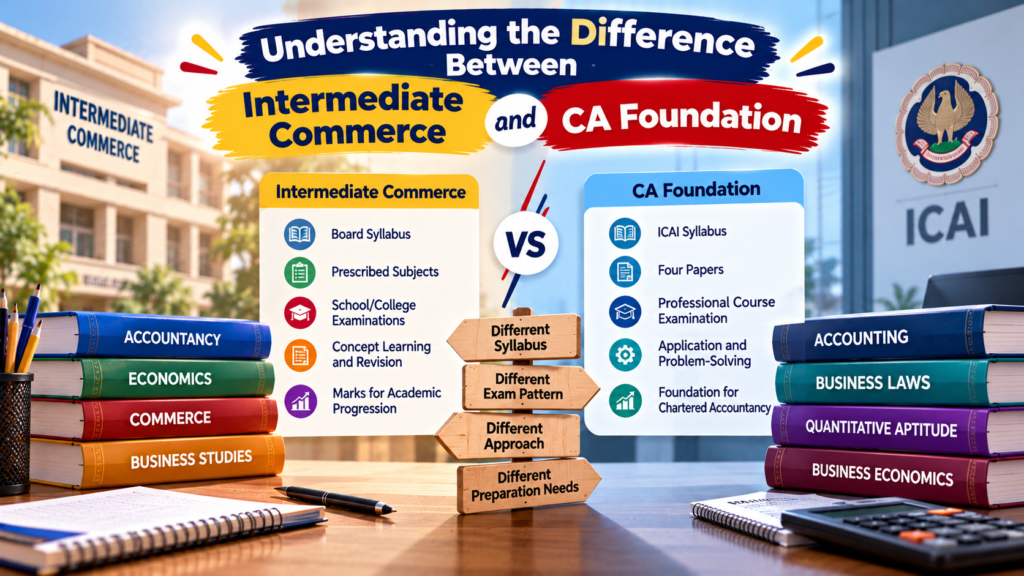
Intermediate Commerce focuses on helping students understand subjects such as Accountancy, Economics, Commerce and other subjects included in their chosen stream. Students need to learn concepts, complete prescribed coursework, practise examination questions and prepare according to their board’s assessment pattern. Building a strong understanding of these subjects is important because Intermediate marks can influence future academic opportunities and help students develop the discipline needed for further studies.
CA Foundation, conducted by the Institute of Chartered Accountants of India (ICAI), is the entry-level examination for students pursuing the Chartered Accountancy route under the applicable scheme. Its subjects include Accounting, Business Laws, Quantitative Aptitude and Business Economics. Although some concepts may connect with what students learn during Intermediate, CA Foundation has its own syllabus, question formats and examination requirements. Students should therefore treat it as a separate preparation goal rather than assuming that board-exam preparation alone will be sufficient.
How Intermediate Commerce Can Support CA Foundation Preparation
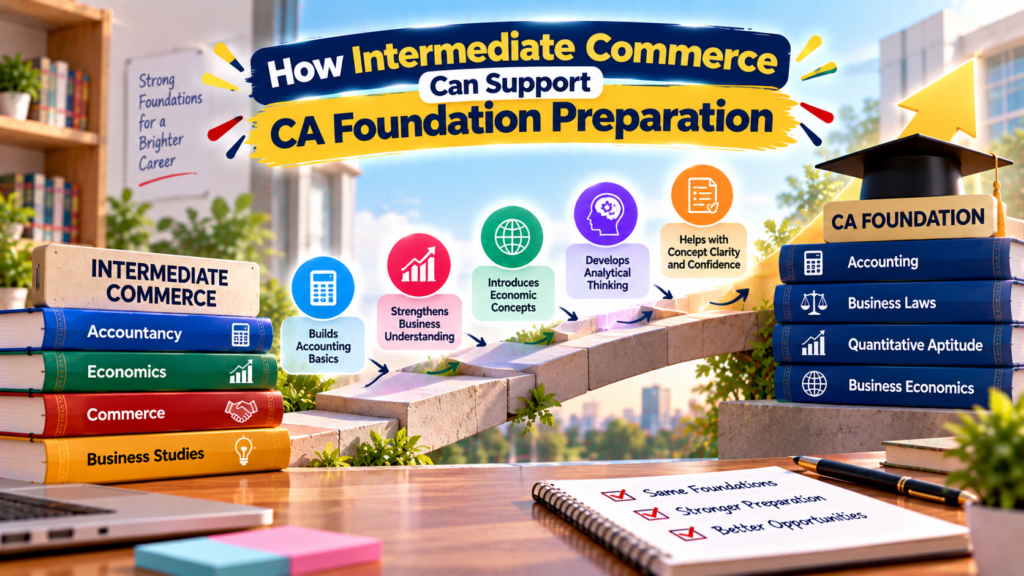
The knowledge gained through Intermediate Commerce can provide a useful starting point for CA Foundation preparation. Students who regularly practise accounting problems, understand basic economic concepts and become familiar with business terminology may find it easier to approach related topics in their professional studies. Learning concepts thoroughly during Intermediate can also reduce the pressure of having to understand foundational ideas for the first time when preparing for CA Foundation.
However, students should recognise that the depth and application of concepts may differ between school-level subjects and CA Foundation. Professional-course preparation often requires more structured problem-solving, careful interpretation of questions and familiarity with the examination’s specific requirements. Students should identify where their existing knowledge overlaps with the CA Foundation syllabus and where additional learning is necessary. This helps them use their time efficiently without neglecting topics that require a different approach.
Creating a Practical Study Timetable for Both Goals
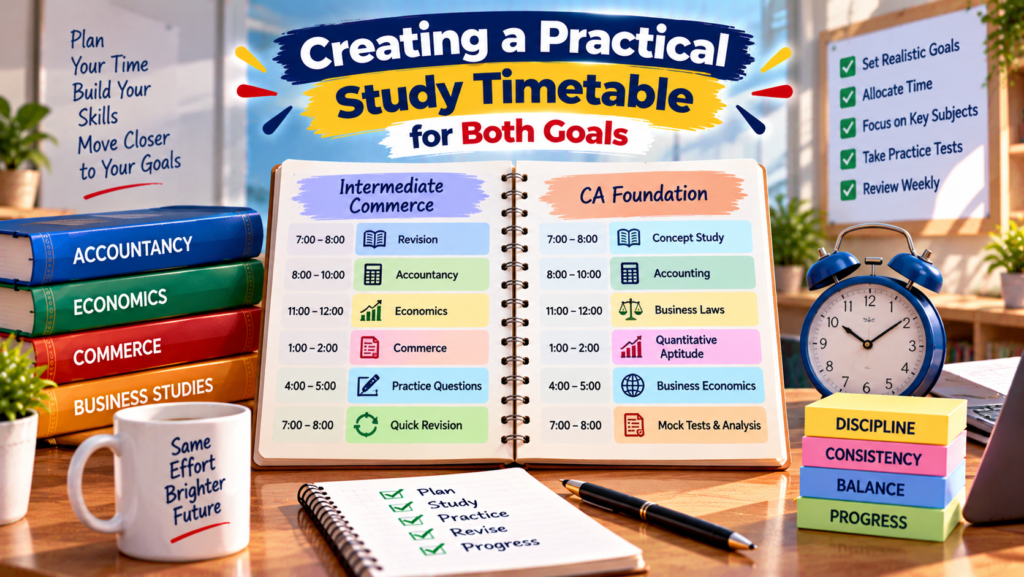
A well-planned timetable helps students distribute their effort across Intermediate subjects and CA Foundation preparation. Instead of trying to study every subject every day, students can assign specific periods to important topics based on their difficulty, upcoming tests and current progress. For example, a student may dedicate regular weekday sessions to Intermediate lessons and revision, while reserving selected sessions for CA Foundation concepts and question practice. The exact schedule should reflect school or college timings, personal learning speed and the amount of syllabus remaining.
Consistency is more important than creating an unrealistic timetable filled with long study hours. Students should set achievable weekly targets, include short breaks and leave room for revising topics they have not understood completely. A weekly review can help them check whether they have completed planned tasks and whether one goal is receiving less attention than necessary. During Intermediate examinations, board preparation may need greater priority; at other times, students can increase the time devoted to CA Foundation practice according to their examination timeline.
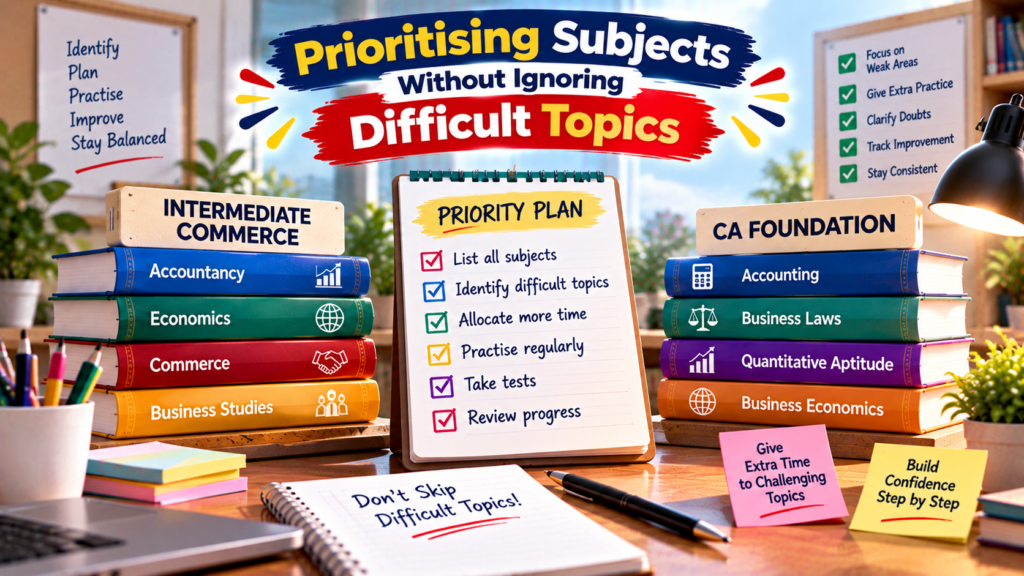
Prioritising Subjects Without Ignoring Difficult Topics
Students often spend more time studying subjects they enjoy and postpone topics they find challenging. While this may feel comfortable in the short term, it can create gaps in understanding and make revision more difficult later. A better strategy is to identify subjects and chapters that require extra effort, divide them into smaller tasks and work through them regularly. For Intermediate Commerce, this may involve practising accounting problems or revising theoretical concepts, depending on the student’s stream and syllabus.
CA Foundation preparation also requires attention to all prescribed papers. Students should not focus exclusively on Accounting because it appears closely related to Commerce studies. Business Laws requires careful reading and understanding of legal concepts, Quantitative Aptitude involves mathematical and logical problem-solving, and Business Economics requires conceptual clarity and application. Reviewing the syllabus and tracking progress paper by paper can help students maintain a balanced approach. If a topic remains difficult, asking a teacher for clarification early is often more useful than repeatedly revising the same misunderstanding.
Using Revision and Practice Tests Effectively
Revision helps students retain information and identify concepts that need further attention. Rather than waiting until an examination is near, students can revisit recently studied topics at regular intervals. Short revision sessions, written summaries, formula reviews and solving questions without referring to notes can help them assess how well they remember a concept. For theory-based topics, explaining an idea in their own words can reveal whether they understand it or have merely memorised the wording.
Practice tests are equally important, but the tests should match the goal being prepared for. Intermediate students should practise according to their board’s question style and marking expectations, while CA Foundation aspirants should become familiar with the applicable ICAI syllabus, examination format and official study materials. After each test, students should review incorrect answers, identify whether the problem arose from a conceptual gap, calculation error or time-management issue, and practise similar questions again. This approach makes testing a learning activity rather than simply a way to measure marks.
Managing Time, Stress and Expectations
Preparing for Intermediate examinations and CA Foundation at the same time can feel demanding, particularly when assignments, internal assessments and entrance or professional-course preparation overlap. Students may become discouraged if they compare their progress with classmates who have different schedules or prior knowledge. Instead, they should measure progress against their own weekly targets and focus on improving their understanding gradually. Adequate sleep, short breaks and realistic daily goals can also support concentration and help make a study routine more sustainable.
Parents and teachers can support students by encouraging regular effort rather than placing all the emphasis on marks or study hours. When students fall behind, the most useful response is to review the timetable, identify the reason and make practical adjustments. A missed target does not mean the entire plan has failed. Breaking a large chapter into smaller tasks, seeking help with difficult concepts and returning to a consistent routine can help students regain momentum without adding unnecessary pressure.
How Integrated CA Coaching Can Support Intermediate Students
For students who want to pursue Chartered Accountancy, integrated coaching can help bring Intermediate learning and CA Foundation preparation into a more coordinated plan. Rather than treating the two goals as completely separate activities, students can understand which concepts support both areas, which topics require additional professional-course preparation and how to distribute revision time across their commitments. A structured learning environment can also help students follow a syllabus, practise questions regularly and clarify doubts before they become larger learning gaps.
At CMS CA Institutes in Hyderabad, students exploring Intermediate Commerce and CA preparation can work towards developing their academic foundation while becoming familiar with the demands of the CA pathway. The objective is to help students approach both goals with greater clarity, discipline and a practical study plan. Students should still understand the separate requirements of their board examinations and the latest ICAI guidelines, and adjust their preparation according to their own progress and examination schedules.
Conclusion
Managing CA Foundation preparation alongside Intermediate Commerce is possible when students understand that the two goals are related but not identical. Intermediate studies help build subject knowledge and academic discipline, while CA Foundation requires focused preparation across Accounting, Business Laws, Quantitative Aptitude and Business Economics. Recognising the areas of overlap, identifying topics that need additional attention and following a realistic timetable can help students make steady progress in both.
The most effective approach is to start with clear priorities, practise consistently and review progress instead of relying on last-minute study. Students should protect time for board-exam revision, build their CA Foundation preparation gradually and use practice tests to identify areas for improvement. With appropriate guidance and a balanced routine, Intermediate Commerce students can strengthen their academic performance while preparing thoughtfully for the next stage of their Chartered Accountancy journey.