
Introduction
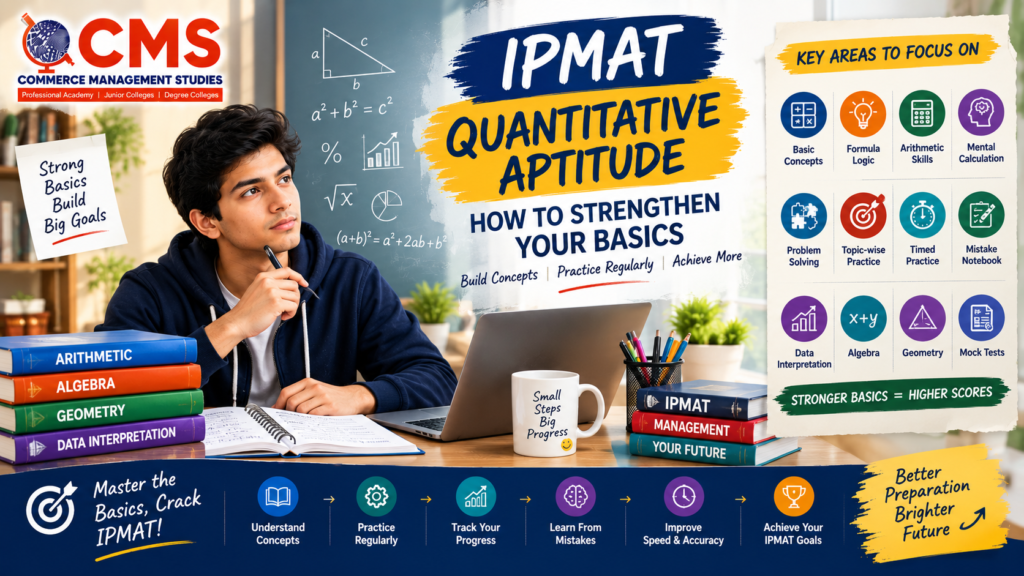
Quantitative Aptitude is an important part of IPMAT preparation because it tests a student’s ability to work with numbers, understand mathematical relationships, and apply concepts to different types of problems. Unlike a school examination where questions may closely follow familiar examples, aptitude examinations can present concepts in unfamiliar ways and require students to identify the right approach quickly. This makes a strong mathematical foundation particularly valuable for students preparing for IPMAT.
Students do not necessarily need to begin with advanced problems to improve their quantitative aptitude. A better approach is to strengthen the basics first and gradually move toward more challenging questions. Understanding fundamental concepts, practicing regularly, improving calculation skills, learning from mistakes, and developing time-management habits can help students become more comfortable with quantitative problems over time.
Understanding Quantitative Aptitude in IPMAT
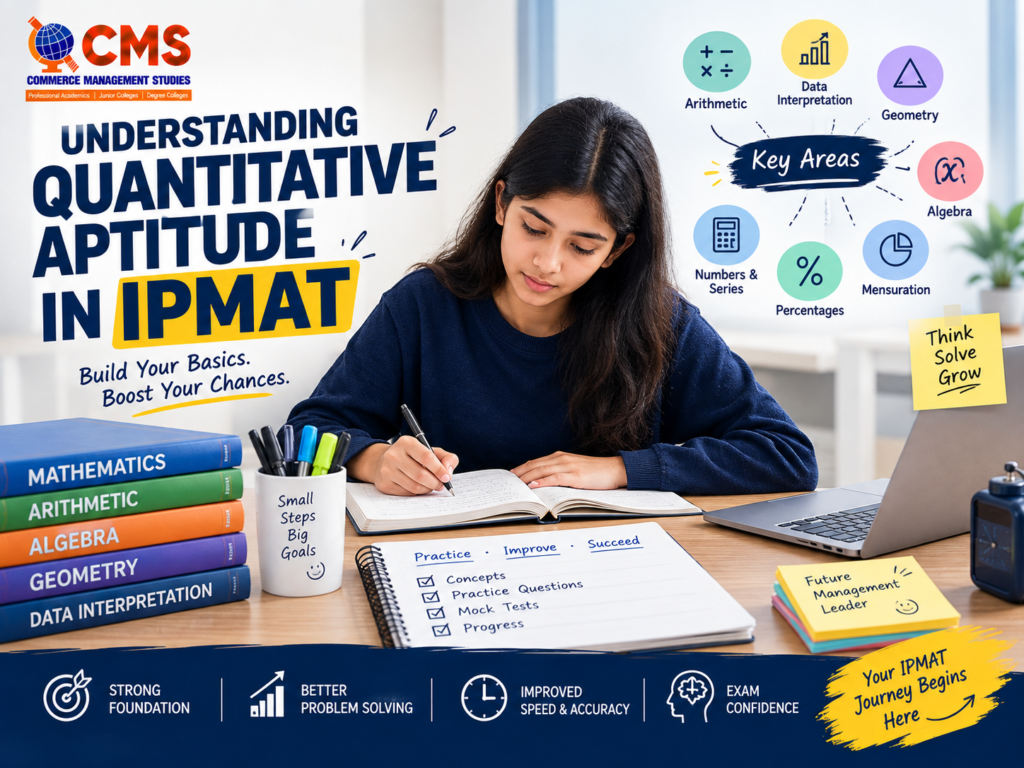
Quantitative Aptitude focuses on the practical application of mathematical concepts. Depending on the examination and its applicable pattern, students may encounter questions involving arithmetic, algebra, geometry, numbers, data interpretation, and other quantitative areas.
The important difference is that students are expected to apply concepts rather than simply recall formulas. A question may combine multiple concepts or require a student to identify a quicker method of solving it. Therefore, preparation should focus on understanding why a particular method works and learning how to recognize when it can be applied.
1. Start With the Fundamental Concepts
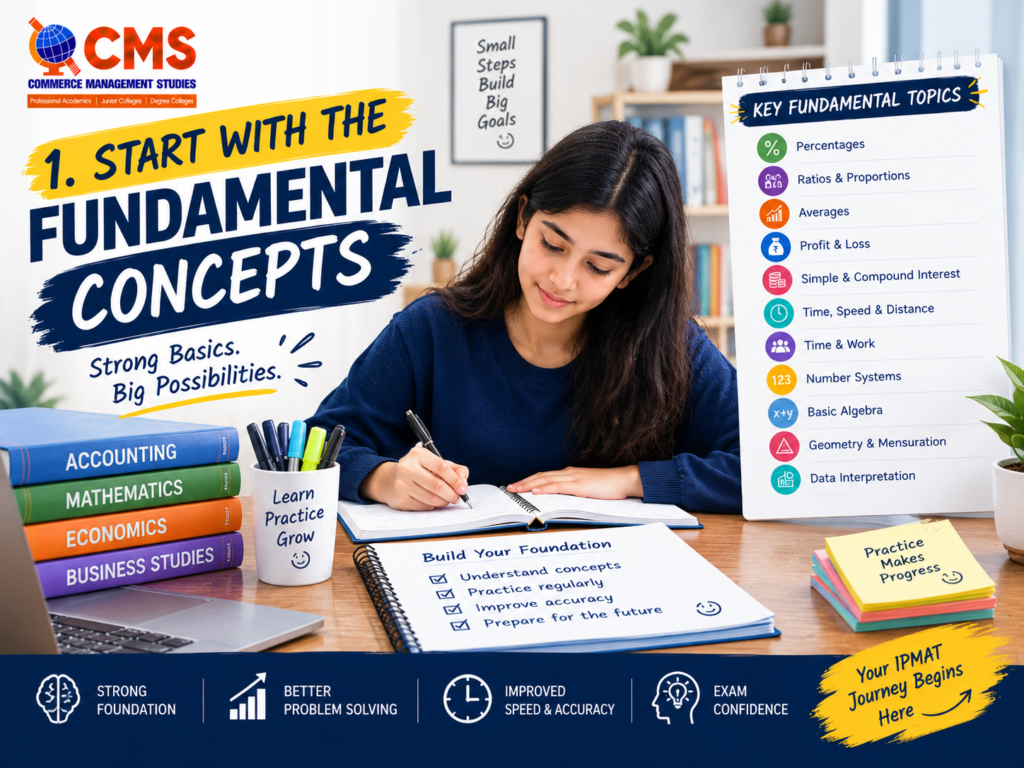
Students should begin by making sure their basic mathematical concepts are clear. Trying to solve advanced aptitude questions without understanding the fundamentals can make preparation unnecessarily difficult.
Important foundational areas can include:
- Percentages
- Ratios and proportions
- Averages
- Profit and loss
- Simple and compound interest
- Time, speed, and distance
- Time and work
- Number systems
- Basic algebra
- Geometry and mensuration
- Data interpretation
The exact importance of each topic can vary according to the examination pattern, but a strong foundation across common quantitative concepts can make it easier to approach unfamiliar questions.

2. Understand the Logic Behind Formulas
Memorizing formulas can help students solve familiar questions, but understanding the logic behind those formulas is more useful in the long term. When students understand how a formula works, they are better positioned to identify how it can be adapted to a different problem.
For example, instead of memorizing percentage formulas mechanically, students can understand how percentage changes relate to the original value. Similarly, when studying averages, students should understand the relationship between total values and the number of observations. This conceptual approach makes it easier to solve questions that are presented differently from textbook examples.
3. Strengthen Arithmetic First
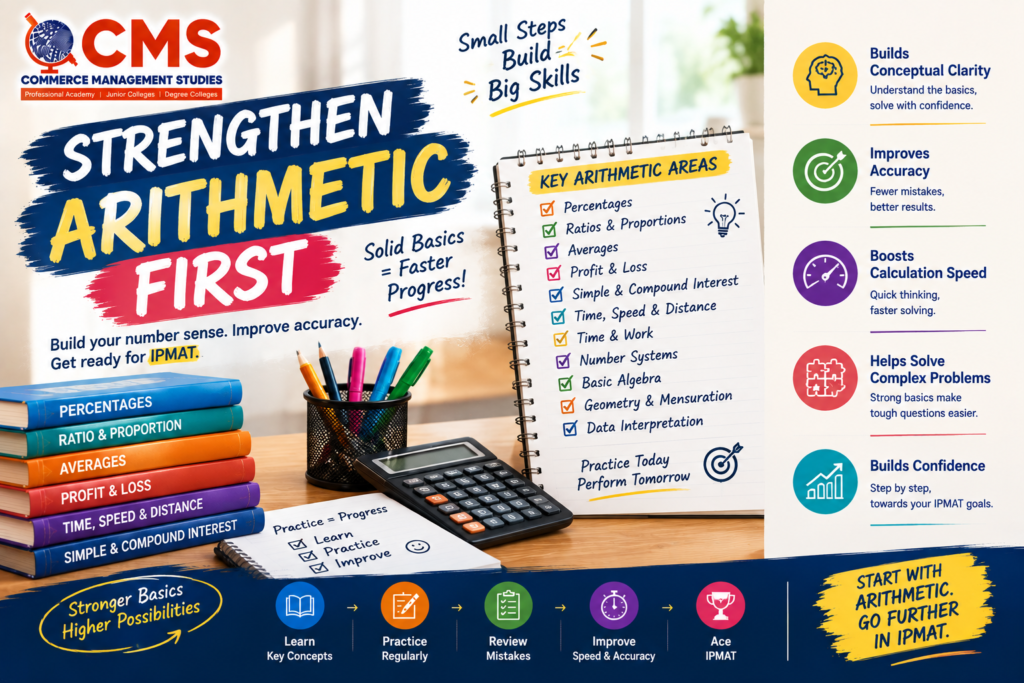
Arithmetic is often a useful starting point for students beginning aptitude preparation because many problems are based on everyday numerical relationships. Concepts such as percentages, ratios, averages, profit and loss, and time-related problems can also appear in different combinations.
Students should first learn the basic methods and then practice questions of gradually increasing difficulty. Once the fundamentals become comfortable, they can begin exploring alternative methods and shortcuts where appropriate.
The objective should be to develop accuracy first and speed later. Speed is important in a competitive examination, but solving questions quickly without understanding them can lead to repeated errors.
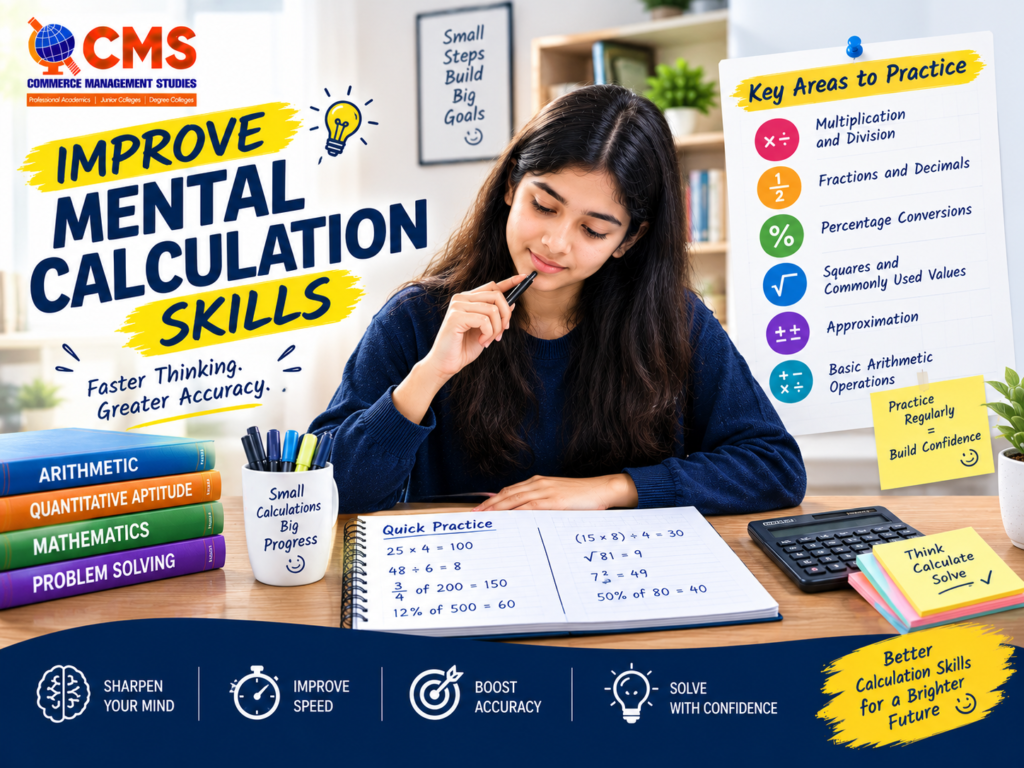
4. Improve Mental Calculation Skills
Strong calculation skills can save valuable time during an aptitude examination. Students do not need to perform every calculation mentally, but becoming comfortable with basic arithmetic can reduce unnecessary dependence on lengthy calculations.
Students can gradually practice:
- Multiplication and division
- Fractions and decimals
- Percentage conversions
- Squares and commonly used values
- Approximation
- Basic arithmetic operations
Regular practice can make calculations more familiar and reduce hesitation when working through numerical problems.

5. Learn to Break Down Difficult Problems
A difficult-looking question is not always difficult mathematically. Sometimes the challenge comes from the way information is presented. Students can learn to break a problem into smaller parts before attempting to solve it.
A useful approach is to identify:
What information is given?
What needs to be found?
Which concept connects the given information to the required answer?
Can the problem be simplified?
This method encourages students to think logically rather than immediately searching for a formula. With practice, breaking down problems can become a natural part of the solving process.
6. Practice One Topic at a Time
Students who are new to quantitative aptitude may find mixed question sets difficult because they have not yet learned to identify which concept is required. Topic-wise practice can help them develop this recognition ability.
For example, students can spend a few days focusing on percentages and then move to ratios and averages. After becoming comfortable with individual topics, they can begin solving mixed sets that require them to identify the appropriate method independently.
This gradual progression can make preparation more organized and help students identify specific areas where they need additional practice.
7. Move From Easy to Difficult Questions
Students should not feel that they need to solve the hardest questions immediately. Difficulty should increase gradually as their conceptual understanding improves.
A useful progression is:
Basic Questions → Moderate Questions → Application-Based Questions → Mixed Sets → Timed Practice
Starting with manageable questions can help students develop confidence and understand the underlying concepts. More challenging questions can then be introduced once the basics are secure.
8. Focus on Accuracy Before Speed
One of the common mistakes in aptitude preparation is trying to solve questions as quickly as possible from the beginning. Speed matters, but it should develop alongside accuracy.
If students repeatedly make errors while attempting questions quickly, they should first identify the cause. The problem may be a conceptual gap, calculation mistake, misreading of the question, or an incorrect method.
Once accuracy improves, students can gradually introduce time limits. This allows speed to develop naturally without compromising the quality of their answers.
9. Maintain a Mistake Notebook
A mistake notebook can be a simple but effective tool for quantitative preparation. Students can record questions they answered incorrectly, concepts they misunderstood, and calculation mistakes they repeatedly make.
The purpose is not to copy every question. Instead, students should record the learning point behind the mistake. For example, they may note that they confused two percentage concepts or used the wrong method for a particular type of problem.
Reviewing these mistakes periodically can prevent students from repeating the same errors and make revision more focused.
10. Practice Data Interpretation
Data Interpretation requires students to extract information from tables, graphs, charts, or other forms of numerical data and use it to answer questions. It combines calculation with comprehension and logical analysis.
Students can begin with simple datasets and gradually work toward more complex sets. They should practice identifying the information that is actually required rather than calculating every number provided in the question.
This can also improve efficiency because competitive examinations often reward students who can identify relevant information quickly.
11. Develop Algebraic Thinking
Algebra can initially seem difficult to students who are more comfortable with arithmetic, but developing basic algebraic thinking can help them approach many types of quantitative problems.
Students should become comfortable with equations, variables, expressions, identities, and basic algebraic manipulation. More importantly, they should understand what an equation represents rather than treating algebra as a collection of rules.
Regular practice can gradually improve the ability to translate a word problem into a mathematical expression and solve it systematically.
12. Strengthen Geometry Basics
Geometry is another area where understanding concepts is more useful than simply memorizing formulas. Students should become familiar with basic properties of lines, angles, triangles, circles, quadrilaterals, and other common geometric figures.
Drawing a simple diagram can often make a problem easier to understand. Students should therefore develop the habit of representing information visually when appropriate.
Once the fundamental properties are clear, students can practice application-based questions and gradually increase their difficulty level.
13. Use Regular Short Practice Sessions
Quantitative aptitude improves through repeated exposure. Students do not necessarily need to spend several hours every day solving mathematics questions. Regular, focused practice can be more sustainable.
A short daily session could involve:
- Revising one concept
- Solving a small set of questions
- Reviewing mistakes
- Practicing calculations
- Attempting a few timed questions
The important factor is consistency. Practicing regularly helps students maintain familiarity with concepts and gradually improve their solving ability.
14. Introduce Timed Practice Gradually
Once students become comfortable with individual topics, they can begin solving questions under time limits. This helps them understand how their performance changes when they have to work quickly.
Initially, the time limit can be relatively relaxed. It can then be reduced gradually as accuracy improves. Students should record both the number of questions solved and the number answered correctly.
This allows them to identify whether they need to work primarily on speed, accuracy, or conceptual understanding.
15. Learn Different Approaches to the Same Problem
Some quantitative problems can be solved using more than one method. Students can benefit from understanding alternative approaches after they have mastered the standard method.
Shortcuts can sometimes save time, but students should avoid collecting shortcuts without understanding the underlying concept. A shortcut is useful only when the student knows when it can be safely applied.
The best approach is to first understand the conventional method and then learn efficient alternatives where they genuinely improve speed or simplify the calculation.
16. Use Mock Tests to Measure Progress
Mock tests allow students to apply multiple quantitative concepts within a limited amount of time. This is different from topic-wise practice because students need to identify the appropriate method without being told which chapter the question belongs to.
After each mock test, students should analyze their performance carefully. They can identify questions they got wrong, questions that took too long, and questions they skipped because they did not know how to approach them.
This analysis can help students decide what to practice next instead of simply taking another test without addressing their weaknesses.
Common Mistakes to Avoid
Students preparing for IPMAT quantitative aptitude can sometimes make their preparation more difficult through avoidable habits. Recognizing these mistakes early can make the learning process more effective.
Common mistakes include:
- Memorizing formulas without understanding them
- Starting with very difficult questions
- Ignoring basic arithmetic
- Focusing on speed before accuracy
- Practicing only familiar question types
- Avoiding topics that appear difficult
- Not reviewing incorrect answers
- Taking mock tests without analyzing performance
- Depending entirely on shortcuts
A structured approach can help students overcome these issues gradually.
Balancing Quantitative Preparation With Other IPMAT Sections
IPMAT preparation is not limited to quantitative aptitude. Depending on the examination, students may also need to prepare for verbal ability, reading comprehension, and other aptitude areas. Spending all preparation time on Mathematics can therefore create an imbalance.
Students should divide their study schedule according to their individual strengths and weaknesses. A student who is already strong in quantitative aptitude may need more time for verbal preparation, while another student may need additional quantitative practice.
The objective is to develop balanced preparation across all relevant areas.
MEC and IPMAT Quantitative Preparation
Students pursuing MEC—Mathematics, Economics, and Commerce can use their Intermediate Mathematics studies as a foundation for developing quantitative ability. Regular exposure to mathematical concepts can help students become comfortable with numbers, equations, logical relationships, and problem-solving.
However, school or Intermediate Mathematics and aptitude-based questions are not always identical in style. Students preparing for IPMAT should therefore combine their academic Mathematics preparation with dedicated aptitude practice. This allows them to strengthen their concepts while learning how to apply them to competitive-examination questions.
CEC Students Can Also Build Quantitative Skills
Students from CEC can also prepare for IPMAT by developing their quantitative ability alongside their regular Intermediate subjects. Since Mathematics is not part of the CEC combination, students may need to give additional attention to quantitative fundamentals if their target examination requires them.
Starting early can make this process more manageable. Students can begin with basic arithmetic and gradually progress toward more advanced aptitude concepts. Consistent practice can help them build confidence rather than trying to cover the entire quantitative component in a short period.
The Importance of Consistency
Quantitative aptitude is a skill that develops through practice. Students should not become discouraged if they initially find certain questions difficult or take longer than expected to solve them.
Progress can be measured in several ways, not just through test scores. A student may gradually reduce calculation time, make fewer mistakes, recognize question types faster, or become more comfortable with previously difficult topics. These small improvements can eventually contribute to stronger overall performance.
Integrated IPMAT Preparation Alongside Intermediate
Students preparing for IPMAT alongside Intermediate can benefit from beginning aptitude preparation early rather than postponing it until after completing their academic studies. This provides more time to strengthen fundamentals and develop the habit of solving application-based questions.
At CMS, students can pursue MEC or CEC with integrated IPMAT Coaching in Hyderabad preparation, allowing them to work toward their Intermediate academic goals while developing skills relevant to management entrance examinations. A structured approach can help students balance quantitative aptitude with verbal ability, reasoning, mock tests, and regular academic preparation.
Conclusion
Strengthening quantitative aptitude for IPMAT is a gradual process that begins with strong fundamentals. Students should focus on understanding basic concepts, practicing arithmetic, developing calculation skills, solving questions systematically, and learning from mistakes before moving toward more difficult and time-bound problems.
The most effective preparation is not necessarily about solving the largest number of questions. It is about understanding why a solution works, recognizing patterns, improving accuracy, and gradually becoming faster and more confident. By building these skills consistently during Intermediate, students can develop a stronger quantitative foundation and approach IPMAT preparation in a more organized and practical way.