
Introduction
Preparing for CUET alongside Intermediate can be a positive and productive approach for students who want to keep strong undergraduate opportunities open after Class 12. The Common University Entrance Test (CUET-UG), conducted by the National Testing Agency, provides a common entrance platform for undergraduate admissions across participating Central, State, Deemed, and Private Universities. This gives students an opportunity to work toward their Intermediate qualification while simultaneously preparing for an entrance examination that can be relevant to their preferred university programmes.
Rather than viewing Intermediate studies and CUET preparation as two completely separate responsibilities, students can treat them as complementary parts of their academic journey. Concepts learned through Intermediate subjects can support entrance-examination preparation, while regular CUET practice can improve students’ speed, accuracy, comprehension, and familiarity with objective-type questions. Starting preparation in a structured manner can therefore help students build confidence gradually instead of having to begin everything immediately before the examination.

Understanding CUET and Its Importance
CUET-UG is designed to provide a common platform for students seeking admission to undergraduate programmes at participating universities. The examination covers languages, domain-specific subjects, and a General Aptitude Test, with the exact requirements depending on the university and programme selected. For CUET-UG 2026, NTA stated that the examination offered 37 subjects, including 13 languages, 23 domain-specific subjects, and one General Aptitude Test.
The wide range of participating institutions means that students can explore different undergraduate opportunities while planning their preparation around their intended courses. However, students should always check the latest eligibility requirements and subject combinations specified by their preferred universities and programmes, because these requirements can vary. NTA itself advises candidates to verify the required language, domain subjects, General Test requirements, and eligibility conditions for their chosen programme.
Why Preparing Alongside Intermediate Can Be Beneficial
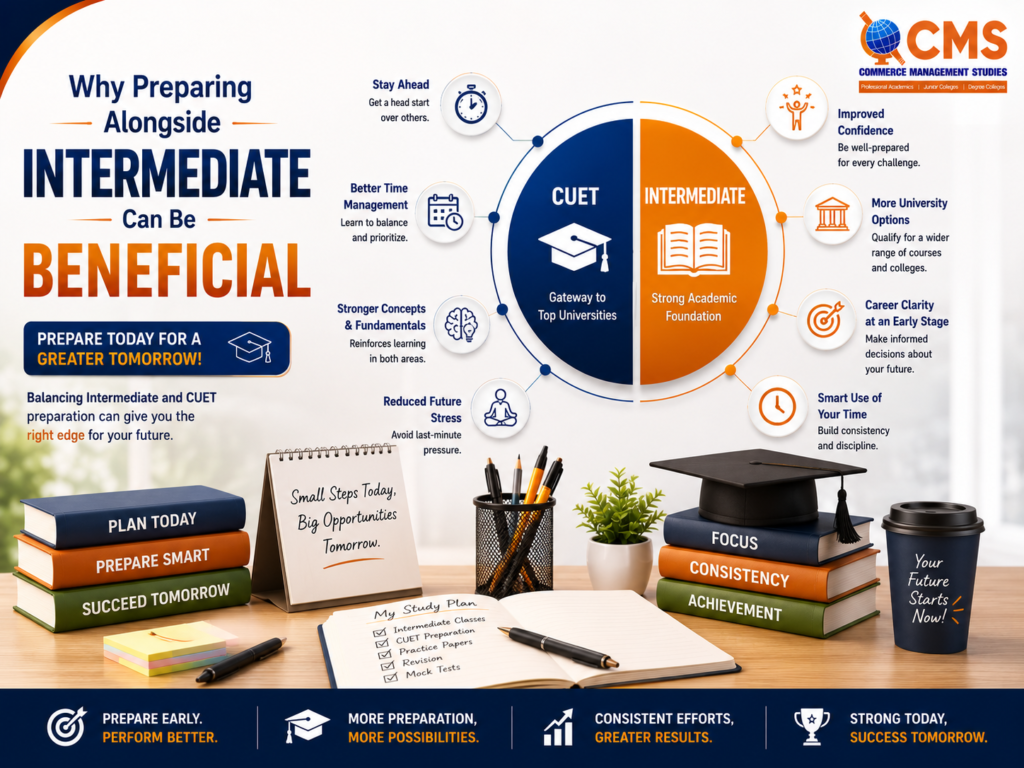
Preparing for CUET while studying Intermediate can help students develop a consistent academic routine. Instead of waiting until the final months to become familiar with the examination pattern, students can gradually introduce CUET-oriented practice into their regular studies. This provides more time to understand concepts, identify weaker areas, improve accuracy, and become comfortable with solving questions within a limited time.
Another advantage is that students can connect their Intermediate learning with entrance-examination preparation. When a subject studied in class is also relevant to the student’s chosen CUET domain, regular academic study can reinforce entrance preparation. This can make learning more meaningful because students begin to understand how their Intermediate knowledge can support their next academic step.
How Intermediate Subjects Can Support CUET Preparation
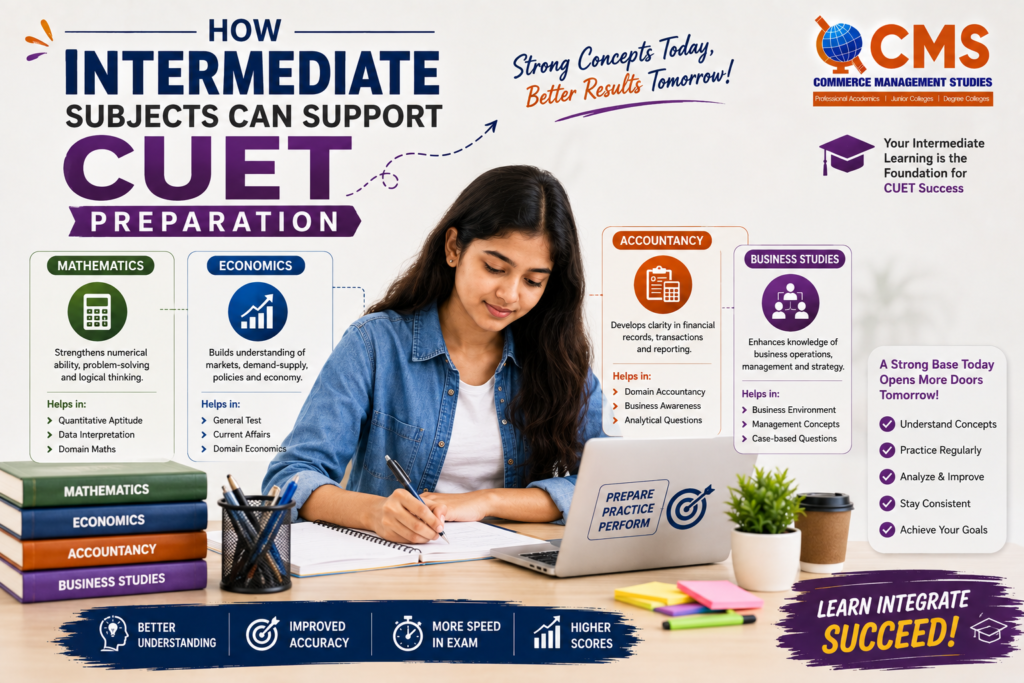
Intermediate education provides students with the conceptual foundation required for higher education. For commerce students, subjects such as Mathematics, Economics, Accountancy, and related areas can be particularly useful when the student’s intended undergraduate programme requires corresponding CUET domain subjects. However, the exact subject requirements vary by university and programme, so students should select their CUET subjects carefully after checking the latest official requirements.
Studying Intermediate subjects thoroughly can also strengthen comprehension, numerical ability, analytical thinking, and subject knowledge. Instead of treating CUET preparation as additional material that must be memorized separately, students can use their regular academic learning as a foundation and then adapt it to the examination format through practice and revision.
Benefits of Starting CUET Preparation Early
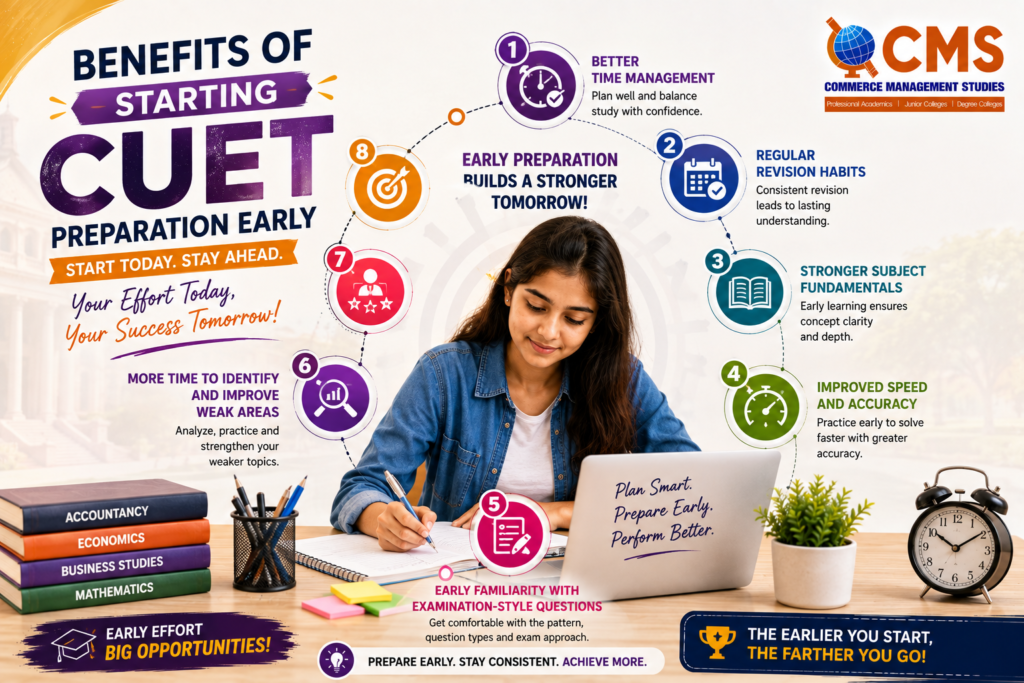
Beginning preparation during Intermediate gives students the opportunity to develop their examination skills gradually. Students can spend the initial stage strengthening concepts and understanding the question format before moving toward timed practice and mock examinations. This gradual progression can make preparation more comfortable and allow students to identify areas that need additional attention.
Early preparation can also help students develop better study habits. Regular revision, question practice, reading, and self-assessment can become part of their routine instead of being introduced suddenly before the examination. Students can therefore approach the entrance examination with greater familiarity and confidence while continuing to focus on their Intermediate academics.
Some benefits of preparing alongside Intermediate include:
- Better time management
- Regular revision habits
- Stronger subject fundamentals
- Improved speed and accuracy
- Early familiarity with examination-style questions
- More time to identify and improve weak areas
- Greater confidence before the examination
- Reduced dependence on last-minute preparation
Building a Balanced Study Routine
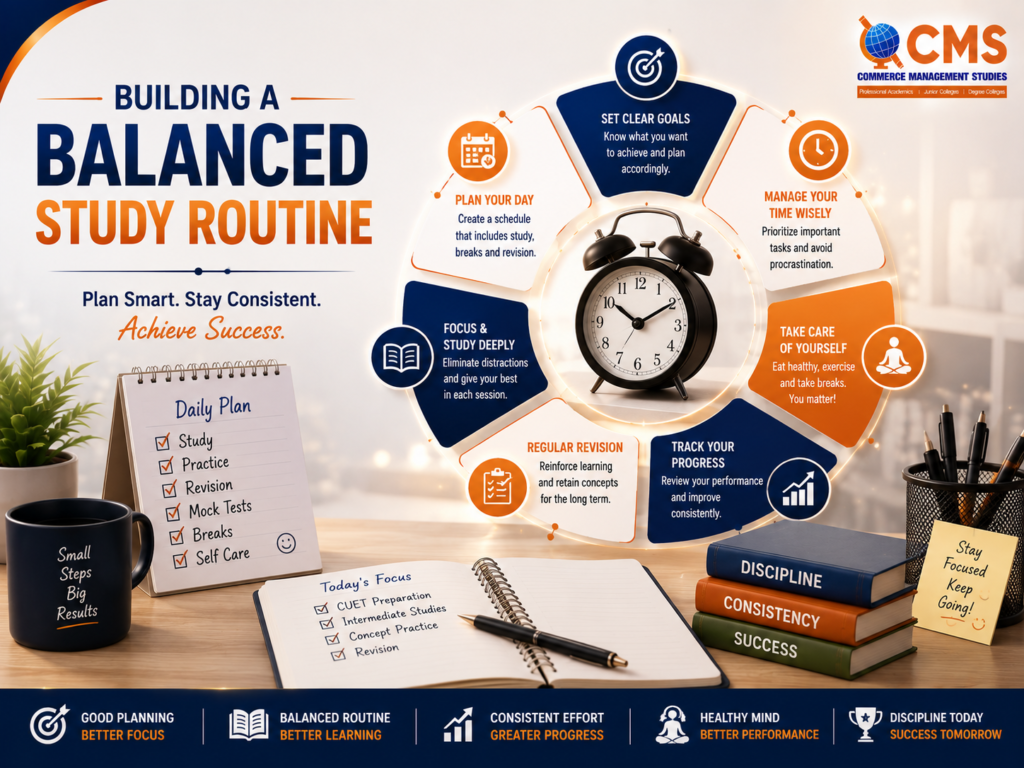
The key to successful preparation is balance. Students should not feel that CUET preparation requires them to ignore their Intermediate syllabus. Instead, they can create a timetable that gives appropriate importance to school or college academics, CUET practice, revision, assignments, and adequate rest.
A balanced routine can begin with regular academic study followed by a manageable amount of entrance-examination practice. As the examination approaches, students can gradually increase the time devoted to mock tests, revision, and timed question-solving. This approach allows preparation to grow progressively rather than creating unnecessary pressure from the beginning.
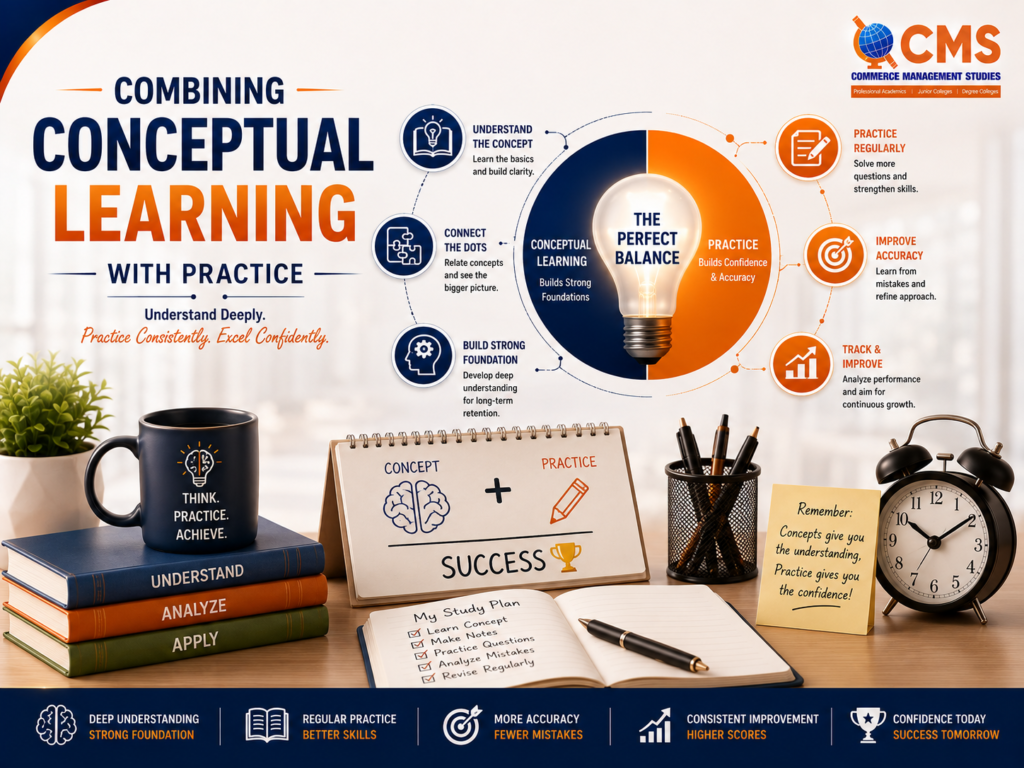
Combining Conceptual Learning with Practice
Understanding concepts should remain the foundation of preparation. Students who simply memorize answers may find it difficult to handle questions presented in unfamiliar ways. Conceptual understanding allows them to apply what they have learned to different types of questions and improves their ability to identify the correct answer logically.
Practice then helps students convert that knowledge into examination performance. Solving questions regularly can reveal common mistakes, improve time management, and increase familiarity with different question formats. A combination of conceptual learning, practice, revision, and testing can therefore create a more complete preparation strategy.
The Importance of Mock Tests
Mock tests can play an important role in CUET preparation because they allow students to experience examination-style conditions before the actual test. Timed practice helps students understand how quickly they need to read, interpret, solve, and move between questions. It also provides an opportunity to identify subjects or question types where additional preparation may be required.
Students should not view mock-test scores only as a measure of success or failure. The more important purpose is to analyze performance. After every test, students can review incorrect answers, identify why mistakes occurred, and revise the relevant concepts. Over time, this process can help improve both accuracy and confidence.
Developing Speed and Accuracy
Entrance examinations require students to manage both knowledge and time. A student may understand a concept well but still lose marks if they spend too much time on individual questions. Regular timed practice can help students develop the ability to recognize familiar question types and decide how much time to spend on each section.
Accuracy is equally important. Students should learn to distinguish between questions they can answer confidently and questions that require additional thought. By practicing regularly and analyzing mistakes, students can gradually develop a more effective approach to managing time while maintaining accuracy.
Staying Updated About CUET Requirements
One of the most important parts of CUET preparation is understanding the requirements of the programmes a student wants to pursue. Different universities and courses may have different eligibility criteria and subject requirements. The official CUET information should therefore be treated as the primary source when selecting subjects and planning applications.
Students should regularly check official notifications rather than relying entirely on old preparation material or information shared by others. This is particularly important because examination patterns, subject options, participating universities, and programme requirements can change from one admission cycle to another. Careful planning based on current information can help students avoid unnecessary confusion later.
CUET Preparation for Commerce Students
For MEC and CEC students, CUET can provide opportunities to explore undergraduate programmes in areas such as commerce, economics, business, management, and other disciplines, depending on the university and programme requirements. The official participating-university lists include institutions from different categories, giving students a broad range of programmes to research.
This makes early preparation particularly useful because students can spend time researching the courses they are interested in, checking eligibility requirements, identifying the relevant CUET subjects, and then aligning their Intermediate studies with their future plans. Rather than choosing subjects at the last moment, students can make decisions based on a clearer understanding of their preferred academic pathway.
How Integrated Preparation Can Help
An integrated approach can make CUET preparation more manageable because students can work on Intermediate academics and entrance-examination skills as part of one structured learning plan. Instead of completely separating the two, related concepts can be reinforced through classroom learning, practice questions, revision, and assessments.
At CMS CUET Coaching in Hyderabad, students can pursue Intermediate education with integrated CUET preparation, allowing them to strengthen their academic concepts while also developing entrance-examination skills. Regular practice and assessments can help students monitor their progress and become more comfortable with the demands of competitive entrance examinations.
Developing the Right Mindset
Preparing for CUET alongside Intermediate should be viewed as an opportunity rather than an additional burden. Students have the advantage of working toward their Intermediate qualification while simultaneously developing skills that can support their transition to undergraduate education. With proper planning, preparation can become a regular part of their academic routine rather than something that creates pressure at the end.
Students should also remember that progress does not have to happen instantly. Improving performance is a gradual process. Understanding concepts, practicing questions, reviewing mistakes, and revising regularly can steadily strengthen preparation. A positive and consistent approach can make the overall journey more productive and rewarding.
Conclusion
Preparing for CUET alongside Intermediate can be a positive academic strategy for students who are planning to pursue undergraduate programmes through the entrance route. It gives students time to build strong fundamentals, become familiar with examination-style questions, develop better time management, and gradually improve their performance. Since CUET provides a common platform for undergraduate admissions across participating universities, early and organized preparation can help students approach their higher-education plans with greater clarity.
The key is to maintain a healthy balance between Intermediate academics and CUET preparation. Students can strengthen their subject knowledge through regular studies, supplement it with targeted entrance-examination practice, take mock tests, revise consistently, and stay informed about the latest university and CUET requirements. With this approach, preparing for CUET alongside Intermediate can become a valuable part of a student’s academic journey and help them move confidently toward their preferred undergraduate opportunities.