

Enroll Now

CMS For CA : For Your Growth in Education
Best CA Inter Coaching in Hyderabad:
Best CA Inter Coaching in Hyderabad- Delivering the Best CA Class in Hyderabad

CMS For CA : For Your Growth in Education
Future Scope for Chartered Accountants in India Post Completion of Your CA Inter Coaching
Post successful completion of our Best CA Coaching in Hyderabad and after becoming Qualified as CA you can expect several benefits like
- Any person that has qualified as a Chartered Accountant (CA) can look forward to a career of stability, good pay, and respect.
- Entry level salaries start at around INR 10-12 lakhs per annum while experienced CAs may easily earn up to 30 lakhs annually and above.
- The qualified CA can apply for a government job, public or private sectors both.
- They can also give their services for the capital market.
- Can secure high salaried jobs across varied industry verticals.

Complete Info as per ICAI (Latest / New Scheme)
- Levels
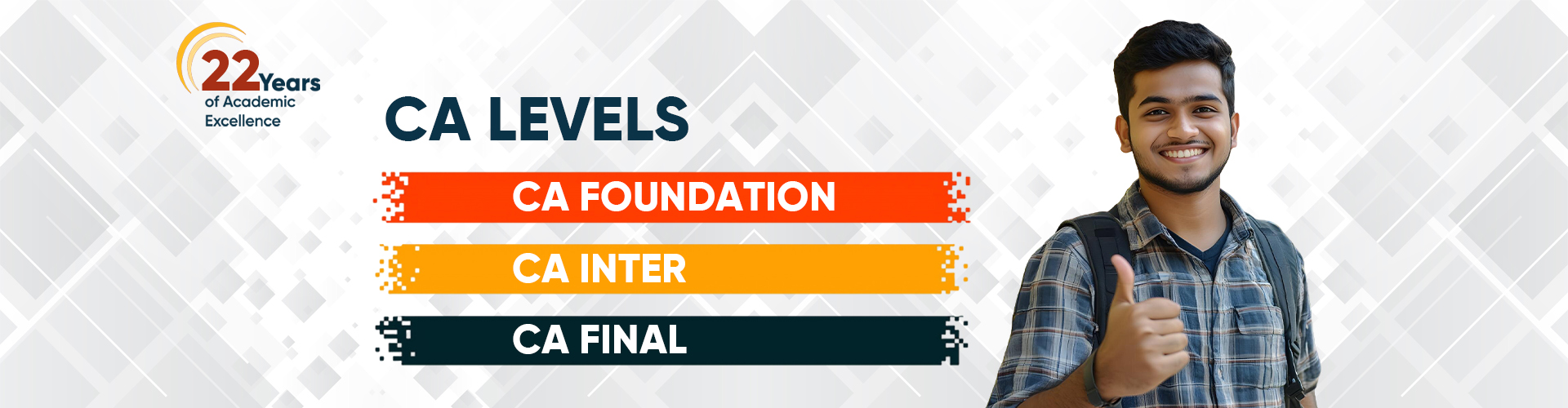
There are three main levels in the CA course under the new scheme:
- Foundation Course
- Intermediate Course
- Final Course
Additionally, there are Self-Paced Online Modules (SPOM) which are required after registering for Final Course.
Also, practical / training / soft skills components:
- ICITSS / Advanced‐ICITSS (Information Technology & Soft Skills)
- Articleship / Practical Training under a practicing CA
- Qualification Required (Eligibility)
What is required to register / move through levels:
- Foundation Course
Can be registered after Class 10. But can only appear in the Foundation exam after Class 12 / 10+2.
- Intermediate Course
Two routes:- Foundation Route: Passed Foundation + Class 12.
- Direct Entry Route: Graduates / Postgraduates:
- Commerce graduates with at least 55% marks.
- Non-commerce graduates / postgraduates with at least 60%.
- Also passed Inter-level of CMA / CS etc.
Provisional registration is allowed while final year of graduation is in progress. But one must complete graduation + complete an 8-month study period before appearing Intermediate exam.
- Final Course
Must have passed both groups of the Intermediate exam. Also must register for Final Course (which includes registering for SPOM). Practical training / articleship and ICITSS / Advanced ICITSS required.
- Who Can Write (Appear for Exams)
- Foundation Exam: After the candidate has sorted the Class 12 requirement (i.e. has appeared/passed Class 12) and has been registered at least 4 months before the exam.
- Intermediate Exam: Once registered (either via Foundation or Direct Entry), and for Direct Entry the required 8-month study period after registration finishes before appearing.
- Final Exam: Only after both groups of Intermediate are passed, and the candidate has registered for Final, and has completed requirements like Articleship / practical training + ICITSS etc. Also SPOM modules as required.
- How to Register
- Registration is online via ICAI’s Student / Self-Service Portal (SSP).
- Fill registration form for respective level (Foundation, Intermediate, Final). Submit required documents (mark sheets, identity proofs etc.).
- For Final level registration, one also selects SPOM modules (Sets C & D) at that time.
- For Intermediate via Direct Entry, if you are in final year of graduation, you can provisionally register, but need to submit your graduation result and complete study period before exam eligibility.
- Registration Fee (for levels)
As per ICAI (Indian students):
Level | Fee for Registration (both groups) |
Foundation Course | ₹ 9,000 |
Intermediate Course | ₹ 18,000 (for both groups) |
Final Course | ₹ 22,000 (for both groups) |
Note: There are concession / reduced fees for students from certain Northeastern states / UTs etc. in earlier years; check current notifications.
- Coaching Type
ICAI official sources do not mandate or prescribe coaching. Coaching is via private institutions etc, which vary in cost, mode (classroom / online). ICAI itself provides:
- Study Material (physical & digital) after registration.
- Virtual / live revision classes (LVRC) etc. (
- Digital Learning Campus / LMS for SPOM modules (video lectures etc).
So “coaching type” under ICAI = self-study materials, virtual / online classes, revision test papers; private coaching is external.
- Examination for Each Level
What exam(s), frequency, pattern etc:
Level | When Held / Frequency | Exam Pattern Highlights |
Foundation | Thrice a year: January, May, September | 4 Papers. Subjective & Objective mix. Minimum marks per paper and aggregate. Negative marking for objective / MCQ portions. |
Intermediate | Thrice a year: January, May, September | 6 papers (2 groups of 3 papers each) under New Scheme. Each paper 100 marks. In each paper: combination of descriptive (essay/problem) + MCQ case-scenario etc (approx 70% descriptive, 30% objective/case scenario MCQs) |
Final | Twice a year (Typically May & November) | 6 papers (2 groups) under New Scheme. Full detailed pattern in the ICAI syllabus page. Also includes integrated business solutions case study etc. SPOM modules are precondition. |
Also: SPOM (Self-Paced Online Modules) exams for the modules A, B, plus elective one’s C & D. These are done via “Self-Paced Module Test (SPMT)” portal.
- Subjects for Each Level with Brief Intro
Here are the subjects under the New Scheme and what they cover, at a high level.
Foundation Course
There are 4 Papers:
- Accounting – Basics of accounting, recording of transactions, financial statements.
- Business Laws – Basic law relevant to business (business law topics as per syllabus).
- Quantitative Aptitude – Business mathematics, logical reasoning, statistics.
- Business Economics – Micro and macro-economics, business environment etc.
Intermediate Course
6 Papers (Group I & Group II):
- Group I:
- Advanced Accounting – Accounting standards, presentation, complex accounting (consolidations, etc.).
- Corporate and Other Laws – Company law + other relevant laws.
- Taxation – Income Tax Law + Goods & Services Tax (GST) sections.
- Group II:
- Cost and Management Accounting – Costing techniques, managerial decision making etc.
- Auditing & Ethics – Auditing principles, practices, standards + professional ethics.
- Financial Management & Strategic Management – Financial decision making, planning, strategic management concepts.
Self-Paced Online Modules (SPOM)
(After registering for Final Course, student must complete these modules):
- SET A (Mandatory): Corporate & Economic Laws
- SET B (Mandatory): Strategic Cost & Performance Management (
- SET C (Elective – choose one): Options like Risk Management; Sustainable Dev & Sustainability Reporting; Public Finance & Govt Accounting; Insolvency & Bankruptcy Code; International Taxation; Arbitration & Conciliation; Forensic Accounting; Valuation; Financial Services & Capital Markets; Forex & Treasury Management.
- SET D (Elective – choose one): Options such as Constitution of India & Art of Advocacy; Psychology & Philosophy; Entrepreneurship & Start-up Ecosystem; Digital Ecosystem & Controls.
Final Course
6 Papers (2 Groups). The exact paper names are:
- Group I (all 100-marks papers):
- Financial Reporting
- Advanced Financial Management
- Advanced Auditing, Assurance & Professional Ethics
- Group II:
- Direct Tax Laws & International Taxation
- Indirect Tax Laws
- Integrated Business Solutions (a Multi-disciplinary Case Study)
- Exam Qualification (Passing / Passing Criteria)
What you need to pass, get exemptions etc:
- Foundation Level:
- Minimum 40% marks in each paper.
• Minimum 50% in aggregate over all papers.
- Intermediate Level:
- Minimum 40% in each paper.
• Minimum 50% in aggregate in the group you are attempting. You can pass group-wise. - Exemptions: If you get ≥ 60% in a paper, you may get exemption for that paper for next three attempts in that group.
- Final Level:
- Similar passing marks: usually 40% in each paper + 50% aggregate in a group. (As per ICAI, for Final Course under new scheme)
- SPOM Modules:
- Must complete prescribed learning hours via LMS.
• Pass each module with minimum 50% marks.
• No negative marking in SPOM exams.
• Marks in SPOM do not get aggregated with core Final Course papers for determining Final exam pass.
- Other Important Details
- The New Scheme became effective from June 23, 2023.
- Validity of registration:
- Foundation Course registration validity: 4 years from first eligible attempt.
• Intermediate registration validity: 5 years from date of registration. It may be revalidated once (with fee) for further period.
- There is no revalidation at Foundation level.
- Negative marking:
- In Foundation & Intermediate objective/MCQ/case scenario portions: there is negative marking of 0.25 (¼ mark) for each wrong answer.
• In SPOM exams, no negative marking.
- Programme durations and training:
- Articleship / Practical Training is compulsory. New Scheme has relaxations for students who were under old scheme etc.
• IT & soft skills training (ICITSS / Advanced ICITSS) required at appropriate stages.
- Exemption windows / permanent exemptions: ICAI provides a Permanent Exemption Window for Intermediate / Final for certain candidates under certain conditions.
Complete Info as per ICAI (Latest / New Scheme)
1. Levels
There are three main levels in the CA course under the new scheme:
- Foundation Course
- Intermediate Course
- Final Course
Additionally, there are Self-Paced Online Modules (SPOM) which are required after registering for Final Course.
Also, practical / training / soft skills components:
- ICITSS / Advanced‐ICITSS (Information Technology & Soft Skills)
- Articleship / Practical Training under a practicing CA
2. Qualification Required (Eligibility)
What is required to register / move through levels:
Foundation Course
Can be registered after Class 10. But can only appear in the Foundation exam after Class 12 / 10+2.
Intermediate Course
Two routes:
- Foundation Route: Passed Foundation + Class 12.
- Direct Entry Route: Graduates / Postgraduates:
- Commerce graduates with at least 55% marks.
- Non-commerce graduates / postgraduates with at least 60%.
- Also passed Inter-level of CMA / CS etc.
Provisional registration is allowed while final year of graduation is in progress. But one must complete graduation + complete an 8-month study period before appearing Intermediate exam.
Final Course
Must have passed both groups of the Intermediate exam. Also must register for Final Course (which includes registering for SPOM). Practical training / articleship and ICITSS / Advanced ICITSS required.
3. Who Can Write (Appear for Exams)
Foundation Exam:
After the candidate has sorted the Class 12 requirement (i.e. has appeared/passed Class 12) and has been registered at least 4 months before the exam.
Intermediate Exam:
Once registered (either via Foundation or Direct Entry), and for Direct Entry the required 8-month study period after registration finishes before appearing.
Final Exam:
Only after both groups of Intermediate are passed, and the candidate has registered for Final, and has completed requirements like Articleship / practical training + ICITSS etc. Also SPOM modules as required.
4. How to Register
- Registration is online via ICAI’s Student / Self-Service Portal (SSP).
- Fill registration form for respective level (Foundation, Intermediate, Final). Submit required documents (mark sheets, identity proofs etc.).
- For Final level registration, one also selects SPOM modules (Sets C & D) at that time.
- For Intermediate via Direct Entry, if you are in final year of graduation, you can provisionally register, but need to submit your graduation result and complete study period before exam eligibility.
5. Registration Fee (for levels)
As per ICAI (Indian students):
Level | Fee for Registration (both groups) |
Foundation Course | ₹ 9,000 |
Intermediate Course | ₹ 18,000 (for both groups) |
Final Course | ₹ 22,000 (for both groups) |
Note: There are concession / reduced fees for students from certain Northeastern states / UTs etc. in earlier years; check current notifications.
6. Coaching Type
ICAI official sources do not mandate or prescribe coaching. Coaching is via private institutions etc, which vary in cost, mode (classroom / online). ICAI itself provides:
- Study Material (physical & digital) after registration.
- Virtual / live revision classes (LVRC) etc. (
- Digital Learning Campus / LMS for SPOM modules (video lectures etc).
So “coaching type” under ICAI = self-study materials, virtual / online classes, revision test papers; private coaching is external.
7. Examination for Each Level
What exam(s), frequency, pattern etc:
Level | When Held / Frequency | Exam Pattern Highlights |
Foundation | Thrice a year: January, May, September | 4 Papers. Subjective & Objective mix. Minimum marks per paper and aggregate. Negative marking for objective / MCQ portions. |
Intermediate | Thrice a year: January, May, September | 6 papers (2 groups of 3 papers each) under New Scheme. Each paper 100 marks. In each paper: combination of descriptive (essay/problem) + MCQ case-scenario etc (approx 70% descriptive, 30% objective/case scenario MCQs) |
Final | Twice a year (Typically May & November) | 6 papers (2 groups) under New Scheme. Full detailed pattern in the ICAI syllabus page. Also includes integrated business solutions case study etc. SPOM modules are precondition. |
Also: SPOM (Self-Paced Online Modules) exams for the modules A, B, plus elective one’s C & D. These are done via “Self-Paced Module Test (SPMT)” portal.
8. Subjects for Each Level with Brief Intro
Here are the subjects under the New Scheme and what they cover, at a high level.
Foundation Course
There are 4 Papers:
- Accounting – Basics of accounting, recording of transactions, financial statements.
- Business Laws – Basic law relevant to business (business law topics as per syllabus).
- Quantitative Aptitude – Business mathematics, logical reasoning, statistics.
- Business Economics – Micro and macro-economics, business environment etc.
Intermediate Course
6 Papers (Group I & Group II):
Group I:
- Advanced Accounting – Accounting standards, presentation, complex accounting (consolidations, etc.).
- Corporate and Other Laws – Company law + other relevant laws.
- Taxation – Income Tax Law + Goods & Services Tax (GST) sections.
Group II:
- Cost and Management Accounting – Costing techniques, managerial decision making etc.
- Auditing & Ethics – Auditing principles, practices, standards + professional ethics.
- Financial Management & Strategic Management – Financial decision making, planning, strategic management concepts.
Self-Paced Online Modules (SPOM)
(After registering for Final Course, student must complete these modules):
- SET A (Mandatory): Corporate & Economic Laws
- SET B (Mandatory): Strategic Cost & Performance Management (
- SET C (Elective – choose one): Options like Risk Management; Sustainable Dev & Sustainability Reporting; Public Finance & Govt Accounting; Insolvency & Bankruptcy Code; International Taxation; Arbitration & Conciliation; Forensic Accounting; Valuation; Financial Services & Capital Markets; Forex & Treasury Management.
- SET D (Elective – choose one): Options such as Constitution of India & Art of Advocacy; Psychology & Philosophy; Entrepreneurship & Start-up Ecosystem; Digital Ecosystem & Controls.
Final Course
6 Papers (2 Groups). The exact paper names are:
Group I (all 100-marks papers):
- Financial Reporting
- Advanced Financial Management
- Advanced Auditing, Assurance & Professional Ethics
Group II:
- Direct Tax Laws & International Taxation
- Indirect Tax Laws
- Integrated Business Solutions (a Multi-disciplinary Case Study)
9. Exam Qualification (Passing / Passing Criteria)
What you need to pass, get exemptions etc:
Foundation Level:
- Minimum 40% marks in each paper.
- Minimum 50% in aggregate over all papers.
Intermediate Level:
- Minimum 40% marks in each paper.
- Minimum 50% in aggregate in the group you are attempting. You can pass group-wise.
- Exemptions: If you get ≥ 60% in a paper, you may get exemption for that paper for next three attempts in that group.
Final Level:
- Similar passing marks: usually 40% in each paper + 50% aggregate in a group. (As per ICAI, for Final Course under new scheme)
SPOM Modules:
- Must complete prescribed learning hours via LMS.
- Pass each module with minimum 50% marks.
- No negative marking in SPOM exams.
- Marks in SPOM do not get aggregated with core Final Course papers for determining Final exam pass.
10. Other Important Details
- The New Scheme became effective from June 23, 2023.
Validity of registration:
- Foundation Course registration validity: 4 years from first eligible attempt.
- Intermediate registration validity: 5 years from date of registration. It may be revalidated once (with fee) for further period.
- There is no revalidation at Foundation level.
Negative marking:
- In Foundation & Intermediate objective/MCQ/case scenario portions: there is negative marking of 0.25 (¼ mark) for each wrong answer.
- In SPOM exams, no negative marking.
Programme durations and training:
- Articleship / Practical Training is compulsory. New Scheme has relaxations for students who were under old scheme etc.
- IT & soft skills training (ICITSS / Advanced ICITSS) required at appropriate stages.
- Exemption windows / permanent exemptions: ICAI provides a Permanent Exemption Window for Intermediate / Final for certain candidates under certain conditions.
Frequently Asked Questions
Best CA Coaching in Hyderabad – Institutes, Fees and Course Guide. When choosing CA coaching in Hyderabad, prioritize institutes that offer experienced faculty, structured exam preparation, regular mock tests, and dedicated revision support. These factors help students prepare for CA Foundation, Intermediate, and Final with clear academic guidance. CMS is one institute offering coaching for these CA levels, and students can review its courses, teaching approach, fees, and learning support to determine whether it suits their needs.
How to Choose CA Coaching in Hyderabad
The choice of a CA coaching institute should depend on faculty expertise, subject coverage, fees, mock tests and revision support. Students should also check whether the institute offers the course level and learning format they need.
Which institute is best for CA coaching in Hyderabad?
The right CA coaching institute depends on a student’s academic needs, preferred teaching method, preparation level and budget. Students should compare institutes based on faculty experience, subject-wise teaching, study materials, mock tests, revision classes, doubt-solving facilities and academic monitoring. CMS is one option for students seeking CA coaching in Hyderabad, with programs for Foundation, Intermediate and Final. Students can compare its available courses, faculty support, batch schedules, learning resources and fees with those of other institutes before making a decision.
What should I consider before joining a CA institute in Hyderabad?
Before joining a CA coaching institute, students should evaluate the academic support and facilities available for their chosen course. Important factors include:
- Faculty experience and subject expertise
- Complete syllabus coverage
- Teaching methodology and classroom interaction
- Study materials and practice questions
- Regular mock tests and revision sessions
- Doubt-solving and individual academic support
- Batch size and class timings
- Course fees and included facilities
- Online and offline learning options
Students should also consider whether the coaching schedule is compatible with their college or other academic commitments.
What are the fees for CA coaching in Hyderabad?
CA coaching fees in Hyderabad vary according to the institute, course level, number of subjects, teaching format and academic support provided. Foundation, Intermediate and Final coaching may have different fee structures. Integrated programs may have additional academic components. Students should request the latest fee details directly from institutes and check whether the quoted amount includes study materials, mock tests, revision classes and other learning resources. Coaching fees are separate from ICAI registration and examination fees.
Are mock tests and revision sessions available at CA coaching institutes in Hyderabad?
Many CA coaching institutes offer mock tests, practice examinations and revision sessions as part of their academic programs. However, the frequency, format and availability of these facilities can differ between institutes and batches. Students should ask whether their chosen institute provides chapter-wise assessments, full-length mock examinations, evaluated answer sheets, performance feedback and dedicated revision classes. These facilities can help students identify weak areas and improve their examination preparation.
Do CA coaching centers in Hyderabad offer online classes?
CA coaching centers may offer classroom coaching, online classes or a combination of both. Offline classes provide direct interaction with faculty, while online classes allow students to attend lessons remotely and manage their study schedules with greater flexibility. Students should check whether online courses include live sessions, recorded lectures, digital study materials, online assessments and doubt-solving support. The available options may vary depending on the institute and course level.
What are the different levels of CA courses offered in Hyderabad?
CA coaching institutes in Hyderabad offer preparation for the three main levels of the Chartered Accountancy course:
- CA Foundation: The entry-level examination covering Accounting, Business Laws, Quantitative Aptitude and Business Economics.
- CA Intermediate: The second level, covering advanced accounting, taxation, corporate laws, auditing and financial management.
- CA Final: The final examination level, focusing on advanced professional knowledge, financial reporting, strategic financial management, auditing and other professional subjects.
Students can choose coaching according to their current qualification and progress through the course.
What are the eligibility criteria for CA courses?
The eligibility criteria depend on the level of the CA course and the student’s entry route.
- CA Foundation: Students can register after passing Class 10, but must meet the prescribed educational requirements to appear for the examination.
- CA Intermediate: Students can enter after passing CA Foundation or through the Direct Entry Route if they meet the applicable educational qualifications and minimum marks.
- CA Final: Students must pass the required Intermediate examinations and fulfil the applicable registration, training and other requirements.
Students should check the latest ICAI guidelines for the eligibility conditions applicable to their chosen route.
What is CA Intermediate?
CA Intermediate is the second level of the Chartered Accountancy course. It develops students’ knowledge and application skills in advanced accounting, corporate and other laws, taxation, cost and management accounting, auditing, financial management and strategic management. The course consists of two groups, each containing three papers. Students can prepare for the groups according to their eligibility, preparation level and examination plan.
How can I join CA Intermediate after CA Foundation?
Students who have passed CA Foundation can register for CA Intermediate through the prescribed student registration process. They must complete the applicable study period and other registration requirements before applying for the examination. After fulfilling the requirements, students can prepare for one or both groups according to their examination plan.
Can graduates join CA Intermediate without CA Foundation?
Yes. Eligible graduates and postgraduates can register for CA Intermediate through the Direct Entry Route without completing CA Foundation. The route is subject to prescribed educational qualifications and minimum marks. The requirements differ according to the candidate’s academic background. Students should check the latest ICAI eligibility criteria before applying.
How many groups are there in CA Intermediate?
CA Intermediate has two groups, with three papers in each group. Students entering through the Foundation Route can choose to prepare for one group at a time or both groups together. Direct Entry candidates must follow the applicable registration requirements.
What subjects are included in CA Intermediate?
CA Intermediate consists of six papers divided into two groups.
Group I
- Advanced Accounting
- Corporate and Other Laws
- Taxation
Group II
- Cost and Management Accounting
- Auditing and Ethics
- Financial Management and Strategic Management
Students should follow the current ICAI syllabus and examination scheme when planning their preparation.
What is the CA Intermediate examination pattern?
The CA Intermediate examination includes descriptive questions and case-scenario or case-study-based multiple-choice questions. Students need to develop both conceptual understanding and the ability to apply concepts to examination questions. Preparation should include numerical problem-solving, theory revision, answer presentation and time management. Students should also practise the different question formats used in the examination.
Is there negative marking in CA Intermediate?
There is no negative marking for multiple-choice questions in the CA Intermediate examination under the applicable examination pattern. Students should nevertheless focus on interpreting questions correctly, understanding concepts and managing their time effectively.
What is the CA Intermediate registration fee?
The CA Intermediate registration fee for Indian students is ₹18,000 for both groups and ₹13,000 for a single group, according to the fee structure provided here. Students should verify the latest ICAI fee schedule before registration, as fees and requirements may change.
How do I register for CA Intermediate?
Students can register for CA Intermediate through the designated ICAI online student registration portal. The process generally involves selecting the appropriate entry route, entering personal and academic information, uploading the required documents and paying the prescribed registration fee. Students should review their application carefully and ensure that they meet the applicable eligibility and registration requirements.
Is CA a difficult or easy course?
The difficulty of the CA course depends on a student’s academic background, preparation, subject understanding and consistency. Foundation introduces the fundamentals, Intermediate requires more advanced subject knowledge, and Final focuses on complex professional applications. Students may find certain subjects more challenging than others. Regular study, question practice, revision and mock examinations can help them manage the syllabus and prepare for each level.
Is CA Intermediate difficult?
CA Intermediate can be challenging because it covers several technical and application-oriented subjects across two groups. Students need to understand concepts, practise numerical problems, learn legal provisions and develop effective answer-writing skills. A structured timetable, regular practice, multiple revisions and mock examinations can help students manage their preparation. Students should give additional attention to subjects and topics in which they need more practice.
How can I prepare for CA Intermediate in Hyderabad?
Students preparing for CA Intermediate in Hyderabad can combine coaching with independent study, regular question practice and planned revision. Coaching can provide structured instruction, while self-study allows students to strengthen their understanding and practise topics at their own pace. Students should prepare a timetable covering all their subjects, complete the syllabus systematically and take mock examinations to evaluate their progress. They should also account for college or graduation commitments when planning their study routine.
Can I combine self-study with CA coaching in Hyderabad?
Yes. Combining self-study with coaching can help students reinforce classroom learning and work independently on difficult topics. Coaching provides structured lessons and guidance, while self-study gives students time to practise questions, revise concepts and identify knowledge gaps. Students should review their class notes after each lesson, complete relevant practice questions and maintain a regular revision schedule. The amount of self-study required depends on the student’s preparation level and examination timeline.
Can I prepare for CA Intermediate while pursuing graduation?
Yes. Students can pursue graduation alongside CA Intermediate preparation by following a realistic timetable that accommodates college classes, CA coaching, self-study and revision. They should plan their preparation around college examinations and allocate sufficient time to complete the CA syllabus. Regular weekly targets can help students maintain progress without depending entirely on last-minute preparation.
Can I attempt both CA Intermediate groups together?
Yes. Eligible students can prepare for and attempt both CA Intermediate groups together. Whether to attempt one group or both depends on their preparation level, available study time, syllabus coverage and academic schedule. Students should assess their readiness for each group before finalizing their examination plan.
How long should I study for CA Intermediate each day?
There is no fixed number of study hours suitable for every CA Intermediate student. The required study time depends on the student’s preparation stage, remaining syllabus, academic workload and intended examination session. Students should focus on consistent study, question practice and regular revision. A realistic timetable with achievable daily and weekly targets can help maintain preparation over time.
What is the best way to revise CA Intermediate subjects?
An effective revision plan combines concept review, question practice, previous examination questions, mock tests and focused revision of weak areas. Students should revise completed topics regularly instead of waiting until the entire syllabus is finished. They can also maintain short notes, formula sheets and lists of important concepts to support their revision.
What study materials should I use for CA Intermediate?
Students should use the latest prescribed ICAI study material as their primary academic reference. They can supplement it with practice questions, mock tests, revision resources and coaching materials that match the current syllabus. Using updated resources helps students remain aligned with the applicable examination pattern and course requirements.
How should I prepare for each CA Intermediate subject?
Each subject requires a different preparation approach.
- Advanced Accounting: Focus on conceptual understanding, accounting standards and regular numerical practice.
- Corporate and Other Laws: Understand legal provisions, practise applying them to questions and develop structured answers.
- Taxation: Study concepts systematically and practise problems covering the applicable tax provisions.
- Cost and Management Accounting: Build strong fundamentals and practise numerical problems regularly.
- Auditing and Ethics: Focus on conceptual understanding, structured revision and answer-writing practice.
- Financial Management and Strategic Management: Combine numerical problem-solving with conceptual learning and regular revision.
Students should allocate study time according to the difficulty of each subject and their individual progress.
How can I prepare for CA Intermediate Group 1?
Group 1 consists of Advanced Accounting, Corporate and Other Laws and Taxation. Students should divide their preparation time across all three papers and ensure that they complete the syllabus before beginning intensive revision. Regular numerical practice, learning legal provisions, practising examination-style questions and taking mock tests can help students prepare for the group.
How can I prepare for CA Intermediate Group 2?
Group 2 consists of Cost and Management Accounting, Auditing and Ethics, and Financial Management and Strategic Management. Students should balance numerical practice with conceptual learning and answer-writing preparation. Regular revision, timed practice and mock tests can help students evaluate their progress across all three papers.
Are mock tests useful for CA Intermediate preparation?
Yes. Mock tests help students practise under examination-like conditions, assess their preparation, improve time management and identify topics that require further attention. Students should analyse their mistakes after each test and revise the concepts they struggled with. Reviewing both incorrect and unanswered questions can help them make their subsequent practice sessions more focused.
How can I improve my answer-writing skills for CA Intermediate?
Students can improve answer-writing skills by practising questions within the allotted time, presenting calculations clearly, organizing answers logically and using appropriate working notes. They should also compare their practice answers with suggested solutions to identify gaps in content, structure and presentation. Regular practice can help students become more familiar with the expected examination format.
What happens if I pass only one group of CA Intermediate?
Students who pass one group can prepare for the remaining group in a subsequent examination attempt, subject to the applicable ICAI rules. They should review their examination results, identify the subjects that need additional preparation and plan their next attempt according to the remaining syllabus and applicable exemption provisions.
How many marks are required to pass CA Intermediate?
Students generally need at least 40% marks in each paper and at least 50% marks in aggregate for the group they are attempting. Students attempting both groups together may also qualify under the applicable aggregate provisions. Students should refer to the current ICAI examination regulations for the precise passing criteria applicable to their attempt.
How can I manage CA Intermediate preparation with other academic responsibilities?
Students can manage CA Intermediate preparation alongside other academic responsibilities by creating a weekly timetable that includes dedicated time for each subject, question practice, revision and assessments. They should set realistic targets, track syllabus completion and adjust their study schedules around college examinations. Consistency and proper planning can help students maintain progress across their academic commitments.
When should I start preparing for CA Intermediate?
Students should begin CA Intermediate preparation early enough to allow sufficient time for syllabus completion, question practice, multiple revisions and mock examinations. Starting early can help students identify difficult topics and address them before the examination. The ideal starting point depends on the student’s registration status, preparation level and intended examination session.
What should I do after each CA Intermediate mock test?
After completing a mock test, students should review incorrect answers, identify unanswered questions and analyse their time management. They should also determine whether mistakes resulted from conceptual gaps, calculation errors, question interpretation or insufficient revision. Recording these mistakes and revisiting the relevant topics can make subsequent practice and revision more effective.
Does CMS provide CA Intermediate coaching in Hyderabad?
Yes. CMS provides CA Intermediate coaching in Hyderabad for students preparing for the Intermediate examination. Students can enquire about current batches, course structure, faculty guidance, subject preparation, study resources, assessments and academic support. Students should confirm the current availability of their preferred group and batch before enrolling.
What makes CMS a suitable option for CA Intermediate coaching in Hyderabad?
CMS offers CA Intermediate coaching with a focus on subject-wise learning, conceptual understanding, question practice, assessments, revision and examination preparation. Students can enquire about the available faculty support, current batch structure, class schedule, study materials and academic resources. Comparing these details with their own preparation requirements can help them determine whether the program meets their needs.
How does CMS support CA Intermediate students?
CMS supports CA Intermediate students through structured subject preparation, faculty guidance, question practice, assessments, revision and doubt-solving. These academic activities help students progress from learning concepts to practising examination questions. The specific schedule, resources and assessment arrangements may vary by batch.
Can students prepare for CA Intermediate in one group at a time at CMS?
Students can enquire about group-wise CA Intermediate preparation at CMS and the availability of coaching for their preferred group. Preparing for one group at a time allows students to focus on three papers and plan their revision around that group’s syllabus. Students should confirm the current batch structure, class schedule and admission requirements with the institute.
How can I enquire about CA Intermediate coaching at CMS?
Students and parents can contact CMS to enquire about CA Intermediate coaching in Hyderabad, including current batches, group-wise preparation, course structure, faculty support, class schedules, study materials, assessments, fees and admission requirements. They can also ask about the available academic support and choose a program that fits their preparation needs and examination plan.
Our Branches Which Offer CA Intermediate

BACHUPALLY
(Exclusive Residential Campus for Boys)

KPHB (SONY Campus)
(Exclusive Residential Campus for Girls)

SR Nagar
(Day Scholar Campus)
Secunderabad
(Day Scholar Campus)
